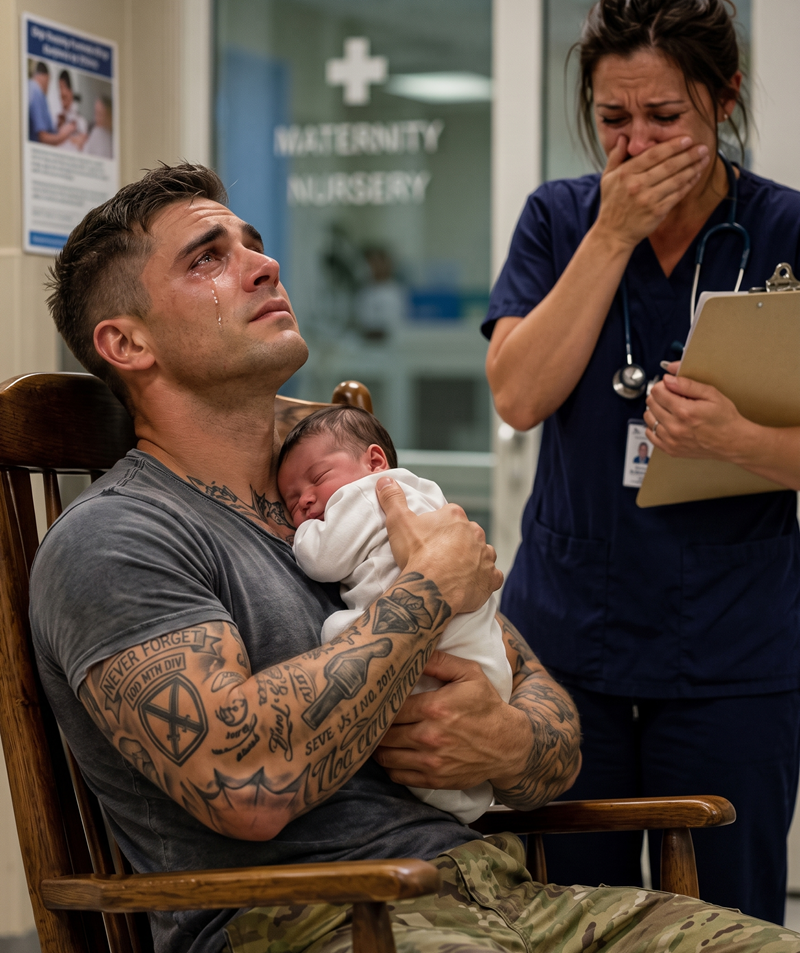
THE MAN WHO LOOKED OUT OF PLACE
The first time I saw Earl “Sarge” Ransom enter the NICU, I thought he had taken a wrong turn.
I had been the charge nurse at Willow Creek Medical Center in Omaha for eleven years. I knew every sound in that unit—the soft monitors, the squeak of nurses’ shoes, and the quiet prayers parents whispered when they believed no one could hear.
Sarge did not look like he belonged there.
He was in his early forties, six-foot-four, with broad shoulders, a heavy jaw, and burn scars climbing both arms. One side of his neck carried the same pale, uneven skin. His eyes moved around the room as if checking every exit.
Hospital rules required him to leave his faded tactical jacket outside. He wore a disposable blue gown over a dark T-shirt, and a volunteer badge hung from his chest.
His hands were huge, rough, and trembling.
“Earl Ransom,” he said. “Most people call me Sarge. I’m here for the infant comfort program.”
His file had been approved. Background check, medical screening, training, and psychological clearance—he had completed everything.
Still, I hesitated.
Then the premature baby in bed seven began to cry.
And everything changed.
THE BABY WITH NO ONE
Her chart said only Baby Girl Reed.
She had been born at twenty-nine weeks, weighing barely more than two pounds. Her lungs were immature, her nervous system overwhelmed, and her toxicology report showed that she had entered the world facing a battle she had never chosen.
Her mother, Megan Reed, had disappeared before the paperwork was complete.
No father had signed in. No grandparent had called. No blanket, stuffed animal, or family photograph waited beside the incubator.
Baby Girl Reed had a plastic bracelet, a temporary name, and a thin cry that seemed too large for her tiny body.
That morning, we had dimmed the lights, reduced stimulation, adjusted her swaddle, checked every line, and followed her care plan.
Still, she cried, arching her back as her heart rate climbed.
Sarge turned toward the sound.
“Is that the little one who needs someone to sit with her?”
I looked at his scarred, shaking hands.
For one ashamed second, I wondered whether hands like those could safely hold a child small enough to fit inside a winter hat.
He noticed.
“You can say no,” he said. “I know what I look like.”
“It isn’t how you look.”
“It’s the shaking.”
I stayed silent.
“Nerve damage,” he explained. “Some days are better. I passed the handling assessment, but you’re in charge.”
He was not offended.
He was afraid of failing the baby before he had even touched her.

THE HANDS I ALMOST DIDN’T TRUST
I positioned a recliner beside bed seven and asked another nurse, Tasha, to remain with us.
“You don’t lift her,” I told him. “We place her with you. Keep both arms supported and tell us if the tremor worsens.”
“Yes, ma’am.”
“And follow every instruction.”
His mouth almost curved into a smile.
“Following orders is one thing I can still do.”
We placed pillows beneath his arms. Then, with her leads protected, I lifted Baby Girl Reed and settled her against his chest.
Sarge stopped breathing.
The baby looked impossibly small against him. Her entire body fit between his collarbone and the center of his chest. One enormous hand curved around her back without closing, forming a wall of warmth.
His tremor did not disappear.
He braced his wrist against the pillow, spread his fingers, and held steady where it mattered.
The baby cried for another half minute.
Then she paused.
Her cheek rested against his shirt. She took one shaky breath, then another. Her heart rate began to settle.
“Well, hello there, Little Bird,” he whispered.
He hummed four low notes over and over. His voice was rough, but the baby softened against him. Her fists opened. Her shoulders relaxed.
Tasha glanced at me over the monitor.
I had been wrong.
His hands were not dangerous.
They were disciplined. They had learned how to shake without letting go.
Then the chain around his neck slipped from beneath his shirt. A metal dog tag swung forward and caught the light.
I saw the name etched into it.
EARL MATTHEW RANSOM.
My stomach dropped.
THE NAME THAT STOPPED THE ROOM
Two hours earlier, our social worker had shown me the only personal item found in Megan Reed’s sweatshirt pocket.
It was a folded piece of notebook paper.
If I can’t stay, please find Earl Matthew Ransom. He is my father. Tell him I’m sorry. Tell him I tried. He may not want me, but maybe he can want her.
At the bottom was an old Omaha address.
The house had been sold years before. We had no current phone number and no way to know whether Earl Ransom was even still in Nebraska.
Now his name was hanging inches above the baby.
“What is your full name?” I asked.
His brows drew together.
“Earl Matthew Ransom.”
The monitor continued its soft rhythm.
No one moved.
Our social worker, Dana, entered the unit and stopped when she saw our faces. I asked her to bring the note.
Sarge kept one arm around the baby while he read it.
His expression did not explode into anger or shock. It simply emptied.
“Megan,” he whispered.
He looked down at the infant.
“My daughter had a baby?”
“We believe so,” Dana said.
“Where is she?”
“We’re trying to find her.”
His hand trembled harder. I started to reach for the baby, but he looked at me sharply.
“I’ve got her.”
It was not a challenge.
It was a plea.
So I left the baby against his chest.
Sarge lowered his scarred cheek toward her tiny cap.
“I didn’t know,” he whispered. “God help me, I didn’t know.”

WHAT SARGE HAD LOST
The story came out slowly.
Sarge had spent nearly twenty years in the military. During his final deployment, an explosion destroyed the vehicle he was riding in. He survived with burns, nerve damage, chronic pain, and a tremor that worsened under stress.
He came home alive, but not truly present.
His wife, Nora, had been a NICU nurse at Willow Creek. She understood his silence better than anyone.
Two years after his return, she died suddenly from an undiagnosed heart condition.
Their daughter, Megan, was nineteen.
“She needed a father,” Sarge said. “What she got was a locked bedroom door and a man who couldn’t sleep.”
They fought constantly. Megan begged him to seek counseling. He refused.
During their last argument, she shouted, “You came home, but you never came back.”
He answered with the words that had haunted him ever since.
“Then stop waiting for me.”
Megan left the next morning.
She later married Caleb Reed, but the marriage ended quickly. Her calls became rare and finally stopped.
Sarge mailed letters to old addresses and drove past places she used to visit, but pride kept him from asking others for help.
“What happened to her?” he asked Dana.
“We know she came to the emergency department alone, frightened and unwell. We know she has struggled. We are searching for her.”
He looked down at the baby.
“Did she name her?”
“No.”
“Nora called scared babies little birds,” he said. “She said they looked fragile, but their whole bodies were built to fight toward the sky.”
Then I understood why he had joined our volunteer program.
He had come looking for the last place where his wife had felt useful.
Without knowing it, he had found his granddaughter there.
THE DAYS HE KEPT SHOWING UP
Sarge returned the next morning at six.
Then the next.
Then every day after that.
He sat beside bed seven for hours, reading western novels in a voice deep enough for the babies in the next room to hear.
He learned gentle containment holds, diaper changes through the incubator openings, and the signs that told us the baby was tired.
He asked question after question.
“What does that number mean?”
“Can she hear me?”
“Will she know I’m here?”
“Yes,” I told him. “Her body can learn that you are safe.”
He looked at me.
“Can adults learn it too?”
“I think so. But it takes repetition.”
That became his mission.
He came back.
He sat down.
He opened his arms.
He stayed.
The baby slowly gained weight. Some days brought progress, while others brought setbacks.
But when Sarge entered and said, “Morning, Little Bird,” her heart rate often settled before he touched her.
The staff stopped noticing his scars first.
We noticed how carefully he washed his hands, how he thanked every nurse by name, and how he waited outside on difficult mornings until his tremor eased.
He was not fearless.
He was careful.
There is a difference.
THE NIGHT THE ALARM SOUNDED
Three weeks later, bed seven’s monitor alarmed during my night shift.
The baby had an apnea episode—a frightening pause in breathing that can happen in premature infants.
Tasha was already at the bedside, following protocol. I joined her.
Sarge stood frozen beside the recliner.
For a moment, he was no longer in Omaha. I saw it in his eyes.
The sound had carried him somewhere loud and terrible, somewhere filled with people he had not been able to save.
“Sarge, look at me.”
He did not respond.
“Earl.”
His eyes snapped to mine.
“She needs us calm. Take one step back.”
He obeyed.
The baby responded to care. Her breathing resumed, her color improved, and the monitor returned to its steady rhythm.
The episode lasted less than a minute.
Sarge left without speaking.
I found him sitting on the family stairwell floor, his hands shaking so hard the dog tags clicked together.
“I can’t do this,” he said. “I froze.”
“You listened when I called your name.”
“What happens when she goes home? What if I go somewhere else in my head?”
“Then you get training, build support, and ask for help before you need it.”
He gave a bitter laugh.
“I’m not good at that.”
“You’re terrible at it,” I said.
He looked up.
“But fear does not disqualify you. Leaving without trying might. You don’t get to teach this baby that people come back and then disappear the first time you’re scared.”
The words were hard, but true.
Ten minutes later, Sarge washed his hands, returned to bed seven, and sat beside the incubator until sunrise.
THE WOMAN WHO CAME BACK
On the thirty-second day of the baby’s life, Dana called me into the consultation room.
“We found Megan.”
A shelter worker had recognized her.
Megan had been staying across town, sick, ashamed, and convinced that returning to the hospital would mean immediate punishment.
She agreed to come after Dana promised that the first meeting would focus on medical information and safety.
I knew who Megan was the moment she entered the NICU.
She had Sarge’s eyes.
She looked exhausted inside an oversized coat. Her hands twisted together as she stared through the glass at bed seven.
Sarge sat in the recliner, holding the baby.
Megan stopped.
He looked up.
For several seconds, neither spoke.
Then Megan covered her mouth.
“You came.”
Sarge stood carefully while I took the baby.
“So did you,” he said.
Megan flinched, expecting anger. He had plenty of it, but beneath the anger was relief.
“I left the note because I didn’t know what else to do,” she said. “I thought you hated me.”
“I thought you were gone.”
“I was.”
“I should have looked harder.”
“You told me to stop waiting.”
His eyes closed.
“I know.”
The truth sat between them.
Sarge did not blame his injuries, grief, or pride.
“I failed you,” he said. “I was hurt, and I used that hurt like a locked door. But you were still my daughter on the other side.”
Megan began to cry.
“I failed her,” she whispered, looking toward the incubator.
“Then we stop failing each other today.”
Real life does not heal in a single speech.
Megan still faced treatment, legal decisions, and the long work of rebuilding trust. Sarge still carried guilt that no apology could erase overnight.
But Megan walked to bed seven and placed one trembling hand through the incubator opening.
Her daughter wrapped tiny fingers around it.
For the first time, Baby Girl Reed was no longer a child without anyone.

A DIFFERENT KIND OF COURAGE
Megan entered a residential treatment program two days later.
She signed the papers allowing Sarge to participate in medical decisions and begin the kinship-care process if the baby was discharged before she was ready.
She also gave her daughter a name.
Grace Nora Reed.
Grace, because Megan said none of them had earned the second chance they received.
Nora, for the grandmother whose kindness still echoed through the NICU.
Sarge cried when he saw the name on the chart.
He did not hide it.
Over the next two months, he prepared for Grace’s discharge with the seriousness of the most important mission of his life.
He completed infant CPR training twice. He learned medication schedules, safe-sleep rules, feeding techniques, and every warning sign requiring a call to the pediatrician.
A home-health nurse inspected his house. He replaced smoke detectors, moved furniture, and painted the spare room cream.
Above the crib, he placed a photograph of Nora in her nursing uniform.
Megan joined supervised visits and video calls from treatment. Some days she looked stronger. Other days she could barely meet her father’s eyes.
Sarge never promised recovery would be easy.
He promised to answer the phone.
That mattered more.
THE DAY BED SEVEN BECAME HOME
Grace spent ninety-one days in our NICU.
On discharge morning, nurses stopped by with cards. Dana carried the final paperwork. Tasha cried while pretending something was in her eye.
Grace weighed more than five pounds. She was still small and medically fragile, but strong enough to leave.
Sarge arrived in a clean flannel shirt carrying a car seat he had checked three times.
His hands were trembling.
“Bad day?” I asked.
“Big day.”
Megan had permission to attend with her treatment counselor.
Sarge stepped aside and let her dress Grace in a pale yellow outfit.
Megan struggled with the buttons.
He waited until she looked up.
“Need help?”
She nodded.
Together, their shaking hands finished the job.
Before leaving, Sarge touched the edge of the empty incubator.
“This is where she found us,” he said.
Megan looked at bed seven.
“No,” she replied. “This is where we came back.”
EPILOGUE: THE HANDS THAT STAYED
A year later, Sarge returned carrying Grace on one hip.
She was round-cheeked, bright-eyed, and fascinated by his dog tags.
Megan walked beside him, healthier and steadier. She had completed treatment, moved into supportive housing, and was working toward full reunification.
There had been setbacks, hard conversations, court dates, and sleepless nights.
But they kept returning.
That was the miracle—not perfection, but return.
By Grace’s second birthday, Megan had resumed primary custody. Sarge moved ten minutes away and became the grandfather who arrived early, brought too many diapers, and read the same book six times.
He kept volunteering in the NICU.
Other former service members heard his story and applied to the program, completing the same screening and training.
Some had scars people could see.
Others carried wounds no one noticed.
Sarge told them what he had learned beside bed seven.
“You don’t have to be steady everywhere. You just have to be steady where someone needs you.”
Three years after Grace left the hospital, she returned for our NICU reunion picnic in a yellow dress and sparkly sneakers.
She ran across the lawn shouting, “Grandpa!”
Sarge bent down and opened his arms.
His hands still trembled.
They probably always would.
Grace never noticed.
She threw herself against his chest, and he lifted her as if she weighed nothing. His dog tags flashed in the sunlight.
Once, the name on that tag had stopped an entire hospital room.
Now it belonged to a man who understood that courage was not only running toward danger.
Sometimes courage was entering a quiet room.
Sometimes it was admitting you had failed.
Sometimes it was answering the phone, returning the next morning, or sitting beside a child who had no one else.
And sometimes the strongest hands in the world were not the ones that never shook.
They were the ones that kept holding on.
Disclaimer: This fictional story is inspired by situations from everyday life. Names, characters, businesses, and locations are created for storytelling purposes, and any resemblance to actual people or events is coincidental.