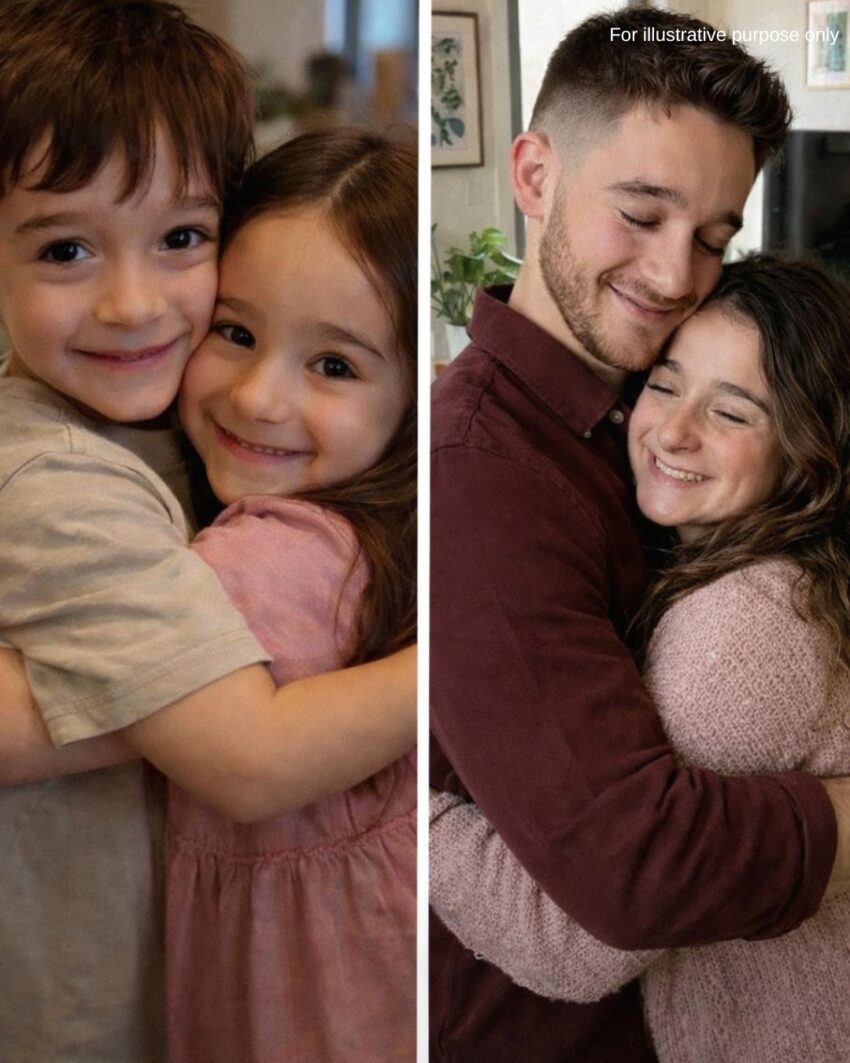
I grew up in foster care with only a blurry version of where I came from, and I learned early not to dig too deep. Then, at 22, a random Instagram DM from a stranger tore open my past—and a year later, just before I met my biological dad, my sister gripped my arm and warned me, “If you go in there without knowing this… you’ll be in danger.” I’m Alan, 23M.

I grew up with one label stamped on me: foster kid. A few placements. Some rough. Some decent. One that finally felt like I could breathe.
That one was Lisa and Mark.
They became my parents in every way that counts. Not flawless. Just steady.
Lisa was the “talk it out” type. Mark was the “fix it with a wrench and a bad joke” type. And they were upfront about the one big unknown.
“You had a family before us,” Lisa told me when I was small. “We just don’t know much.”
Mark would add, “We were told your father was disabled, your mother passed, and there weren’t relatives who could take you.”
So in my mind, my bio family was either dead, monsters, or ghosts.
I never let myself picture a fourth possibility: people who loved me and still lost me.
Fast forward to last year.
I’m 22, on break at work, mindlessly scrolling Instagram, when I notice a DM request from “Barbara Miller.”
Profile picture: a woman with gentle eyes and the same slightly anxious half-smile I’ve seen in my own reflection. Message: “Hey, this is going to sound crazy, but were you born on [date] in [city]? If yes… I think I’m your sister.”
I stared at it until my screen went dark. I almost blocked her.
Instead, I typed, “Who is this?”
She answered immediately. “My name is Barbara. I did a DNA kit. It matched us as close family.”
Then: “I’ve known about you forever. I just didn’t know how to find you.”
That line knocked the wind out of me.
Because I grew up feeling like the world forgot me the moment I was moved.
And here was someone saying, “You were known. You were remembered.”
That night, I told Lisa and Mark in their kitchen.
“I got a message,” I said. “A woman says she’s my sister.”
Lisa’s hand flew to her mouth. “Oh, Alan…”
Mark didn’t panic. He just asked, “How do you feel?”
“Like I’m about to get punched in the stomach,” I said.
Lisa nodded. “Then go slow. And we’re here.”
So I met Barbara.
We chose a diner halfway between us. Bright lights. Plenty of people. Terrible coffee. Perfect for life-changing conversations.
I arrived early and kept glancing at the door like I was waiting for my past to step inside.
When Barbara walked in, my brain short-circuited.
It was like seeing my face if it had lived another story.
Same eyes. Same brow. Same “please don’t hate me” look.
She froze when she saw me.
“Alan?” she said.
“Barbara?” I replied.
She crossed the space and hugged me like she’d been holding her breath for years. “I’m sorry,” she whispered into my shoulder.
I pulled back. “Sorry for what?”
Her eyes filled instantly. “For… everything.”
“Okay,” I said, voice rough. “Let’s start with fries and facts.”
She laughed through tears. “Deal.”
We talked for hours.
She told me our mom’s name was Claire.
“Big heart,” Barbara said, smiling. “Loud laugh. Terrible singing. She’d dance in the kitchen even if the sink was full.”
“What did she look like?” I asked.
Barbara slid her phone across the table.
A picture of a woman with my eyes.
I stared until my chest hurt.
“And our dad?” I asked.
“Richard,” she said. “He’s in a wheelchair. Has been for years.”
My fork froze midair. “So he’s alive.”
Barbara nodded. “Yeah.”
Alive. Not a ghost. Not a monster. Alive.

After that, we started spending time together. Slowly. Awkwardly. Coffee. Bookstore runs. Late-night texts where we tried too hard to sound normal.
Some moments felt easy. Like when we laughed at the same stupid joke and then looked at each other like, Oh. That’s genetic.
Some moments felt sharp. Like when she said “our house” and I remembered I never had one.
And one question sat between us like a third presence. Why did she get to stay… and I didn’t?
Whenever I got close to asking, Barbara would stiffen.
“We’ll talk about it,” she’d say. “I just… need to figure out how.”
A year of that made me feel unsteady.
Like the truth was either too ugly to speak or too shameful to admit.
One day, we were parked outside a coffee shop, sharing fries in the car like we were 12, and I finally said it. “Why did they keep you and not me?”
Barbara went pale.
“Alan…”
“No,” I said. “I need the real answer. Not the padded version.”
She stared at the steering wheel for a long time.
Then she whispered, “Dad wants to tell you himself.”
My stomach dropped. “So you’re setting up a meeting.”
Barbara nodded. “Two weeks.”
I should’ve felt excited.
I felt nauseous.
Two weeks later, we drove to Richard’s house. Quiet street. Small place. Ramp instead of steps.
My hands were sweating through my jeans.
Right before I opened the door, Barbara grabbed my arm. “Alan,” she said urgently, “there’s something I need to tell you first.”
I exhaled. “What now?”
“Grandma’s here,” she said. “She has a lot of opinions.”
“Okay…?” I said, already annoyed.
Barbara’s grip tightened. “Wait. If you go in there without knowing this… you’ll be in danger.”
“In danger,” I repeated. “From an old lady?”
“Not physical,” she said quickly. “She’ll mess with your head. She’ll make you feel like you’re the problem. Don’t let her rewrite what happened.”
I stared at the house.
“If she was part of sending me away,” I said, “I’d rather hear it to my face.”
Barbara swallowed. “Just… promise you won’t believe her.”
“I’ll try,” I said, and stepped out anyway.
Inside looked like every grandma’s house: lace curtains, framed photos, that clean-old smell.
In the living room, an older woman sat upright in a chair like she was waiting to scold someone.
Iron-gray hair. Pearls. Tight mouth.
She looked me over like I was an inconvenience.
“You must be Alan,” she said coldly. “You should have waited outside. This is very stressful for your father.”
No hello. No warmth. Nothing.
Barbara stepped forward. “Grandma—”
“I told you this was a bad idea,” Grandma snapped. “We signed the papers for a reason. We did what was best for everyone. Dragging this up is selfish.”
Heat rushed into my chest.
“We?” I said. “We signed papers?”
Grandma waved her hand. “Everything was handled properly.”
Then I saw him.
Richard.
In a wheelchair by the window, thinner than I imagined, hands trembling in his lap.
He turned his head slowly toward me, like it took effort.
His eyes met mine.
“Alan?” he whispered.
He said my name like it hurt.
“You… you came.”
I stood there, frozen, until Barbara guided me to the couch.
“Dad,” she said tightly, “this is Alan.”
Richard’s mouth trembled. “I know.”
Grandma hovered behind us like a storm cloud.
“Don’t confuse him,” she muttered. “This isn’t good for his health.”
Barbara snapped, sharp as glass. “Kitchen. Now.”
Grandma blinked. “Excuse me?”
Barbara didn’t blink. “Kitchen. Now.”
Grandma huffed off, but not before tossing one more line at me. “You look just like Claire,” she said, like it was an accusation.
Then she disappeared.
The silence she left behind felt heavy.
Richard took a shaky breath.
“I assume you want to know why you ended up where you did,” he said.
“Yeah,” I said. “I do.”
Richard’s eyes filled.
“I loved your mother,” he said. “Claire was… light in a dark room.”
Barbara nodded, jaw tight.
“We had Barbara young,” Richard continued. “We managed. Not rich, but… we managed.”
He tapped the arm of his chair. “Then my health started failing. Neurological disease. Progressive. I fought it. I lost.”
I swallowed.
“Then Claire got pregnant with you,” he said. “Surprise. Scary. But we were happy.”
Barbara’s face tightened, like she knew what was coming.
Richard’s voice broke. “Your birth was complicated. Hemorrhage. Claire… didn’t make it.”
The room tilted.
Barbara whispered, “She was gone before she ever took you home.”
I pressed my fingers into my palms. “So what happened to me?”
Richard looked down, like his hands had betrayed me.
“I was grieving,” he said. “Disabled. Broke. Barbara was 17, trying to keep everything from falling apart.”
Barbara stared at the floor, tears gathering.
“That’s when my mother moved in,” Richard said. “And took over.”
“Grandma,” I said.
He nodded.
“She told me I couldn’t care for you,” he said. “That Barbara deserved college, not… a life as a caretaker.”
Barbara’s voice turned bitter. “She said I’d waste my life.”
Richard continued, “She called CPS. Said we needed ‘options.’”
“Options,” I repeated, the word tasting toxic.
“A social worker came,” Richard said. “Ms. Greene.”

The name sounded official. Final.
Richard’s eyes squeezed shut. “Ms. Greene said letting you go to another family was the kindest thing I could do.”
Barbara let out a harsh laugh. “Grandma repeated that like scripture.”
Richard’s voice cracked. “I signed the papers. Your grandmother pushed the pen into my hand.”
He looked up at me, wrecked.
“I told myself I was being noble,” he whispered. “Truth is, I was terrified. And I let other people decide for me.”
My throat burned.
Barbara finally looked at me, crying now.
“And I froze,” she said. “Grandma cornered me and made a deal.”
“What deal?” I asked, even though I knew it would hurt.
Barbara wiped her face. “College and her help… if I didn’t take on a baby and Dad. If I let them place you. If I said nothing.”
Her voice shattered. “I loved you. I wanted to grab you and run. But I was drowning.”
I stared at her, anger and grief tangled together.
Richard spoke softly. “I tried to write you letters.”
My head jerked up. “You did?”
He nodded quickly. “Dozens. I kept them in a metal box.”
Barbara’s voice flattened. “Grandma got rid of it when we moved.”
My stomach dropped.
“So I never got one,” I said.
Richard’s eyes filled. “No.”
From the kitchen, Grandma’s voice drifted out, sharp and smug.
“He was better off,” she called. “This is pointless.”
Barbara jumped to her feet. “Be quiet!”
Silence.
Richard whispered, “I’m sorry, Alan.”
I couldn’t respond. I stood and walked out before my body betrayed me and collapsed.
In the car, Barbara kept saying my name.
“Alan. Please. Alan.”
I stared out the window. “You let her.”
Barbara sobbed. “I know.”
After a long moment, I said, “Take me home.”
Home meaning Lisa and Mark’s.
When I told my parents everything, Lisa went pale. Mark’s jaw clenched so tightly it looked painful.
Lisa pulled out my old file. The one the system gave them.
“Unstable home,” she read, shaking. “No relatives willing. Disabled father, questionable capacity. Contact not advised.”
Mark’s hands trembled. “If we’d known he wanted contact,” he said, “we would’ve fought for open adoption.”
Lisa’s eyes filled. “We trusted the system. I’m so sorry.”
Then Lisa grabbed my hands.
“You don’t owe anyone a relationship,” she said. “Not your grandma. Not your dad. Not even us.”
Mark nodded. “Whatever you decide, we’re in your corner.”
That was the first real breath I took all day.
I started therapy. Real therapy. The kind where you say the ugly sentences until they stop controlling you.
I took time.
Then I chose.
Not dramatic. Not flawless.
Just determined.
I would try.
I told Barbara, “I can’t magically forgive you. But I’ll get to know you now.”
She nodded, crying. “That’s fair.”
I told Richard, “I want to see you. But I’m not pretending it didn’t hurt.”
He whispered, “I don’t want you to pretend.”
And Grandma?
She doesn’t get access to me just because we share DNA.
If she ever wants a conversation, it’ll be on my terms.
Six months in, it’s still complicated.
Sometimes I leave Richard’s house and sit in my car shaking.
Sometimes Barbara sends me a dumb meme, and I laugh so hard I hate myself for liking it.
Sometimes Richard and I avoid the past entirely. We watch sports and complain about refs like two guys who don’t know how to say “I missed you.”
Lisa and Mark met Richard last month.
Lisa cried. Richard cried. Barbara cried. Mark extended his hand, and Richard shook it like it was a peace offering.
No one said the perfect thing.
But it felt real.
I’m still angry. I probably always will be.
But I’m thankful I know the truth.
No more empty spaces. No more “maybe they didn’t want me.”
They did want me.
They just failed me in very human, very painful ways.
And for the first time in my life, instead of being the kid everyone decides for, I’m the one deciding what happens next.