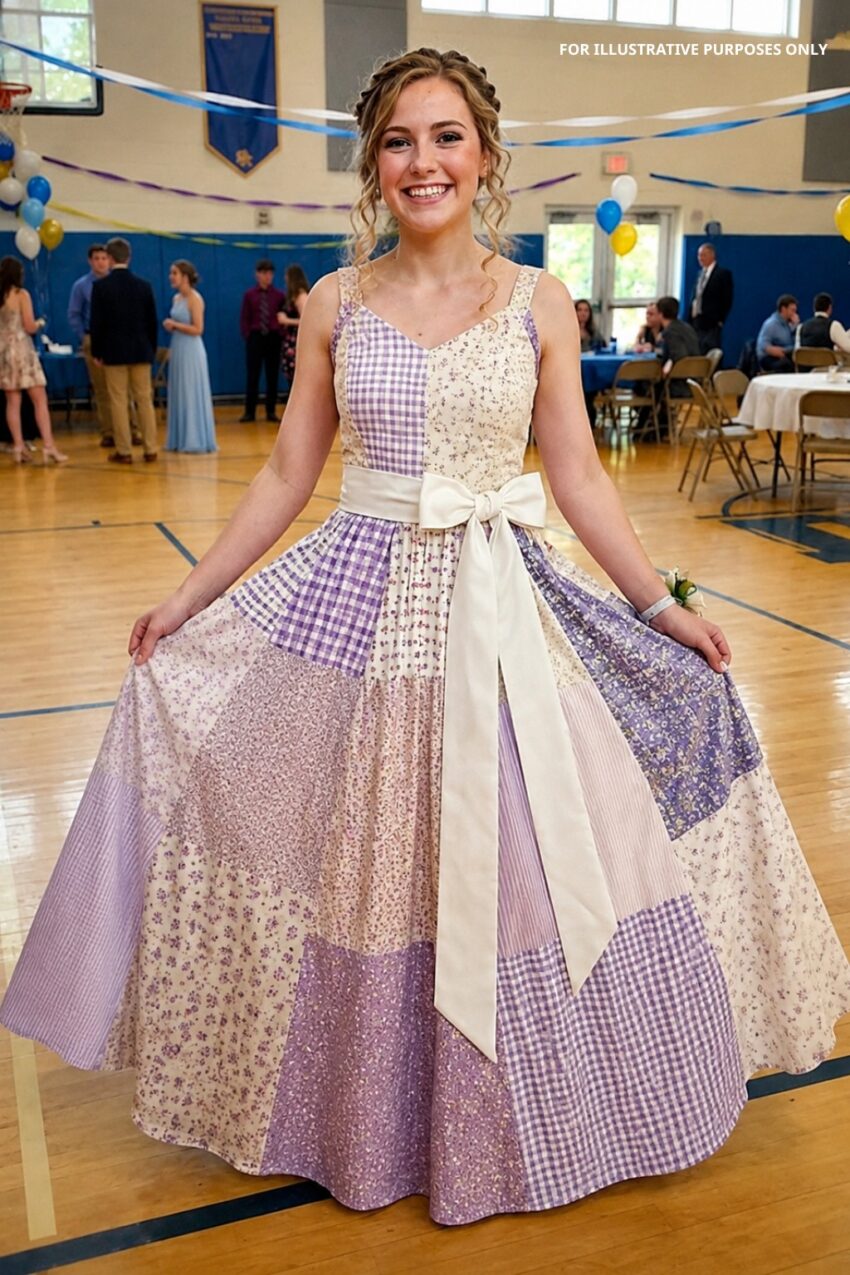
It was always just Dad and me.
My mother died giving birth to me, so my father, Johnny Whitmore, became everything at once. He packed my lunches before dawn shifts, burned pancakes almost every Sunday because he insisted on flipping them too early, and somewhere around second grade, taught himself how to braid hair by watching YouTube tutorials late at night because he refused to let his little girl go to school looking different from everyone else.
He worked as the janitor at the same school I attended, which meant I spent most of my childhood hearing exactly what people thought about that.
“That’s the janitor’s daughter.”
“Her dad scrubs our toilets.”
Kids can be cruel in ways adults forget exist. They laugh at uniforms. They laugh at old cars. They laugh at people who smell like bleach and cleaning supplies after work because they don’t yet understand that some of the strongest people in the world spend their lives doing invisible jobs nobody appreciates until they stop getting done.
I never cried about it in front of anyone.
I saved that for home.
But Dad always knew anyway. Somehow he could look at my face for three seconds and understand everything I was trying to hide. Some nights he’d place dinner in front of me, sit across from me quietly, and say, “You know what I think about people who make themselves feel big by making others feel small?”
I’d shrug weakly and ask, “What?”
“Not much, sweetheart.”
And somehow… every single time, it helped.
Dad believed honest work carried dignity no matter what the world said about it. He walked through those school hallways with his head up even while carrying mop buckets and trash bags. What nobody noticed was how much of that school quietly survived because of him. Broken lockers mysteriously repaired overnight. Torn backpacks stitched together and returned before first period. Sports uniforms washed before games so kids wouldn’t have to admit they couldn’t afford laundry fees.
Dad never told anyone he did those things.
He just did them.
Quietly.
Like kindness was as normal as breathing.
By sophomore year, I made myself a promise. One day, I was going to make him proud enough to erase every cruel comment people ever made about him.
Then cancer arrived and shattered everything.
At first Dad tried pretending it wasn’t serious. He kept working long after doctors begged him to stop. Some afternoons I’d find him leaning heavily against the supply closet looking pale and exhausted, but the second he noticed me, he’d straighten up immediately and joke, “Don’t look at me like that. I’m too handsome for pity.”
But he was getting weaker.
And both of us knew it.
Still, there was one thing he kept talking about constantly.
Prom.
“I just need to make it to your prom,” he’d say while rubbing tired hands together at the kitchen table after work. “Then graduation. I want to see you all dressed up walking out that front door like you own the world.”
“You’re gonna see way more than that,” I always promised him.
I believed it too.
Until the hospital called.
Dad died three months before prom while I stood in the middle of the school hallway with my backpack hanging off one shoulder. I remember staring at the floor tiles thinking they looked exactly like the floors he spent years polishing. I remember someone asking if I was okay. Then I don’t remember much after that.
The week after the funeral, I moved into my Aunt Hilda’s house. Her spare bedroom smelled like cedarwood and fabric softener instead of coffee and bleach and Dad’s old aftershave. Nothing felt familiar anymore.
Then prom season arrived like a cruel reminder of everything I lost. Girls at school obsessed over designer dresses and limousine rentals while posting screenshots of gowns that cost more than Dad earned in months. I felt completely disconnected from all of it because prom was never supposed to be about dresses for me. It was supposed to be about Dad taking too many photos while pretending not to cry.
Without him, the whole thing felt empty.
One evening, I opened the cardboard box the hospital returned after his death. Inside sat his cracked wristwatch, his wallet, and folded beneath everything else exactly the careful way he folded all his clothes, his work shirts.
Blue.
Gray.
Green.

I picked one up slowly and held it against my chest for a long moment.
Then suddenly the idea arrived so clearly it almost felt like Dad placed it there himself.
If he couldn’t come to prom with me…
I would bring him anyway.
“I barely know how to sew,” I admitted nervously to Aunt Hilda that night.
She looked down at the shirts spread across the kitchen table and simply said, “Then I’ll teach you.”
So we started.
The kitchen became covered in scissors, measuring tape, loose thread, and pieces of fabric carrying years of memories stitched invisibly into them. At first I was terrible at it. I cut sections unevenly, sewed crooked seams, ruined entire pieces and cried while ripping stitches back out at two in the morning. Aunt Hilda never lost patience. She’d quietly move beside me, guide my hands, and whisper, “Slow down. Your father rushed through instructions too.”
Some nights I cried while sewing.
Some nights I talked to Dad out loud while stitching fabric together piece by piece.
And somehow… every shirt carried a memory.
The faded green one from the afternoon he ran behind my bicycle while teaching me how to ride.
The gray one he wore the day he hugged me after the worst day of junior year without asking a single question.
The blue shirt from my first day of high school when he stood in the doorway smiling proudly even though I was terrified.
The dress slowly stopped feeling like fabric.
It became him.
Every stitch held pieces of our life together.
The night before prom, I finally finished it.
I stood in front of Aunt Hilda’s hallway mirror wearing a dress sewn from every color my father had ever worn, and for the first time since losing him, I didn’t feel completely alone anymore.
Aunt Hilda appeared behind me in the mirror and immediately covered her mouth.
“Oh, Nicole…” she whispered tearfully. “Your father would’ve absolutely lost his mind seeing this.”
I touched the fabric carefully and suddenly it felt like Dad was still there somehow, folded into every seam the same way he’d always been folded into every ordinary part of my life.
Prom night arrived glowing with music and lights and excitement everyone else had spent months dreaming about. For one brief moment standing outside those doors, I almost lost my nerve completely.
Then I heard Dad’s voice inside my head.
Walk in like you own the world, princess.
So I did.
The whispering started almost immediately.
At first quiet.
Then louder.
Then impossible to ignore.
A girl near the entrance laughed loudly enough for everyone nearby to hear.
“Wait… is that dress made from the janitor’s clothes?”
Another boy smirked.
“Guess that’s what happens when you can’t afford a real dress.”
Laughter spread through the room in ugly little waves while people shifted away from me slightly, creating that cruel invisible circle crowds make around someone they’ve decided deserves humiliation.
My face burned instantly.
Still, somehow, I forced myself to answer.
“I made this dress from my dad’s shirts,” I said shakily. “He died a few months ago, and this was my way of bringing him with me tonight.”
For one second, silence fell.
Then another girl rolled her eyes dramatically.
“Relax. Nobody asked for the sob story.”
And suddenly I felt eleven years old again hearing people whisper, “She’s the janitor’s daughter.”
I wanted to disappear.
I sat near the edge of the dance floor gripping my hands tightly together while trying desperately not to cry in front of everyone. Then someone shouted across the room that my dress was disgusting, and that sentence hit somewhere so deep inside me I physically felt myself starting to break apart.
Right before the tears fully came…
The music stopped.
The entire room turned.
Principal Bradley stood in the middle of the dance floor holding a microphone.
“Before we continue tonight,” he said calmly, “there’s something important I need to say.”
The room fell silent immediately.
No music.
No whispers.
Nothing.
Then he looked directly at me.
“I want to talk about Nicole’s father.”
Every person who laughed minutes earlier stopped smiling.
“For eleven years, Johnny Whitmore cared for this school in ways most people never noticed,” Principal Bradley continued. “He repaired broken lockers so students wouldn’t lose belongings. He cleaned uniforms before games so athletes didn’t have to miss competitions. He quietly fixed backpacks and returned them before students had to feel embarrassed they couldn’t afford replacements.”
The room stayed completely still.
“Many of you standing here tonight benefited from Johnny’s kindness without ever realizing it.”
Then his voice softened.
“That dress is not made from rags. It is made from the shirts of a man who spent over a decade taking care of this school and the people inside it.”
I stopped breathing.
Then Principal Bradley said something nobody expected.
“If Johnny Whitmore ever helped you in any way… fixed something, encouraged you, protected you, stayed late for you, or made your life easier without asking for recognition… please stand.”
One teacher stood first.
Then a football player.
Then two girls near the photo booth.
Then more.
And more.
Teachers.
Students.
Parents.
Staff.
One by one, the room rose to its feet around me.
The same people who laughed moments earlier now stood silently honoring the man they barely noticed while he was alive.
The girl who mocked my dress stared at her hands without moving.
Someone started clapping softly.
Then another person joined.
Then another.
Until the entire ballroom erupted into applause so loud it echoed against the walls.
And finally…
I broke.
Not from humiliation.
From love.
From grief.
From realizing my father mattered far more than cruel people ever understood.
Principal Bradley handed me the microphone gently. My hands shook while holding it.
“I made a promise a long time ago,” I whispered through tears. “I promised myself I would make my dad proud someday. And if he’s watching tonight… I hope he knows every good thing about me came from him.”
That was all I could manage before crying again.
But somehow…
It was enough.
After the music returned, people approached me quietly one by one. Some apologized. Some admitted Dad had helped them years earlier in ways they never forgot. A basketball player confessed Dad secretly paid for his shoes sophomore year. A teacher admitted Dad once fixed her car battery during winter without accepting money.
Story after story appeared from people who suddenly realized how much kindness one quiet man carried through that school every single day.
Later that night, Aunt Hilda drove me to the cemetery. The grass was damp beneath the fading evening light when we reached Dad’s grave.
I crouched slowly beside the headstone and rested my hands against the cold marble.
“I did it, Dad,” I whispered softly. “I brought you with me.”
Wind moved gently through the trees above us.
And for the first time since losing him, the grief inside my chest no longer felt empty.
Because that night taught me something I would carry forever:
People may overlook quiet kindness because it doesn’t arrive wrapped in money or status. They may mock honest work because they don’t understand dignity until life humbles them enough to learn it.
But eventually…
The truth always stands up.
And when it does, no cruelty in this world is louder than the love left behind by a good man.