When I Rescued My Father and Took Everything Back
The phone rang at 6:42 p.m. on a Thursday. My father’s voice trembled, thin with embarrassment.
“Ethan… could you come by the house?”
I hadn’t stepped foot inside that house in almost two years. After my mother died, my father, Richard Whitaker, married Denise — a woman whose smile shone in public, pearls gleaming at church, spouting “family values” like she had invented them. Behind closed doors, she treated my father as nothing more than a burden, a living ATM. Her son, Kyle, twenty-nine and perpetually unemployed, treated him the same.
I drove from downtown Chicago to Lake Forest in my black Rolls-Royce Cullinan, a car my father didn’t know I owned. He still believed I ran a modest logistics office, unaware that Whitaker Freight Solutions, the company he’d built from a rented garage, was now a national operation under my control.
When I arrived, the front door was open.
I heard Denise before I saw her.
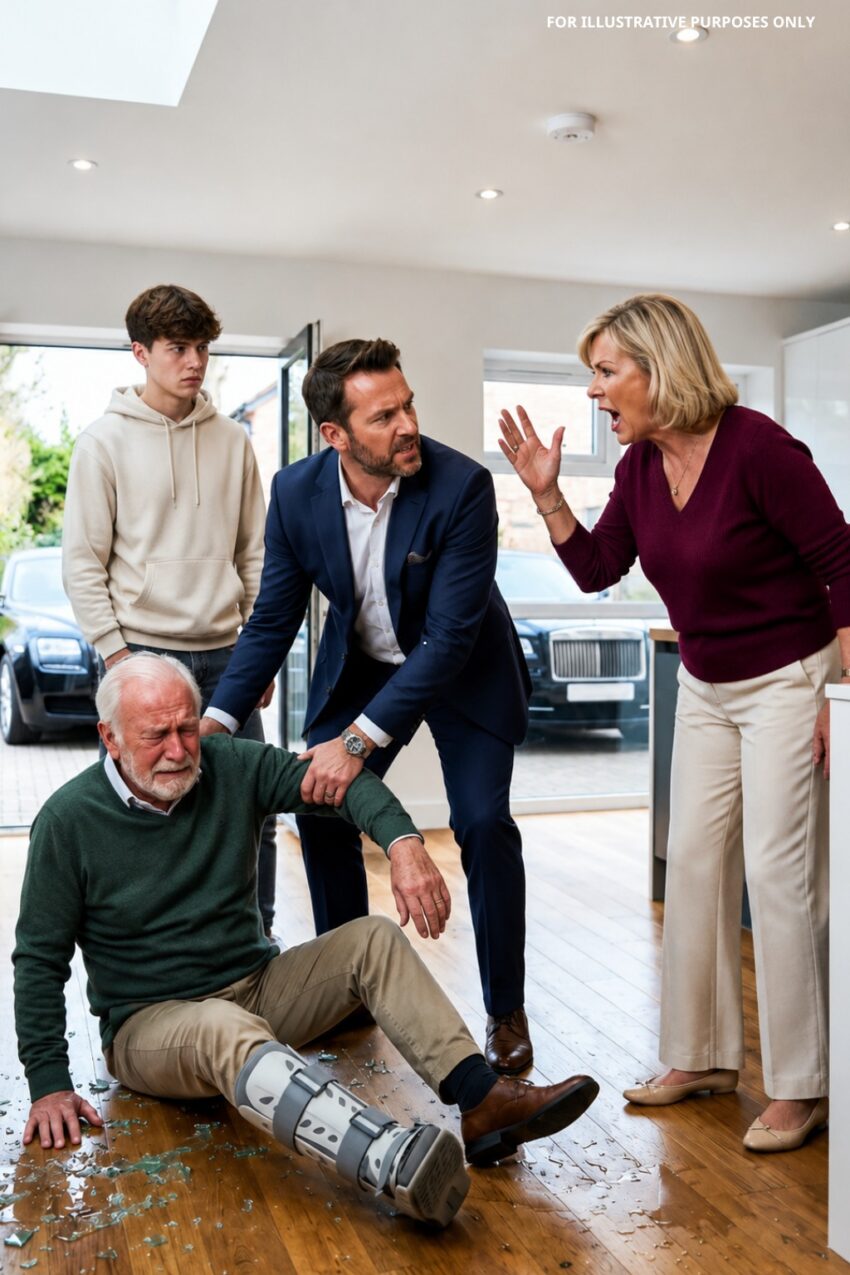
“Go crawl for it yourself, you crippled old man.”
I froze. My father was on the kitchen floor, one leg trapped under him, a medical boot around his broken right leg. His face was pale, a shattered glass near the sink. Water spread across the tile. Denise hovered with a wineglass in her hand. Kyle leaned against the counter, absorbed in his phone.
“Dad,” I said softly.
His eyes met mine, relief and shame warring in his gaze. “I… I slipped. Just needed water.”
Denise turned, her practiced mask faltering. “Ethan… we didn’t know you were coming.”
“No,” I said. “You didn’t.”
Kyle snickered. “He’s being dramatic. The doctor said he should move around.”
I walked past them, crouched beside my father, and steadied him.
“Don’t touch him like you care now,” Denise snapped.
I stared at her for a second. “Pack nothing.”
Her smile faltered. “Excuse me?”
I guided my father toward the door. He leaned on me, fragile but determined, and I helped him into the Rolls-Royce. Outside, Denise and Kyle’s smugness thinned as they realized the gravity of the moment.
I dialed my attorney.
“Marianne,” I said, my gaze fixed on Denise. “Activate the emergency removal clause. Freeze the household accounts. Notify the trust board, Adult Protective Services, and the Lake County Sheriff’s Office. Start the eviction tonight.”
Denise’s wineglass slipped from her fingers. Hours later, she and Kyle lost everything they believed they owned.
My father didn’t speak for the first twenty minutes of the drive. He stared out the windshield at the city lights, every few seconds wincing from pain. He had built his life with sweat and sacrifice, yet humiliation had bent even him.
At Northwestern Memorial, the orthopedic team confirmed my suspicion: my father hadn’t “slipped.” He’d been walking on an unstable fracture, dehydrated, blood pressure high, and the bruises on his forearm didn’t match any fall.
“Mr. Whitaker… do you feel safe at home?” the doctor asked.
He looked at me. Pride, loyalty, fear — all warring within. Then finally, a single word:
“No.”
That word shattered Denise more than any argument could.
By 9:15 p.m., Marianne arrived, calm and decisive. She explained the trust held the residence, controlled all accounts, vehicles, and discretionary spending, and that Denise’s conditional occupancy had been violated.
By 10:12 p.m., deputies enforced protective orders. Denise could collect only essential items; Kyle was ordered out immediately. The kitchen camera, unnoticed by them, had recorded every moment: my father struggling, Denise sneering, Kyle indifferent.
Everything collapsed quietly, efficiently, legally. Their access, their control, evaporated.
Three days later, my father sat in my penthouse, sun glinting off Lake Michigan. Leg elevated, robe on, he sipped water, a tired smile on his face.
“I should have listened to you,” he admitted.
“I should have come sooner,” I replied.
We didn’t speak for a while. Then he murmured, “Denise wasn’t always like that.”
People rarely become cruel all at once. Sometimes entitlement replaces kindness slowly, inch by inch.
“What happens now?” he asked.
“APS will finish its investigation. The sheriff has the footage. Marianne is filing protective orders. A divorce attorney is ready when you are.”
“And Kyle?”
“He’ll find someone else to blame.”
He laughed quietly, painfully. Two weeks later, Denise was erased from every account, her attempts at spousal support denied, Kyle’s property claims invalidated. The house stood empty, cleaned, ready for sale.
I drove my father back to Lake Forest, not to stay, but to look.
“I thought dying alone would be the worst thing,” he said.
“You’re not alone,” I reminded him.
A month later, he moved into a smaller, sunlit home by the lake. Our Wednesday dinners, baseball arguments, and quiet evenings rebuilt the bond we thought was broken.
Denise sent a final letter. My father handed it to Marianne unread. This time, no one made him crawl.