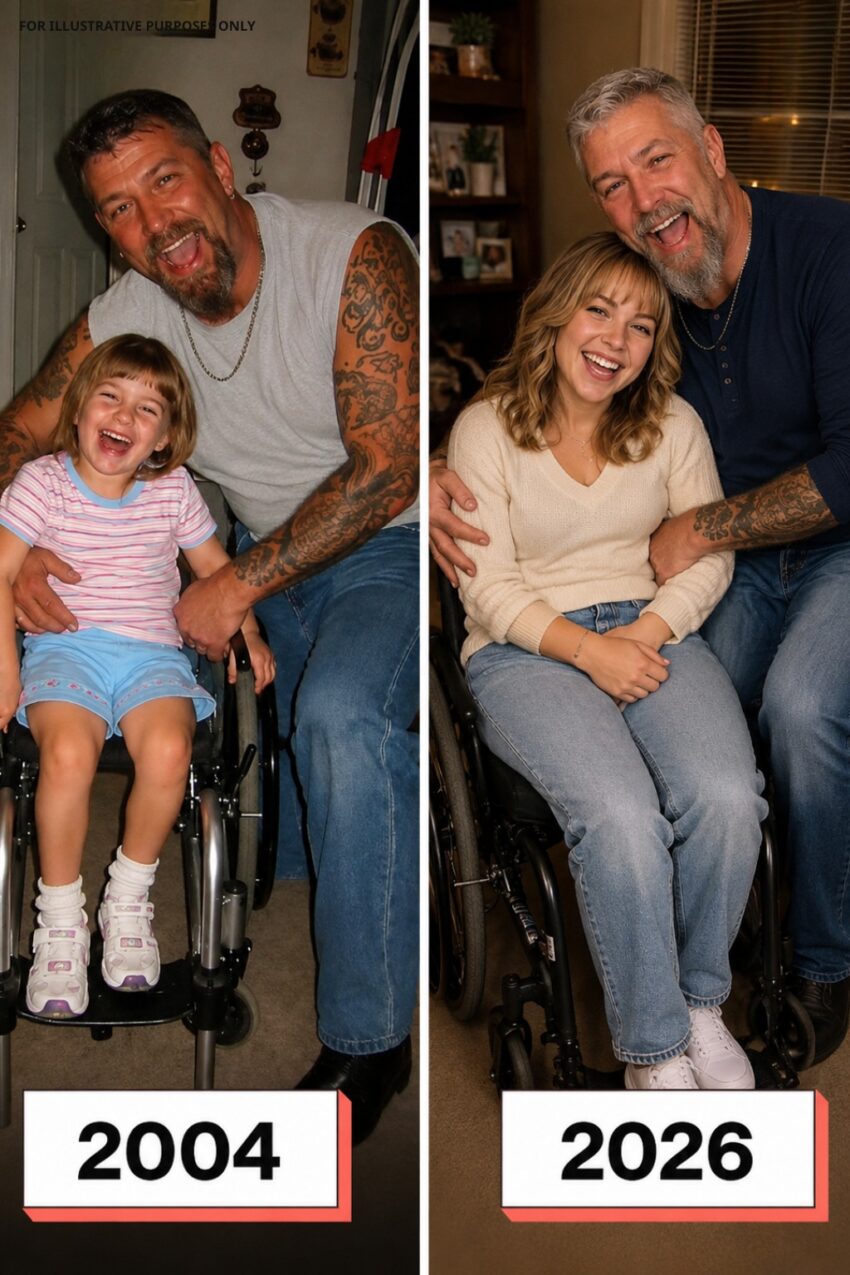
I was twenty-six years old when my world shattered for the second time.
The first time happened when I was four. That was the day my parents died. It was also the day I lost the use of my legs.
Most people hear that and immediately imagine a hospital room, a wheelchair, and a life defined by tragedy.
But my story didn’t begin there.
I had a before.
I remember flashes of it.
My mother, Lena, singing far too loudly while making breakfast.
My father, Mark, coming home smelling of motor oil and peppermint gum.
A pair of light-up sneakers I adored.
A purple sippy cup I refused to share.
Tiny memories scattered like pieces of a photograph that time could never completely erase.
What I don’t remember is the crash.
For twenty-two years, I believed I knew exactly what happened that night.
There was an accident.
My parents died.
I survived.
My spine didn’t.
That was the story.
The only story.
And the man who spent the next twenty-two years making sure I survived was my uncle, Ray.
My mother’s brother.
The man who became everything.
When the social worker arrived at my hospital room, she spoke in the careful voice adults use when discussing children they believe are broken.
“We’ll find a loving home,” she said.
She carried a clipboard and wore a smile that never reached her eyes.
Then the door opened.
And Ray walked in.
He looked like a man carved from concrete and bad decisions.
Broad shoulders.
Calloused hands.
Permanent scowl.
The kind of man who never looked comfortable indoors.
“We’ll find a loving home,” the social worker repeated.
“No,” Ray said.
She blinked.
“Sir—”
“I’m taking her.”
His voice was flat.
Certain.
Final.
“We have families experienced with special—”
“She’s not going with strangers.”
“Mr. Walker—”
“She’s mine.”
And just like that, my future changed.
Ray had never raised a child.
He didn’t have a wife.
Didn’t have children.
Didn’t even know how to brush a little girl’s hair.
But he learned.
Every nurse who entered my room became his teacher.
Every procedure became a lesson.
He carried a battered notebook everywhere.
How to lift me safely.
How to prevent pressure sores.
How to help me sleep.
How to make sure I never felt like a burden.
The first night he brought me home, his alarm went off every two hours.
Every.
Single.
Night.
I’d wake to find him standing beside my bed with his hair sticking up in every direction.
“Pancake time,” he’d mumble.
Then he would gently roll me to protect my skin.
He was exhausted.
But he never complained.
Not once.
Money was always tight.
Insurance fought us on everything.
Wheelchairs.
Equipment.
Therapy.
Basic necessities.
I still remember hearing Ray pacing the kitchen while arguing with an insurance representative.
“No,” he snapped.
“She can’t ‘make do’ without a shower chair.”
A pause.
Then:
“You want to explain that to her yourself?”
They never did.
When I was six, Ray built a wheelchair ramp from plywood scraps.
It was crooked.
Ugly.
And probably violated every building code in existence.
But it worked.
To me, it looked like freedom.
Mrs. Patel, our next-door neighbor, brought casseroles and unsolicited advice.
“She needs friends,” she told him.
“She needs not to break her neck on your front steps,” Ray grumbled.
But later that afternoon he pushed my wheelchair around the neighborhood and introduced me to every child he could find.
At the park, people stared.
Kids always stared.
Adults tried not to.
Sometimes that was worse.
Then one little girl walked up and asked:
“Why can’t you walk?”
I froze.
Ray crouched beside me.
“Because her legs don’t listen to her brain.”
The girl frowned.
Ray added:
“But she’ll probably destroy you at cards.”
The girl grinned.
“No, she won’t.”
That was Zoe.
My first friend.
Ray had a gift for that.
Taking uncomfortable moments and making them hurt less.
When I was ten, I found a strange chair in the garage.
Yarn had been taped to the backrest.
Several messy braids dangled from it.
“What’s this?” I asked.
“Nothing.”
“Looks suspicious.”
“Don’t touch it.”
That night, he sat behind me on my bed.
His hands shook.
“Hold still.”
“What are you doing?”
“Learning.”
The braid he produced looked like it had survived a tornado.
It was terrible.
Absolutely terrible.
I loved it more than anything.
Puberty was even worse.
One afternoon he entered my room carrying a plastic shopping bag and looking like he wanted the earth to swallow him whole.
“I bought… stuff.”
“For what?”
He stared directly at the ceiling.
“For when things happen.”
Inside were pads.
Deodorant.
Mascara.
Shampoo.
Every item a terrified uncle had purchased after spending hours researching online.
“You watched YouTube tutorials.”
He grimaced.
“Those girls talk very fast.”
I laughed until I cried.
Life wasn’t easy.
It never would be.
But Ray never let me believe I was less.
When I cried because I couldn’t dance, he sat beside me and said:
“You’re not less.”
When I cried because I couldn’t run:
“You’re not less.”
When I wondered if anyone would ever love me:
“You’re not less.”
It became his mantra.
And eventually, mine.
Then, slowly, the strongest man I knew started getting weaker.
At first, it was easy to dismiss.
A forgotten key.
A burned dinner.
A pause halfway up the stairs.
“I’m fine,” he insisted.
“Just getting old.”
He was fifty-three.
Old wasn’t the problem.
Cancer was.
The diagnosis came like a bullet.
Stage Four.
Everywhere.
No cure.
No miracle.
No second chance.
The night before he died, he asked everyone to leave.
Even the hospice nurse.
Even Mrs. Patel.
Then he came into my room.
He sat beside my bed.
Took my hand.
And looked at me the way people do when they’re memorizing something they’re about to lose.
“You know you’re the best thing that ever happened to me?”
I tried to smile.
“That’s kind of sad.”
He laughed softly.
“Still true.”
Then I said the thing I’d been terrified to admit.
“I don’t know how to do this without you.”
His eyes filled with tears.
“So do it scared.”
“What?”
“Live.”
His voice cracked.
“You’re gonna live, kiddo.”
Then he whispered something that didn’t make sense at the time.
“I’m sorry.”
“For what?”
He looked away.
“For things I should’ve told you.”
The next morning, he was gone.
And three days later, after the funeral, I received a letter written in his unmistakable handwriting.
A letter that began with seven words that would destroy everything I thought I knew.
Hannah, I’ve been lying to you your whole life.