I can’t explain the excitement I felt as I drove to the hospital that morning.
The sun was bright, the back seat was ready with two tiny car seats, and a bunch of pink balloons floated beside me, bumping softly against the roof of the car every time I turned a corner. I had barely slept the night before, but I didn’t care. After years of waiting, praying, and hoping, Suzie and I finally had our baby girls.
Twin daughters.
I had spent the past three days turning our little house into a welcome-home celebration. I painted the nursery wall pale yellow because Suzie said she wanted something “warm but not too princessy.” I cooked enough food for a week. I even bought a cake with shaky icing that said, “Welcome Home, Lily and Rose.”
I pictured Suzie laughing when she saw it.
I pictured her walking out of the hospital tired but smiling, one baby in each arm, while I tried not to cry in front of everyone.
But when I reached her room, the bed was empty.
At first, I thought maybe she was in the bathroom. Then I noticed the drawers were open. Her overnight bag was gone. The flowers I had brought two days earlier were still sitting on the windowsill, but the room felt strangely cold.
The two bassinets were there.
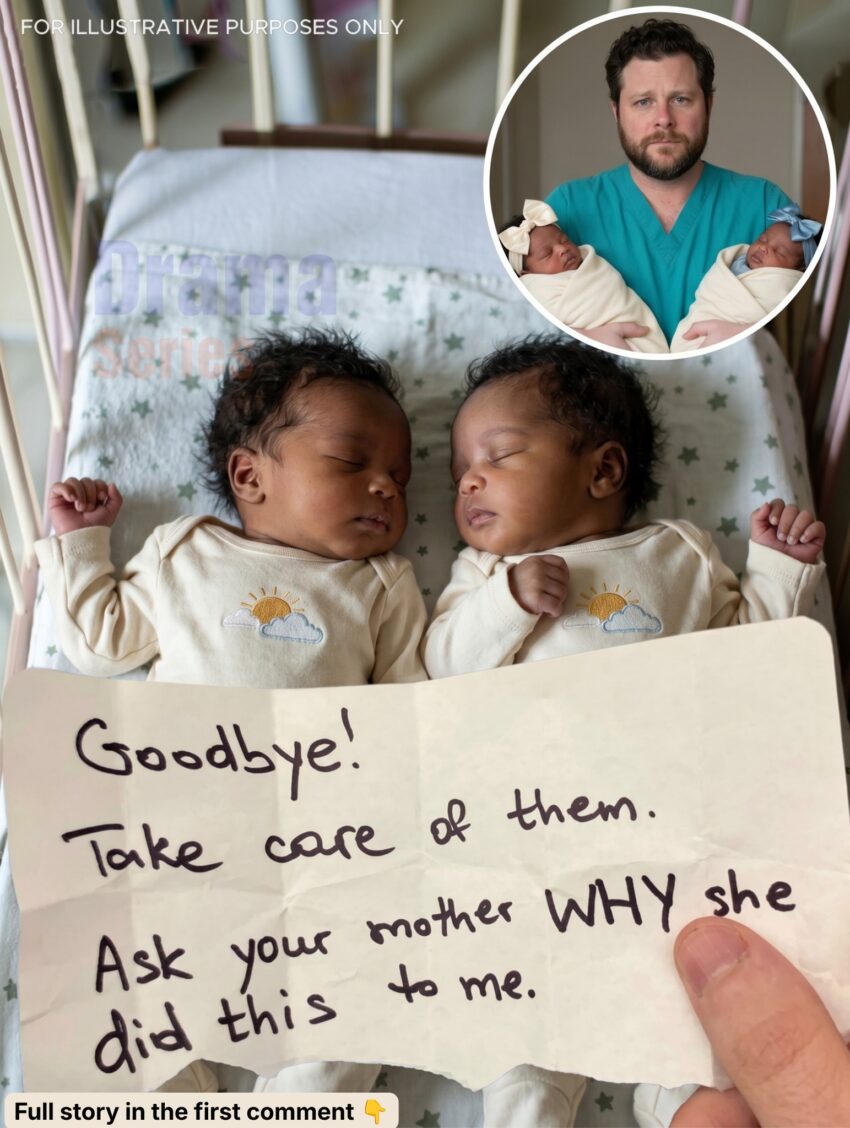
Our daughters were sleeping peacefully, wrapped in soft blankets.
And beside them was a folded note.
My heart began to pound before I even touched it.
With shaking hands, I opened it.
“Goodbye. Take care of them. Ask your mother WHY she did this to me.”
For a moment, I couldn’t breathe.
I read the words again. Then again.
Goodbye?
Ask my mother?
What did that even mean?

I rushed into the hallway, clutching the note so tightly it crumpled in my fist. A nurse looked up from her desk, startled by my face.
“Where’s my wife?” I asked.
She hesitated. “Mrs. Carter checked out this morning.”
“Checked out?” My voice cracked. “With who?”
“Alone,” she said carefully. “She told us you knew.”
“Knew?” I almost laughed from shock. “I came here to take her home!”
The nurse’s expression changed. She looked genuinely worried then. “She seemed upset, but she was calm. She signed the discharge papers and left about an hour ago.”
I ran outside. I called Suzie once, twice, ten times. Straight to voicemail. I called her sister, her best friend, her old coworker. No one had heard from her.
By the time I drove home with the twins, I felt like I was living inside a nightmare.
Every red light seemed too long. Every tiny sound from the back seat made my chest tighten.
What had happened to my wife?
Had I missed something?
Suzie had been quiet near the end of her pregnancy, but I thought she was tired. She had smiled when I rubbed her swollen feet. She had cried when we first heard both heartbeats. She had squeezed my hand in the delivery room and whispered, “We made it, Mark.”
We made it.
So why had she left?
When I pulled into the driveway, my mother’s car was already there.
She stepped onto the porch holding a casserole dish, smiling as if nothing in the world was wrong.
“Oh, let me see my grandbabies!” she said warmly.
I didn’t move.
Her smile faded.
“Mark?”
I held up the note. “What did you do to Suzie?”
The color drained from her face so quickly I knew.
I knew before she spoke.
“Mark, I can explain.”
“Then explain.”
She looked toward the car, where the twins were still sleeping. “Not out here.”
I laughed bitterly. “You’re worried about neighbors? My wife is gone, Mom. She left our newborn daughters behind because of something you did.”
My mother’s mouth trembled. For the first time in my life, she looked small.
Inside, after I carried the babies in and laid them safely in their bassinets, I turned to her.
“Talk.”
She sat at the kitchen table, staring at her hands.
“I thought I was protecting you,” she whispered.
My stomach twisted. “From what?”
“From her.”
I felt anger rise in my chest. “Don’t start.”
“She wasn’t good enough for you, Mark. You know I always felt that. She came from a broken family. She didn’t have stability. She was emotional. I worried she would trap you.”
“She’s my wife,” I said through clenched teeth. “She just gave birth to my children.”
My mother wiped her eyes, but I felt no pity.
“What did you say to her?”
She didn’t answer.
“What did you say?”

Finally, she broke.
“I told her the truth.”
“What truth?”
“I told her you had doubts.”
The room went silent.
I stared at her. “I never said that.”
“I know,” she whispered.
My hands went cold.
She continued, her voice shaking. “A few weeks ago, when you were at work, I went to see her. She was alone. I told her that you were overwhelmed. That you felt trapped. That you had confessed to me you weren’t sure you could love two babies at once.”
I stepped back as if she had struck me.
“You lied?”
“I panicked,” she said. “She kept talking about moving farther away after the babies came. She wanted boundaries. She said we needed space. I felt like she was taking you from me.”
“So you tried to break her?”
“I thought if she understood how hard this would be, maybe she’d lean on me more.”
I couldn’t believe what I was hearing.
My mother had always been controlling, but I had made excuses. She was lonely. She had raised me alone. She meant well.
But this wasn’t love.
This was cruelty dressed up as concern.
“What else?” I asked.
She lowered her head.
“There’s more?”
“I gave her some papers.”
“What papers?”
“I found a template online. A custody agreement. I told her you had asked me to help prepare it in case she became unstable after birth.”
For a second, the room spun.
“You made my wife believe I was planning to take her babies?”
“She was so emotional. I didn’t think she would actually leave.”
I slammed my hand on the table. “She left because she thought I betrayed her!”
The twins startled and began to cry. Their tiny cries cut through the room like a plea. I rushed to them, lifting Lily first, then Rose, trying to soothe both at once while my own heart was breaking.
My mother reached for one of them.
“Don’t,” I said.
She froze.
“You need to leave.”
“Mark, please—”
“Leave.”
When the door closed behind her, the house fell into a terrible silence, broken only by the soft cries of my daughters.
I sat on the nursery floor with both babies against my chest and cried harder than I had in years.
Then I called everyone again.
This time, Suzie’s sister answered differently.
“Mark,” she said quietly, “Suzie called me.”
My whole body stiffened. “Where is she?”
“I can’t tell you unless I know you’re not part of this.”
“I’m not,” I said, my voice breaking. “I swear I’m not. My mother lied. All of it was a lie.”
There was a long pause.
Then she said, “Suzie’s at a motel outside town. She’s scared. She thinks you want to take the babies from her.”
I closed my eyes. “Tell her I’m coming. Or no—tell her I won’t come unless she wants me to. Tell her I love her. Tell her the girls are safe. Tell her I know everything.”
An hour later, my phone rang.
Suzie.
I answered so fast I nearly dropped it.
“Suzie?”
For a moment, all I heard was breathing.
Then her voice came, small and broken. “Did you really not know?”
“No,” I said. “God, no. I would never do that to you.”
“She showed me papers, Mark.”
“I know. They were fake. She admitted it.”
Suzie started crying. “I thought you hated me. I thought you were waiting until I gave birth so you could take them.”
My chest ached. “I love you. I love our daughters. I should have protected you from her sooner. I’m so sorry.”
She didn’t answer right away.
Then she whispered, “I couldn’t take them with me. I wanted to, but I was afraid if I left with them, she’d use it against me. I thought leaving them with you would prove I wasn’t unstable.”
That broke me.

My wife had been pushed into such fear that abandoning her own babies felt like the safest choice.
“I’m coming to get you,” I said gently. “Only if you want me to.”
A pause.
“Bring them,” she whispered.
When I reached the motel, Suzie was standing outside in the same sweater she had worn at the hospital. She looked pale, exhausted, and terrified.
But when she saw the twins, she ran.
I barely had time to park before she opened the back door and reached for them, sobbing as she kissed their tiny faces.
“I’m sorry,” she cried. “I’m so sorry, my babies.”
I wrapped my arms around all three of them.
For a long time, we just stood there beside the car, holding the family my mother had almost destroyed.
Suzie came home that night.
But my mother did not.
The next morning, I changed the locks.
I sent my mother one message: “Until you take responsibility and get help, you are not welcome near my wife or our children.”
She called. She cried. She blamed loneliness, fear, and “a mother’s love.”
But love does not manipulate.
Love does not lie.
Love does not terrify a new mother days after giving birth.
Months passed before Suzie could sleep through the night without waking in panic. Trust returned slowly, in small pieces. A cup of tea left beside her. My hand reaching for hers before she had to ask. Me answering every fear with patience instead of frustration.
We went to counseling. Together.
I also went alone, because I had to face the truth: I had ignored the warning signs for years. Every cruel comment my mother made, every boundary she crossed, every time Suzie looked hurt and I said, “That’s just how Mom is.”
That sentence had nearly cost me my family.
A year later, on Lily and Rose’s first birthday, Suzie stood in our backyard under strings of soft lights, laughing as the girls smashed cake across their cheeks.
She looked at me and smiled.
Not the old smile.
A stronger one.
A healed one.
My mother wasn’t invited. Maybe one day, if she truly changed, things could be different. But that day was not about her.
It was about Suzie.
It was about our daughters.
It was about the family we chose to protect.
That night, after the guests left and the girls fell asleep, Suzie found the old hospital note tucked inside a drawer. I thought she might cry when she saw it.
Instead, she folded it carefully and placed it in a small memory box.
“Why keep it?” I asked softly.
She looked toward the nursery, where our daughters slept peacefully.
“Because one day,” she said, “when they’re old enough to understand, I want them to know that leaving wasn’t the end of our family.”
She took my hand.
“It was the moment we finally learned how to fight for it.”
And she was right.
Sometimes the most dangerous thing in a marriage isn’t a stranger, a mistake, or even a secret.
Sometimes it’s the person standing too close, smiling like they belong there, while quietly pulling everything apart.
But love—real love—doesn’t survive by pretending nothing happened.
It survives when someone finally tells the truth.
And I will spend the rest of my life being grateful that Suzie gave me the chance to prove mine.
Note: This story is a work of fiction inspired by real events. Names, characters, and details have been altered. Any resemblance is coincidental. The author and publisher disclaim accuracy, liability, and responsibility for interpretations or reliance. All images are for illustration purposes only.