For six years, I believed my mother-in-law was one of the safest people in my son’s life. Cheryl was patient, dependable, and endlessly attentive. She remembered every school event, knew exactly which snacks Nathan liked, and could calm him down faster than almost anyone.
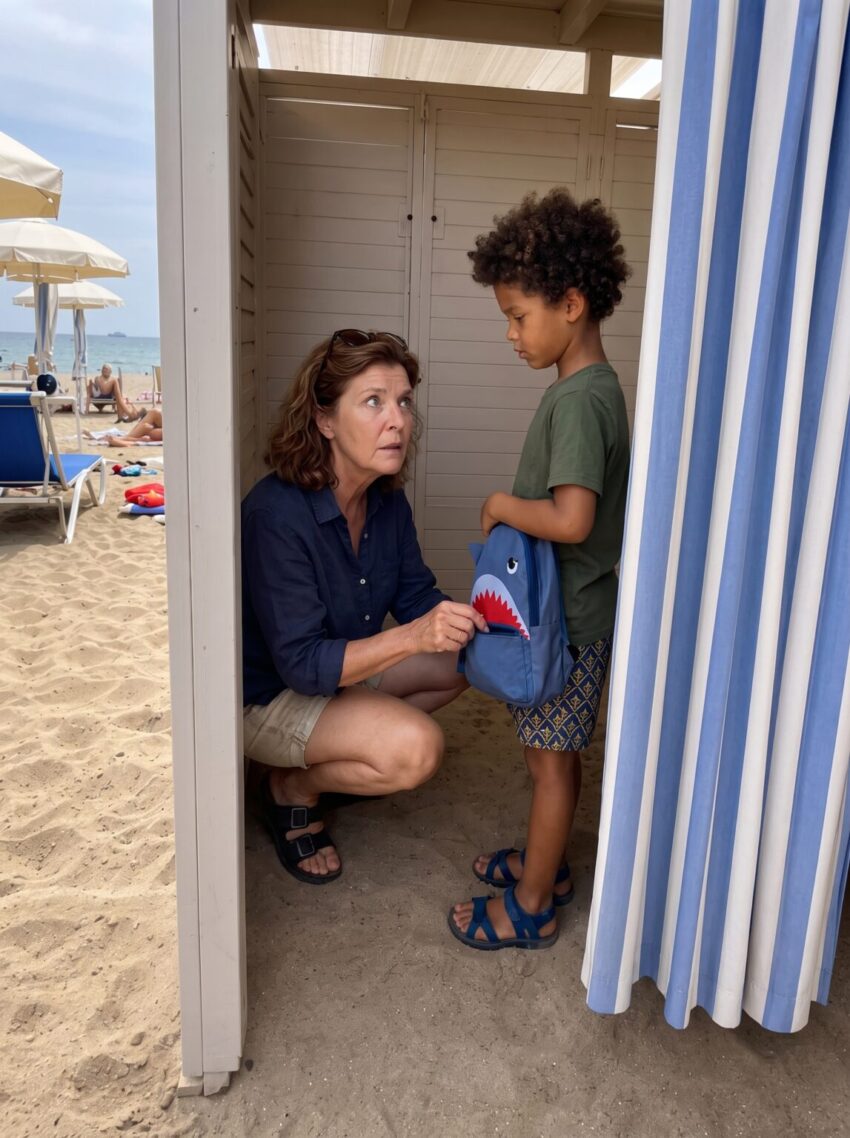
I never imagined I would one day find her kneeling inside a beach changing cubicle, whispering to my six-year-old son that I could never know what she had placed inside his backpack.
At that moment, everything I thought I knew about her seemed to collapse.
But by the end of the day, a tiny glass bottle would reveal a truth I had never expected—and teach me something about love, family, and memory that I would carry for the rest of my life.
The Voice Behind the Curtain
The curtain of the changing cubicle was slightly open.
Through the narrow gap, I could see Nathan’s bright blue sandals.
That was the only reason I did not immediately panic.
The second thing I noticed was Cheryl’s voice.
I knew that voice as well as my own.
It was the voice that sang badly while making pancakes every Wednesday morning. The voice Nathan imitated when he lined up his stuffed animals and ordered them to behave. The voice that had comforted him through fevers, skinned knees, bad dreams, and his first nervous week of kindergarten.
For years, hearing Cheryl speak to my son had made me feel grateful.
That afternoon, however, her voice made my entire body go cold.
“Now tell Grandma what we agreed,” she whispered.
My hand stopped inches from the curtain.
Inside the cubicle, Nathan answered with the serious concentration of a child repeating something important.
“Mommy can never know what you gave me.”
For a moment, the beach seemed to disappear.
I could no longer hear the waves, the gulls, or the children shouting near the water. All I could hear was my heartbeat pounding against my ribs.
Then Cheryl spoke again.
“That’s my good boy.”
I tore the curtain open.
Cheryl was kneeling in front of Nathan. One hand rested on his shoulder. The other hovered near the front pocket of his shark-shaped backpack.
The zipper had just been closed.
Nobody moved.
Nathan looked up at me, confused.
“Mommy?”
I reached for him immediately and pulled him toward me.
“What did Grandma give you?”
Cheryl stood so quickly that she nearly lost her balance.
“Taylor, please.”
That one word frightened me even more.
People said please when they wanted time to explain.
They also said it when they knew exactly how terrible something looked.

The Bottle in His Backpack
I moved Nathan behind me and grabbed his backpack.
Cheryl stepped forward.
“Don’t open it here.”
I stared at her.
“Why not?”
“Taylor, just listen—”
I pulled the zipper open.
Inside the front pocket was a small glass bottle tied with a pale blue ribbon.
A layer of beach sand covered the bottom. Above it were dozens of tiny rolled pieces of paper, packed carefully together.
A handwritten tag hung around the neck of the bottle.
Cheryl’s handwriting was neat and instantly recognizable.
It read:
“For Nathan, when ordinary days become difficult to remember.”
I screamed.
I did not even understand why.
Maybe it was fear. Maybe it was anger. Maybe it was the shock of hearing my son promise to hide something from me and then discovering an object that looked strangely personal and secretive.
Whatever the reason, my voice echoed across the changing area.
People turned toward us.
Children stopped playing.
A woman near the outdoor showers froze with sunscreen still covering her hands.
Nathan immediately began to cry.
The color drained from Cheryl’s face.
“I’m sorry, sweetheart,” she said to him.
“Don’t,” I snapped, pulling him farther behind me.
At that moment, Will came running from the pier. Wet sand clung to his legs, and he was still holding a fishing pole.
“What happened?”
I held up the bottle.
“Your mother told our son to hide this from me.”
Will looked from the bottle to Cheryl.
His expression changed.
Cheryl closed her eyes.
For the first time since I had known her, she looked fragile.
Not guilty, exactly.
Just suddenly older.
The Grandmother Everyone Trusted
Every summer, Will’s parents rented the same small blue house near the Gulf Coast.
By the second afternoon, damp towels covered the porch railing. The kitchen smelled of lemon soap, grilled seafood, and whatever dessert Cheryl had decided everyone needed.
The refrigerator would be filled with plastic containers labeled in her tidy handwriting.
She washed grapes before anyone asked.
She packed extra sunscreen.
She carried bandages, tissues, pencils, crackers, and wet wipes in a handbag large enough to survive a natural disaster.
That was the kind of grandmother Cheryl was.
Prepared.
Present.
Impossible not to trust.
She never forgot a birthday.
Every Christmas, she knitted Nathan a sweater, even though we lived in Texas and he complained that wearing one made him feel like he was “being hugged by an oven.”
Each Wednesday, she picked him up from kindergarten and made pancakes shaped like whichever animal he loved that week.
She had attempted whales, turtles, dinosaurs, bears, and once, an armadillo.
When Nathan requested a dragon, Cheryl placed something on his plate that looked more like a shoe with horns.
Nathan studied it carefully.
“It’s probably sleeping,” he decided.
Then he ate every bite.
He adored her.
Whenever someone asked who his favorite person was, Nathan never hesitated.
“Grandma!”
I used to smile every time he said it.
That was why the scene in the changing cubicle felt so impossible.
It did not match the woman I knew.
Yet I had heard the words myself.
Mommy can never know.
The Ten Minutes I Couldn’t Account For
That Saturday had started like every other beach day.
Will and his father left early to fish from the pier.
The cousins claimed a stretch of wet sand and began building a castle protected by what they called “shell security.”
Cheryl sat under a striped umbrella, removing wrinkled grapes from a bowl because Nathan had recently decided wrinkled fruit was “too tired to eat.”
The afternoon felt harmless.
Ordinary.
The kind of day people rarely appreciate while they are living it.
There was sunscreen on everyone’s shoulders, crushed chips in the towels, and sand in places sand had no business being.
Nathan ran past me with his shark backpack bouncing behind him.
“Don’t go far,” I called.
“Okay, Mommy!”
I turned to help my niece rinse sand from her eye.
It could not have been more than ten minutes.
When I looked up again, Nathan was gone.
At first, I did not feel afraid.
I checked the waterline.
Then the snack stand.
Then the playground shaped like a pirate ship.
I even smiled to myself, assuming Cheryl had taken him to buy ice cream and would return pretending it had been entirely his idea.
Then I saw the changing cubicles.
I noticed the blue sandals beneath one curtain.
I walked closer.
And I heard my son promise to keep something from me.

The Difference Between a Secret and a Surprise
Back at the beach house, I kept the bottle inside my bag.
I did not want to examine it while Nathan was awake. He had already cried enough, and I could tell he did not understand why the adults were upset.
That night, he took longer than usual to fall asleep.
He asked twice whether Grandma was in trouble.
Then, as I tucked the blanket around him, he looked up at me.
“Mommy, are secrets always bad?”
The question made my chest ache.
I sat beside him and brushed a few grains of sand from his eyebrow.
“Some secrets can make people feel uncomfortable or unsafe,” I explained. “Especially when someone tells a child not to tell their parents.”
Nathan frowned.
“Grandma called it a surprise.”
“Then why did you call it a secret?”
He thought about that for a long time.
Finally, he whispered, “I forgot the difference.”
I softened my voice.
“A surprise is something happy that people will find out later. A secret is something someone says must stay hidden. Do you understand?”
He nodded uncertainly.
“Is Grandma mad at me?”
“No,” I said. “You did the right thing by answering me.”
He was quiet for another moment.
“Are you mad at Grandma?”
I looked toward the dark hallway.
“I need to understand what happened first.”
Once Nathan was asleep, I returned to the kitchen.
Cheryl sat alone at the table beneath a single lamp. Will stood beside the sink with his arms crossed.
The glass bottle rested between them.
Cheryl had not tried to take it back.
For some reason, that made me even more uneasy.
I sat across from her.
“Explain everything.”
The Note From Her Childhood
Cheryl did not reach for the bottle.
Instead, she slipped one hand into the pocket of her cardigan and removed an old folded piece of paper.
I had seen Cheryl manage crowded birthday parties, kitchen disasters, illnesses, and family arguments without losing her composure.
That night, her fingers trembled.
“This belonged to my mother,” she said.
She unfolded the paper carefully.
The creases were pale and worn from years of being opened and closed.
“My mother wrote this when I was nine. We were spending a week beside a lake. I had just lost one of my front teeth, and I refused to smile in any photographs.”
A small, sad smile touched Cheryl’s face.
“She wrote that I kept hiding my smile behind slices of watermelon because I thought no one noticed.”
Cheryl placed the note beside the bottle.
“When my mother died, I was terrified I would forget her.”
Her voice became quieter.
“I thought grief would take the biggest memories first. Birthdays. Christmas mornings. Family vacations. The sound of her saying my name.”
Will remained silent.
So did I.
“But those memories stayed,” Cheryl continued. “What disappeared were the small ones.”
She touched the edge of the paper.
“I forgot the song she hummed while watering her flowers.”
Her eyes shimmered.
“I forgot whether she tucked her hair behind her ear before she started reading or after.”
She swallowed.
“I could not remember the way she laughed when the first pancake burned.”
The anger inside me began to loosen.
Cheryl looked directly at me.
“I still loved her just as much. But love alone could not protect every little detail.”
Outside, waves rolled toward the shore, their sound faint through the open window.
“The summer after she died,” Cheryl continued, “I started writing down ordinary memories whenever we came to the beach.”
She placed her hand beside the bottle.
“Not milestones. Not graduations or birthdays. Just the tiny moments no one realizes they are losing.”
The Memories Hidden Inside
I looked at the tightly rolled papers inside the glass.
They no longer appeared threatening.
They looked delicate.
Almost sacred.
I slowly removed the cork.
The first note was written in Cheryl’s neat blue ink.
It described the first time I had seen the ocean as a child. According to Cheryl, I had cried because I believed the waves were chasing me.
I looked up in surprise.
“You remembered that?”
Will smiled.
“You also screamed louder than Nathan did today.”
Despite everything, embarrassment warmed my face.
“I had forgotten completely.”
“I know,” Cheryl said gently.
There was no pride in her voice.
Only tenderness.
I opened another note.
It said that Will whistled whenever he felt nervous, even though he did not realize he was doing it.
At that exact moment, the kitchen became strangely quiet.
Will had stopped whistling.
A laugh escaped me before I could hold it back.
The next note was about Nathan.
It recalled the afternoon he had cried after seeing a crab with only one claw.
I remembered the crab.
But I had forgotten Nathan’s concern for it.
Another note said I always collected broken shells because I believed someone should still choose them.
I stared at the words.
Every summer, I filled a bowl on our windowsill with chipped and cracked shells.
I had never considered why I passed over the perfect ones.
Paper after paper revealed a version of our family I had not realized Cheryl was quietly preserving.
One note said Nathan’s grandfather pretended to enjoy kale because Nathan believed superheroes ate green vegetables.
Another said Will checked beneath Nathan’s beach chair before sitting down because he worried about pinching his fingers.
One reminded us that Nathan fell asleep more quickly when someone rubbed slow circles on his back instead of patting him.
None of the memories were dramatic.
That was what made them so powerful.
They were the moments that disappeared while I was thinking about laundry, school forms, grocery lists, dentist appointments, unanswered messages, and everything waiting for me tomorrow.
I had assumed the important parts of life would announce themselves.
Cheryl’s bottle proved otherwise.
Sometimes the important moments happened quietly while no one was looking.

What Cheryl Had Been Teaching My Son
I continued reading until my eyes blurred.
Then a question returned to me.
“When did you start asking Nathan about his day?”
Cheryl tilted her head.
“What do you mean?”
“You always ask him, ‘What happened today that you never want tomorrow to forget?’”
Recognition crossed her face.
“Oh.”
“I thought you were just making conversation.”
Cheryl smiled faintly.
“I was teaching him to notice.”
The words settled over the kitchen.
Children were taught to read, count, swim, tie their shoes, and look both ways before crossing the street.
Cheryl had been teaching Nathan something I had never considered teaching him.
She was showing him how to pay attention to his own life.
How to recognize a memory before it became one.
How to notice the small details that would otherwise vanish.
I carefully returned the notes to the bottle.
“Then why did you tell him not to tell me?”
Cheryl lowered her eyes.
“I wanted to give the bottle to him when he was older.”
She gave a sheepish little smile.
“I imagined it being a surprise.”
Will leaned against the sink.
“You trusted Nathan to keep a surprise?”
Cheryl sighed.
“That was clearly a mistake.”
I almost smiled.
Nathan had never successfully kept a birthday gift secret.
He had revealed Will’s Christmas present three weeks early.
He had once announced that we were adopting a puppy before we had even completed the paperwork.
“So you told him Mommy could not know yet,” I said.
Cheryl nodded.
“And Nathan translated that into a secret.”
A tired laugh rose from my chest.
“Of course he did.”
For the first time since the beach, the tension in the room began to dissolve.
One Final Note Before We Left
The following morning, the beach house slowly returned to order.
Coolers were packed.
Towels were folded.
Windows were checked twice.
Children searched beneath beds and couches for sandals that somehow disappeared every year.
Nathan hugged his cousins goodbye and then ran toward the porch.
“My bottle!”
My body reacted before my mind did.
I almost called after him.
Then I stopped.
He was not running away from me.
He was running toward something meaningful.
Cheryl stood on the porch waiting for him.
She took a tiny blank strip of paper and a short pencil from her pocket.
I had seen her carry that pencil for years.
I had never once wondered why.
Nathan sat on the bottom step with his tongue peeking from the corner of his mouth. His face tightened in concentration as he wrote.
No one interrupted him.
When he finished, he tried to roll the paper.
It came undone.
He tried again.
It unraveled a second time.
Cheryl knelt beside him and showed him how to tuck the edge beneath itself.
Nathan grinned proudly when the paper finally held its shape.
Then he placed it inside the bottle.
Cheryl did not ask what he had written.
Neither did I.
The Ordinary Moment I Will Never Forget
Halfway home, Nathan fell asleep in the back seat.
His shark backpack rested beside him.
At a red light, I reached behind my seat and carefully removed the bottle.
Will glanced at me but said nothing.
I found Nathan’s newest note inside.
His handwriting wandered unevenly across the paper.
It said:
“Grandma cries when she smiles really big.”
My throat tightened.
I looked toward the front passenger seat.
Cheryl was laughing with Will about how he had missed the same turn three summers in a row.
She did not know what Nathan had written.
But he had noticed.
He had seen the tears shining in her eyes when she smiled at him.
He had recognized a moment worth saving.
I rolled the paper carefully and returned it to the bottle.
Then I placed the bottle inside Nathan’s backpack and gently zipped the pocket closed.
This time, I understood.
Some family traditions are not created for display.
They do not need expensive frames, perfect photographs, or carefully arranged shelves.
Some traditions are carried quietly from one person to another.
A question asked at the dinner table.
A sentence written on a scrap of paper.
A tiny memory protected inside a bottle.
We spend so much of our lives waiting for the important days that we fail to notice the ordinary ones passing beneath our feet.
But ordinary days are not empty.
They are where love lives before anyone realizes it will be missed.
They are burned pancakes, broken shells, silly songs, sleepy children, nervous whistles, and grandmothers who cry when they smile too widely.
And sometimes, if we are fortunate, someone teaches us to notice them before they disappear.
Note: This story is a work of fiction inspired by real events. Names, characters, and details have been altered. Any resemblance is coincidental. The author and publisher disclaim accuracy, liability, and responsibility for interpretations or reliance. All images are for illustration purposes only.