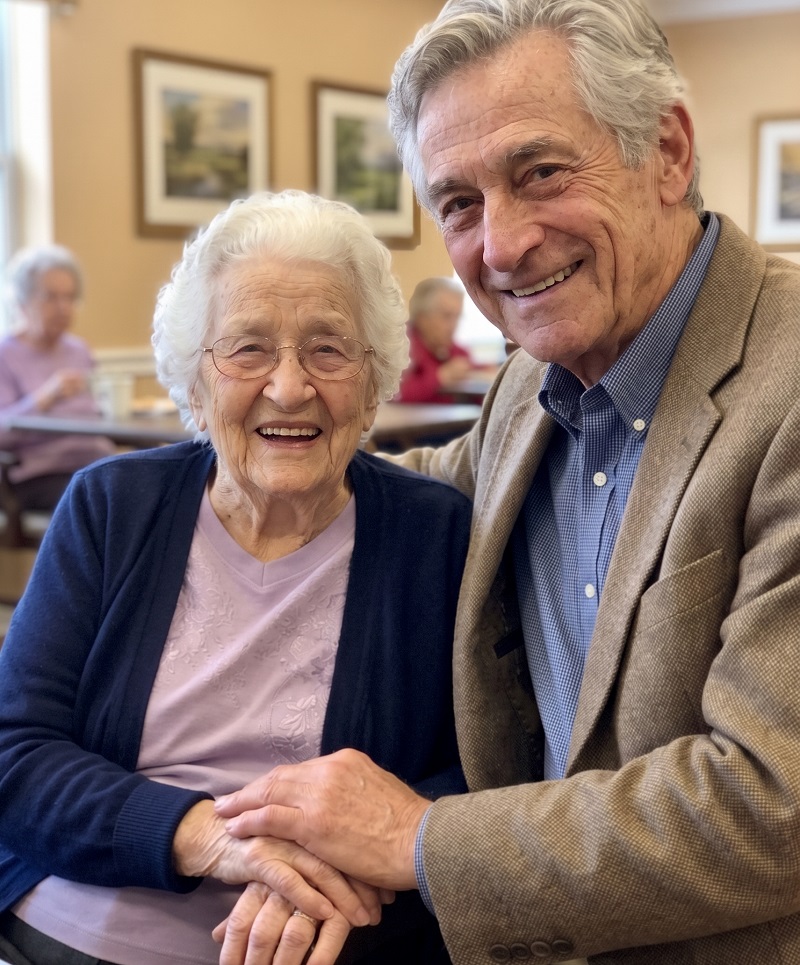
My grandmother had spent her entire life making other people feel remembered. Yet as her health began to fail, she admitted that the one thing she had always wanted was something no one could simply buy for her: the feeling of growing old beside someone who had chosen to stay.
I thought I had found a way to give her that gift before time ran out.
I never imagined the man I hired was not acting at all.
The Wish She Had Carried for a Lifetime
Rain had always belonged to Grandma Evelyn.
Whenever a storm rolled through Bellwood, she would sit on the porch with a quilt over her knees and listen to the drops strike the roof. She said rain made the whole town slow down long enough to notice itself.
That evening, the street shimmered beneath the porch light. Water gathered along the curb, and the air smelled of wet earth and the lavender soap Grandma had used for as long as I could remember.
“You always liked weather that gave you an excuse to stay home,” I teased.
She smiled without looking away from the rain. “Rain is the only weather polite enough not to demand anything from me.”
“You told generations of children it was perfect reading weather.”
“That was not an opinion. It was a professional conclusion.”
For more than forty years, Grandma had worked at Bellwood Library. She had remembered which mystery novels lonely widowers preferred, delivered large-print books to people who could no longer drive, and saved craft supplies for children whose parents could not afford them. Adults still stopped her in grocery store aisles to say she had once helped them find the book that made them love reading.
She had spent her life noticing everyone.
But that night, something about the way she stared into the rain made her seem unbearably alone.
I shifted closer. “Can I ask you something personal?”
“You may ask,” she said. “Whether I answer depends on how nosy you plan to be.”
I laughed, but my question remained lodged in my chest.
“Why did you never marry again after Grandpa?”
The warmth left her expression.
My grandfather had not been a kind husband. Grandma had been three months pregnant with my mother when she learned he was seeing someone else. She packed one suitcase, left the house, and never went back. She raised Mom on a librarian’s salary and refused every suggestion that she return to a man who had treated her as if she were replaceable.
I knew that history. What I did not know was whether it explained everything.
“Was he the only man you ever loved?” I asked.
Grandma’s fingers tightened around the edge of the quilt.
For several seconds, there was only the rain.
Then she said, “No.”
The Boy Who Returned the Same Books
His name was Henry.
Grandma had met him when she was eighteen and working at the library’s front desk after school. He came in every Saturday, checked out books he barely read, and returned them the following week with invented complaints about the plot.
“He was not interested in the books,” she told me, and a shy smile softened her face. “He was interested in the girl stamping the cards.”
Henry had a nervous habit. Before handing her a book, a deck of cards, or even a folded note, he tapped it three times against whatever surface was nearby.
Tap. Tap. Tap.
“I used to pretend it annoyed me,” Grandma said. “The truth was, I waited all week to hear it.”
They were young, certain, and foolish in the way only young people can afford to be. They talked about leaving Bellwood together after Henry found steady work. Grandma imagined a small home with shelves covering every wall. Henry said he wanted a porch where she could read during summer storms.
Then Grandma’s older sister, Ruth, told her she had seen Henry kissing another woman.
Ruth said Henry planned to leave town with that woman. She claimed he had laughed about Grandma’s devotion and called her naive.
“Did you confront him?” I asked.
Grandma lowered her eyes.
“No. I was eighteen, proud, and terrified of hearing him confirm it. I believed my sister because I could not imagine my own family lying to me.”
By the time Grandma gathered enough courage to demand an explanation, Henry had left Bellwood.
Three years later, she married the man who became my grandfather. That marriage ended in betrayal too, but by then she had a child to raise and no space left in her life for old dreams.
“So Henry really left with someone else?” I asked.
Grandma’s eyes filled with a sorrow that looked far older than the woman sitting beside me.
“No,” she whispered. “Ruth lied.”

A Confession That Arrived Decades Too Late
Before Ruth died, she confessed everything.
She had wanted Henry for herself. When he showed no interest in her, jealousy hardened into something cruel. She told Grandma that Henry had betrayed her, then told Henry that Grandma had chosen another man and wanted nothing more to do with him.
Two young people who loved each other had each walked away believing they had been rejected.
“When did Ruth tell you?” I asked.
Grandma hesitated.
“Twelve years ago.”
I turned toward her so quickly the quilt slipped from my knees.
“Twelve years? Grandma, why didn’t you look for him?”
She stared at the wet street.
“Because by then I had already wasted most of my life being angry at an innocent man. I did not know how to face that.”
“You could have called him.”
“And said what? ‘Hello, Henry. I am sorry I believed the worst of you for more than fifty years’?”
“Yes,” I said. “Exactly that.”
She gave me a faint, wounded smile.
“Some doors become heavier the longer they remain closed. Eventually, you convince yourself leaving them shut is kinder than discovering what is on the other side.”
I reached for her hand. “Do you regret it?”
The question seemed to break something inside her.
“I regret never knowing what it feels like to grow old beside someone who chose me,” she said. “I wanted someone to save me a seat at the movies. Someone to complain about my cold feet. Someone to say goodnight because he loved me, not because he was my child or grandchild and felt responsible for me.”
A tear slid down her cheek.
“But I am seventy-six now,” she added. “That kind of life belongs to another version of me.”
I did not tell her she was wrong.
At the time, I did not know how little time we had left.
When Time Became Something We Could Count
Three years later, Grandma moved into Maplewood Nursing Home.
Her heart had weakened. Her lungs were failing. Some days she could walk to the dining room with her oxygen tank. On other days, even speaking for too long left her exhausted.
She rarely complained. That made the truth harder to accept.
One afternoon, after I had helped her arrange a stack of library books beside her bed, a nurse followed me into the hallway.
“You should be here as much as you can,” she said gently.
I understood what she meant, but I forced her to say more.
“Are we talking about months?”
The nurse’s expression answered before her words did.
“It may be weeks. It could be less. Her condition is changing quickly.”
I nodded as if I could receive that sentence calmly.
Then I walked to my car, shut the door, and cried until the windows fogged.
That night, I thought about the rainy porch and the wish Grandma had confessed when she believed no one could grant it.
She had never wanted a grand wedding, jewelry, or dramatic promises. She wanted ordinary companionship. A hand reaching for hers in the dark. A chair saved beside someone. A familiar voice saying, “I am here.”
I could not find Henry. I did not even know whether he was alive.
And I could not walk into Maplewood and ask some kind elderly stranger to pretend he loved my dying grandmother.
The idea was impossible.
Then, because grief makes impossible ideas feel reasonable, I began searching online.
There were actors who performed personalized visits for birthdays, anniversaries, care homes, and family events. Some specialized in companionship roles for elderly clients. Most profiles felt too polished, too theatrical, or too young.
Then I found a man named Gerald.
The Actor From Bellwood
Gerald had silver hair, steady blue-gray eyes, and a smile that seemed gentle rather than rehearsed. His profile said he had spent decades in community theater and regional stage productions. He also offered reading visits, movie companionship, and conversation sessions for nursing home residents.
At the bottom of the page, one small detail caught my attention.
Born in Bellwood.
I sent him a message before I had time to lose my courage.
He called the next evening.
“Tell me what you have in mind,” he said.
His voice was warm but careful.
I explained that my grandmother was very ill. I told him how she had cared for other people all her life and how she had always wished she had grown old beside someone.
“Her name is Evelyn,” I said. “She worked at Bellwood Library.”
Something fell on his end of the line. I heard a sharp clatter, then silence.
“Gerald?”
“I am here,” he said, but his voice had changed.
I should have noticed.
Instead, I kept talking.
I told him about Henry, the young man Grandma had loved, and Ruth’s lie that had separated them.
Then Gerald asked, “Did Evelyn ever learn the truth?”
My throat tightened.
I remembered Grandma’s admission that Ruth had confessed twelve years earlier. I also remembered Grandma saying she had been too ashamed to search for Henry.
A fear took hold of me. If Gerald knew Grandma had discovered the truth and still remained silent, he might decide she had chosen loneliness. He might refuse the job. Worse, he might agree but treat her with the quiet judgment I was already directing at her.
So I lied.
“No,” I said. “She still believes Henry betrayed her.”
Gerald took a slow breath.
“And who would you like me to be?”
“No one specific at first. Just a widower who meets her at Maplewood. Read with her. Play cards. Watch old movies. Hold her hand, but only if she is comfortable. I do not want a performance that embarrasses her. I only want her to feel chosen for a little while.”
“Why did you choose me?”
“Because you are from Bellwood,” I answered. “I thought you might understand where she comes from.”
The silence that followed felt unusually long.
Then he said, “I understand more than you realize. I will come.”

The Woman Who Began Wearing Lipstick Again
Maplewood approved Gerald as a paid companion after completing the required screening.
He arrived two weeks later in a brown sport coat, carrying a mystery novel and a deck of cards.
He met Grandma at the bridge table.
That evening, he sent me a message.
“She corrected my strategy on the third hand. I believe that means she has accepted me.”
I laughed for the first time in days.
More messages followed.
“She says the detective in this novel is an idiot, but she refuses to stop reading.”
“We watched an old Cary Grant film. She pretended not to cry, then blamed her oxygen tube.”
“She fell asleep on my shoulder today. I did not move for forty minutes.”
Sometimes he sent photographs. Grandma sat beside him in the sunroom with a color in her cheeks I had not seen in months. In one picture, her hand rested only inches from his. In the next, their fingers were linked.
The nurses told me she had started asking what day Gerald would visit. She let them style her hair. She wore a soft pink blouse instead of the gray cardigan she had practically lived in. One afternoon, she even asked Mom to bring her lipstick.
“She has not worn that shade in twenty years,” Mom said when I showed her the picture.
I finally told her the truth about Gerald.
Mom did not share my excitement.
“You hired a stranger to romance my dying mother?”
“I hired him to keep her company.”
“Does she know he is being paid?”
“No.”
Mom’s expression hardened. “Then you are deceiving her.”
“I am giving her something life took from her.”
“You do not know that. You are deciding what she needs because you are afraid of losing her.”
Her words stung because they were true enough to frighten me.
Before she left, Mom said, “At least make sure you know who this man really is.”
I thought I did.
Then I met Marcus.
The Name Gerald Had Borrowed
Marcus visited his mother, who lived two rooms down from Grandma. I had passed him in the hallway many times, but we had never spoken.
One afternoon, he stopped me beside the vending machines.
“You are Evelyn’s granddaughter, right?”
“Yes.”
He glanced toward the sunroom, where Gerald and Grandma were reading together.
“That man with her. Does he call himself Gerald?”
Something in his tone made my stomach tighten.
“Why?”
Marcus studied my face as if deciding how much I knew.
“My father kept a photograph of him for years. Gerald was his stage name. His real name is Henry.”
For a moment, the hallway seemed to tilt.
Henry.
The nervous pause during our first call. The object falling when I said Grandma’s name. The strange weight in his voice when I mentioned Bellwood Library.
Every detail I had ignored suddenly arranged itself into the truth.
“That cannot be possible,” I said.
“My father, Samuel, grew up with Henry. They remained close after Henry left town.”
“Why would Henry answer an advertisement to pretend to care about Evelyn?”
Marcus looked toward the sunroom again.
“Maybe you should ask him why he answered at all.”
I found Gerald – Henry – sitting beside Grandma. She was asleep with her head tilted toward him while he read silently, one finger marking his place on the page.
“Can we speak outside?” I asked.
He took one look at my face and understood.
In the hallway, I folded my arms to keep my hands from shaking.
“Who are you?”
He did not pretend to misunderstand.
“You know now,” he said quietly.
“Marcus says your name is Henry.”
He closed his eyes.
“I was going to tell you.”
“When? After she died?”
Pain crossed his face.
“I did not know how to explain it without losing the chance to see her.”
“You let me hire you to pretend to fall in love with a woman you already loved.”
He looked through the glass at Grandma.
“I never pretended.”
The Chance He Had Waited a Lifetime to Receive
Henry admitted he had recognized Grandma’s name during our first phone call.
He had known from the moment I said Evelyn and Bellwood Library.
“You should have told me,” I said.
“Would you have let me come?” he asked.
I opened my mouth, then closed it.
I did not know.
Henry had used the name Gerald throughout his acting career. After leaving Bellwood, he had performed in small theaters, taught drama classes, and built a life far from the town that had broken his heart.
Samuel, Marcus’s father, had been his closest friend. Years after Henry left, Samuel learned that Ruth had lied. He told Henry what he had discovered, but by then Grandma was married and had a daughter.
“I believed contacting her would disturb the life she had chosen,” Henry said. “I thought staying away was the only decent thing I could do.”
“She left her husband years ago.”
“I did not know that until you called.”
His voice broke on the last word.
“I have regretted my silence every day. When you spoke her name, I thought perhaps life was offering me one final door. I was afraid honesty would close it before I could walk through.”
“Does she know who you are?”
“I do not think so.”
I wanted to believe him, but everything about the situation had become tangled in secrecy.
Before I could decide what to do, Grandma stirred in the sunroom. Henry turned immediately, as if even the smallest movement from her could pull him across any distance.
“Give me until tomorrow,” he pleaded. “Let me finish the book with her. Then I will tell her everything. No more stage name. No more pretending to be a stranger.”
“Tomorrow,” I said. “And this time, you tell her the whole truth.”
I walked away furious with him.
I did not yet understand that the most damaging lie in the room was still mine.

She Had Recognized Him Before Any of Us Knew
Maplewood called that night.
The nurse assured me Grandma was stable, but her breathing had worsened. She had asked for me. She had also requested that the staff call Gerald by another name.
My hand tightened around the phone.
“What name?”
“Henry.”
By the time I reached Maplewood, Henry and Marcus were waiting in the family lounge.
An old photograph lay on the table between them.
It showed Grandma at eighteen, standing on the library steps in a light summer dress. Beside her was a young man with Henry’s eyes and the same slight tilt to his smile. They were not touching, but every inch between them seemed alive with possibility.
“My father kept this,” Marcus explained. “He always hoped Henry would return for it.”
I turned to Henry. “What happened?”
“After you left, Evelyn asked me to finish another chapter,” he said. “When I sat beside her, she called me Henry.”
“She recognized you tonight?”
Henry shook his head.
“She said she had known since my third visit.”
“How?”
A sad smile appeared on his face.
“The cards. Before dealing, I tapped the deck against the table three times. She said no one else had ever done it exactly that way.”
Tap. Tap. Tap.
The habit she had remembered for nearly sixty years.
“Why did she stay silent?” I asked.
“She was waiting to see whether I would tell her myself.”
Before I could answer, the lounge door opened.
Grandma stood there with a nurse supporting her. An oxygen tube rested beneath her nose, and her face was pale with effort.
“Are the three of you planning my funeral without inviting me?” she asked.
I rushed toward her. “You should be in bed.”
“I have spent enough of my life waiting quietly in rooms while other people decided what I should know.”
Henry stepped forward.
“Evelyn.”
Her entire expression softened.
“Hello, Henry.”
The Look She Had Waited to See Again
Henry’s eyes filled.
“Why did you not say anything?”
Grandma let the nurse guide her into a chair.
“Because I wanted to know whether you still looked at me the way you used to.”
Henry swallowed. “And do I?”
She studied him with a tenderness that made the years between them feel suddenly fragile.
“Yes,” she said. “You do.”
He laughed once through his tears and lowered his head.
Grandma turned to me.
“You arranged this?”
The shame I had been holding rushed to the surface.
“I am sorry. I thought I was giving you the one thing you still wanted.”
She reached for my hand.
“You gave me courage,” she said. “You also created a terrible mess, but we can discuss that part later.”
Her forgiveness should have relieved me.
Instead, fear tightened around my chest.
There was still something Henry did not know. Something I had deliberately hidden because I wanted to control how this reunion would unfold.
Grandma turned back to him and took his hand.
“Ruth told me what she had done before she died,” she said.
Henry went completely still.
“What did you say?”
“She confessed that she lied to both of us.”
“When?”
Grandma looked down at their joined hands.
“Twelve years ago.”
The Truth I Had Tried to Keep From Him
Henry slowly pulled his hand away.
“Twelve years?”
His voice was not loud. That made it worse.
Grandma’s face crumpled.
“I knew you had never betrayed me,” she said.
Henry turned toward me.
“You told me she never learned the truth.”
I could barely meet his eyes.
“I was afraid you would not come if you knew.”
“You let me believe she had died a little every day thinking I was guilty.”
“I thought the truth would make you feel rejected.”
He looked at Grandma, and the grief in his expression was sharper than anger.
“I do feel rejected.”
Grandma flinched as if he had struck the air between them.
“Henry, please listen.”
“You knew for twelve years. Samuel knew where I was. You could have found me.”
“I was ashamed.”
“So was I,” he replied. “I still would have answered.”
Grandma’s eyes filled with tears.
“By the time I learned the truth, I had already married another man, raised a daughter, and become an old woman who had wasted decades resenting you. I could not bear the thought of asking you to forgive me for believing a lie I should have questioned.”
“You did not give me the chance to decide whether I could forgive you.”
The room fell silent.
For one terrible moment, I thought Henry would leave.
I stepped forward.
“This is my fault too. I lied because I wanted to arrange a beautiful ending. I thought if I could control what each of you knew, I could protect you from losing the little time you had left.”
Grandma looked at me sadly.
“There was almost no time left because all of us were so busy protecting ourselves.”
Then she turned to Henry and held out her hand again.
“I cannot return the years we lost.”
He stared at her hand.
“No,” he said. “You cannot.”
Her fingers trembled in the space between them.
“But I can give you every hour I still have.”

The Hand He Chose to Take
Henry remained motionless for several seconds.
Then he knelt in front of her and placed his hand in hers.
“Do you still like Cary Grant movies?” he asked.
Grandma blinked through her tears. “They are still better than any play you ever performed in.”
Marcus laughed softly.
Henry looked up at her, and for the first time I understood what she meant about being seen by someone who had known you before life taught you to hide.
“There is the Evelyn I remember,” he said.
Mom arrived the next morning.
She stopped in the doorway when she saw Henry sitting beside Grandma’s bed.
“So you are Henry.”
He stood. “And you must be Evelyn’s daughter.”
Mom studied him for a long moment.
“She mentioned you once when I was a child,” she said. “My father had already been gone for years. I asked whether she had ever known a good man.”
Grandma groaned. “There is no need to continue this story.”
Mom smiled. “She said she had known one, but she had been too foolish to keep him.”
Henry looked at Grandma. “You said that?”
“I may have had a fever.”
The tension in the room loosened. Even Henry laughed.
There was no magical repair. Twelve years of silence did not disappear because he took her hand. Neither did the decades that Ruth’s lie had stolen.
But forgiveness began, not as a single grand gesture, but as a series of small choices.
Henry stayed.
Four Days That Belonged to Them
For the next four days, Henry hardly left Grandma’s side.
They watched old films and argued about the endings. He finished the mystery novel he had brought on his first visit. Grandma declared the conclusion ridiculous, so Henry invented a new one in which the librarian solved the case while the detective took credit.
“That is much more believable,” she said.
They played cards, and Henry continued tapping the deck three times before every deal. Sometimes Grandma placed her fingers over his after the third tap, as if reassuring herself that the sound was real.
He told her about the stages he had performed on, the towns he had lived in, and the students he had taught. She told him about library children who had grown into parents and grandparents. They compared the lives they had lived apart without pretending those lives did not matter.
There were painful moments too.
Once, I heard Grandma whisper, “I am sorry,” after Henry believed she was asleep.
He answered, “I know.”
Another time, he stood alone in the hallway, crying silently into his hands. I wanted to apologize again, but something told me grief that old could not be helped by another sentence.
So I sat beside him without speaking.
On Grandma’s final evening, rain tapped gently against the window.
Henry sat beside her bed, holding her hand beneath the blanket.
“Do you remember the library porch?” he asked.
Her eyes remained closed, but she smiled.
“I remember you checking out the same book six Saturdays in a row.”
“I was a slow reader.”
“You never made it past chapter two.”
“The librarian kept distracting me.”
Grandma’s smile deepened.
Mom sat on one side of the bed. I sat at the foot. Henry never released Grandma’s hand.
Shortly before sunrise, her breathing grew quiet and then stopped.
The rain continued for several minutes after she was gone.
Two Flowers and One Final Lesson
At the funeral, Henry found me beneath the trees and placed two pressed flowers in my palm.
One was fresh from his garden, flattened carefully between sheets of paper.
The other was faded almost white with age.
“That one was hidden behind the photograph Marcus returned to me,” he explained. “Evelyn gave it to me when she was eighteen. I think it belongs with her now.”
I placed both flowers on Grandma’s casket – one from the life they had shared when they were young, and one from the few days they had been given at the end.
After the service, Henry stood alone near the edge of the cemetery.
I walked to him.
“I am sorry I lied to you,” I said.
He nodded. “I am sorry I lied to you too.”
“Do you wish I had never contacted you?”
He looked toward Grandma’s grave for a long time.
“No,” he said at last. “I only wish all of us had been brave before time forced bravery upon us.”
Rain began to fall as we walked back toward the others.
Henry offered me his arm, and I took it.
I had wanted to give Grandma a beautiful ending, as if one tender chapter could repair every page that came before it.
It could not.
An ending cannot return stolen years. It cannot erase fear, pride, or silence. It cannot transform every regret into peace.
But sometimes an ending can still tell the truth.
Grandma had spent most of her life believing that closed doors were safer than painful answers. Henry had mistaken silence for sacrifice. I had confused love with control.
In the end, none of us were saved by a perfect plan.
We were saved, for a few precious days, by finally saying what should have been said decades earlier.
And whenever it rains, I remember the sound of Henry tapping those cards against the table.
Tap. Tap. Tap.
Not a reminder of what they lost.
A reminder not to leave love waiting outside a closed door.
Note: This story is a work of fiction inspired by real events. Names, characters, and details have been altered. Any resemblance is coincidental. The author and publisher disclaim accuracy, liability, and responsibility for interpretations or reliance. All images are for illustration purposes only.