Part 1: The Dinner We Had Been Waiting For
All I wanted was one quiet evening with my family.
No doctor’s appointments. No equipment checks. No carefully planned routes through unfamiliar buildings. No worrying about whether a doorway would be wide enough or whether the nearest restroom would actually be accessible.
Just dinner.
My husband, Ben, and I had taken our nine-year-old son, Liam, on a short vacation, and that evening was supposed to be the highlight of the trip. We had reserved a table at the hotel restaurant, promised Liam chocolate cake, and agreed that no one was allowed to discuss schedules until morning.
For the first few minutes, everything felt wonderfully ordinary.
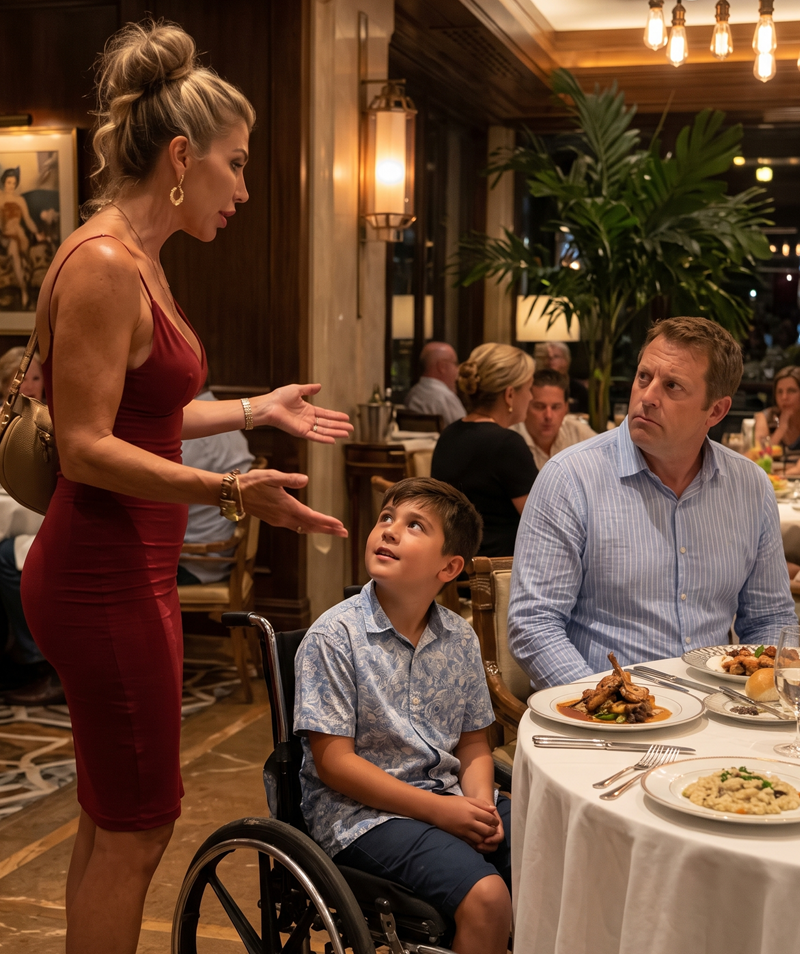
Then a woman from the next table walked over, pointed at Liam’s wheelchair, and said words I would never forget.
“Move him somewhere else. That chair is ruining everyone’s meal.”
The dining room became so quiet that I could hear the faint clink of silverware from the kitchen.
Liam had been halfway through telling us a joke about a fish ordering dessert. His mouth closed. His fingers tightened around his fork, and his eyes dropped toward his plate.
Beside me, Ben shoved his chair backward.
I reached beneath the table and caught his wrist.
Not because I intended to excuse the woman.
Not because I was afraid of making a scene.
I stopped him because I wanted every person in that restaurant to hear exactly what happened next.
Three hours earlier, Liam had challenged us to a race to the elevator.
He always called it racing, although only one of us had wheels.
Ben called it “moving at an unsafe speed near expensive hotel furniture.”
Liam pushed himself quickly down the carpeted hallway and glanced over his shoulder.
“Dad, I know you love me.”
Ben narrowed his eyes. “There’s definitely a ‘but’ coming.”
“But if you grab the back of my chair one more time, I’m charging you.”
“Charging me for what?”
“Transportation services.”
I laughed. “He only accepts cash, dessert, and unrestricted access to the television remote.”
Ben raised both hands in surrender. “Fine. I’m not touching the chair.”
“Good,” Liam said, pushing faster. “Experienced driver coming through.”
The elevator doors began sliding closed just as he reached them.
Ben instinctively lunged forward.
But before he could grab the chair, Liam stretched out his hand, struck the button, and made the doors open again.
He looked back at us with a proud smile.
“Told you.”
Ben smiled too, but I noticed the fear beneath it.
Five years earlier, a car accident had changed the rhythm of our family. Liam had only been four years old. From that day forward, leaving home required more planning than most people ever realized.
We checked ramps, elevators, parking spaces, door widths, bathroom layouts, and the distance between tables. We always carried backup supplies, emergency contact numbers, and a second plan in case the first one failed.
Ben checked everything twice.
And I usually checked on Ben.
Inside the elevator, I leaned closer to him.
“He handled the doors.”
“I know.”
“But you still reached for him.”
Ben stared at the floor numbers lighting up above us.
“I still hear the accident sometimes,” he whispered. “Especially when something happens quickly.”
His admission silenced me.
Liam turned away from the button panel.
“You know I can hear both of you, right?”
Ben rubbed the back of his neck. “I’m trying, buddy. But I’m allowed to get scared too.”
“I know,” Liam said. “But I’m hungry now, so there’s no room left for scary thoughts.”
I smiled and rested my hand on Ben’s arm.
“He needs space to learn what he can do,” I said gently.
Ben nodded. “I know.”
This time, the words sounded less like a defense and more like a promise.
When we reached the restaurant, the manager, Jeff, greeted us warmly. Before Liam needed to ask, Jeff removed an extra chair from the table and checked the space behind him.
“Does this give you enough room?”
Liam rolled forward, turned once, and backed neatly into position.
“Perfect.”
“Let me know if your family needs anything.”
“We need dessert,” Liam replied immediately.
Jeff glanced at me.
“He needs dinner first,” I corrected.
Liam opened the menu and flipped directly to the final page.
“I’m simply planning ahead.”
“You’re planning your entire evening around chocolate cake.”
“That still counts as planning.”
Ben pointed toward the dinner section. “You need to save room for ice cream.”
“I have a separate stomach for ice cream.”
For almost ten minutes, we were simply a family enjoying a vacation.
Liam told terrible jokes. Ben pretended not to laugh. I watched them both and allowed myself to relax.
For those few precious minutes, no one stared.
No one whispered.
No one treated Liam like a problem that needed to be solved.
Then he adjusted his position.
One wheel lightly touched an empty chair behind him. The chair shifted no more than an inch.
“Oh, sorry,” Liam said immediately, turning around. “I didn’t see that.”
The woman at the next table grabbed the empty chair and dragged it closer to herself.
“You need to be more careful.”
“I said I was sorry,” Liam replied.
“Then pay attention to where you’re going.”
Ben slowly placed his fork on the table.
“He barely touched an empty chair.”
I covered his hand with mine before he could rise.
“Liam has already handled it.”
The woman turned toward me. Her hair was pinned neatly behind her head, and a small gift bag rested beside two empty settings at her table.
“He shouldn’t be blocking the walkway.”
I looked behind Liam. There was plenty of room. Two servers could have passed each other without touching his chair.
“He isn’t blocking anything.”
Her expression tightened.
A waitress walked by, and the woman reached out to stop her.
“Can something be done about this arrangement?”
The waitress carefully inspected the aisle.
“The table has enough clearance, ma’am.”
“So you’re leaving it this way?”
“Yes, ma’am.”
The waitress continued toward the kitchen.
Ben leaned closer to me.
“She just asked the staff to move us.”
“I heard her.”
“Why aren’t you saying anything? Do you want me to?”
“Liam already apologized, and the waitress confirmed that the aisle is clear. We don’t have to fight every person who chooses to be unpleasant.”
Across the table, Liam picked up his fork.
“Can I finish my joke now?”
I smiled. “Please do. We’ve already suffered through the first half.”
He took a breath.
“So, the fish says to the waiter—”
The woman’s chair scraped loudly against the floor.
Liam stopped speaking.
She stood, crossed the short distance between our tables, and pointed directly at his wheelchair.
“Move him somewhere else,” she demanded. “It’s ruining everyone’s meal.”
That was when the room fell silent.
And that was when our peaceful family dinner became something none of us would ever forget.

Part 2: The Words That Made My Son Disappear
For a second, I wondered whether I had heard her correctly.
Perhaps I had misunderstood.
Perhaps she had said the chair was blocking the aisle.
Perhaps she had complained about the table arrangement.
But then I saw Liam’s face.
He had folded inward as though he were trying to make himself smaller. His shoulders curved. His eyes remained fixed on his plate.
The laughter that had filled his face only moments earlier was gone.
I looked directly at the woman.
“Say that again.”
She blinked. “His chair takes up too much room. People are trying to eat.”
“No,” I said. “Repeat the part where you claimed my son was ruining everyone’s dinner.”
Her eyes shifted toward the people watching from nearby tables.
“No one wants that thing sitting in the middle of the room.”
That thing.
She wasn’t only insulting the wheelchair.
She was erasing the child sitting in it.
Liam’s voice was barely more than a whisper.
“It’s okay, Mom. We can finish upstairs.”
Something inside me broke at the sound of those words.
He wasn’t offering to leave because he wanted privacy.
He was offering because a stranger had convinced him that disappearing would make everyone else more comfortable.
I moved beside him and lowered myself until we were eye to eye.
“Look at me.”
He continued staring at his plate.
“Liam.”
Slowly, he raised his eyes.
“Did you do anything wrong?”
“I bumped the chair.”
“And what did you do afterward?”
“I apologized.”
“Did anyone get hurt?”
“No.”
“Did the waitress say you were blocking the aisle?”
“No.”
“Then you are not leaving this table.”
His lower lip trembled, but he nodded.
I stood and took my phone from my bag.
The woman folded her arms.
“What do you think you’re doing?”
“I’m writing down exactly what you said.”
“For what purpose?”
“So that when the manager arrives, you can’t pretend this conversation happened differently.”
She gave a humorless laugh.
“You’re turning one tiny accident into a courtroom.”
“No,” I replied. “I’m making sure you don’t turn yourself into the victim.”
Ben rose beside me.
“You’ve said enough,” he told her. “Step away from our son.”
His voice was controlled, but his hands were shaking.
Liam noticed immediately.
“Dad.”
That single word stopped Ben.
It was not loud. It did not need to be.
Ben looked down at him, took a breath, and slowly sat.
I touched his shoulder.
“Stay with Liam.”
Ben moved his chair closer to our son.
I remained standing.
A few seconds later, Jeff hurried into the dining room with the waitress following behind him.
“What’s going on?” he asked.
Then he noticed the woman.
“Cindy. It’s good to see you.”
The familiarity in his greeting made her lift her chin.
She pointed at us before Jeff had even reached the table.
“This family has been disrupting the entire restaurant. The boy nearly ran into me, and his mother began threatening me.”
“I never threatened you,” I said. “I documented your words.”
Jeff looked toward Liam.
“Was anyone injured?”
“No,” the waitress answered. “His wheel brushed an empty chair. He apologized immediately.”
Cindy turned sharply.
“You weren’t part of our conversation.”
“I saw what happened,” the waitress said calmly.
Jeff studied the space behind Liam’s chair.
“I could move your family to another table while I address the situation,” he offered.
“We’re not moving.”
“It might give your son more privacy.”
“Liam didn’t request privacy. He wanted to finish his dinner.”
Jeff looked at him.
Liam swallowed and sat a little straighter.
“I want to stay here.”
Jeff nodded.
“Then you will.”
He turned to Cindy.
“Please return to your table.”
“Wait,” I said.
Cindy’s expression softened, as though she believed I had reconsidered.
I stepped into the aisle and faced the diners around us.
“She told my son that his wheelchair was ruining everyone’s meal. She also claimed she was speaking for the entire room.”
“I never said everyone agreed with me,” Cindy protested.
“You said no one wanted his chair here.”
Several diners shifted in their seats.
I looked around the restaurant.
“Has my son prevented anyone from walking through the aisle?”
A woman seated near the window shook her head.
“Not at all.”
An older gentleman raised one hand.
“I’ve watched at least two servers pass behind him without difficulty.”
Another diner spoke from a table closer to the entrance.
“The boy hasn’t bothered anyone.”
Cindy’s cheeks reddened.
“This is humiliating.”
I kept my voice steady.
“You approached a nine-year-old child and told him his presence was spoiling dinner. You weren’t embarrassed when he was the only one being humiliated. You became embarrassed when everyone heard what you had done.”
Jeff turned toward the waitress.
“Did she complain before approaching the family?”
“Yes. She asked me to move them. I checked the aisle and explained that the spacing was fine.”
Cindy glared at her.
“You never told me that.”
“I did, ma’am.”
I looked back at Cindy.
“So what is the real problem?”
Her mouth opened, but no words came out.
And then two people entered the dining room.
A young man held a small envelope. Beside him, a woman carried a white cake box.
They approached Cindy’s table with cheerful expressions that quickly faded when they noticed the silence surrounding us.
“Mom?” the young man asked. “What happened?”
Cindy’s face changed instantly.
“This family attacked me.”
For the first time since the confrontation began, Liam lifted his head.
“I touched an empty chair,” he said. “Then I said I was sorry.”

Part 3: The Celebration That Ended Before It Began
Cindy’s son looked from Liam to his mother.
Before Cindy could interrupt, Jeff stepped between them.
“Your mother approached this family’s table,” he explained. “She told this child that his wheelchair was ruining everyone’s meal.”
The young man’s face lost its color.
“You said that to him?”
Cindy’s posture stiffened.
“You weren’t here. His chair was blocking the entire walkway.”
“No, it wasn’t,” the waitress said.
Liam’s voice came out quietly.
“I apologized.”
The young man looked at him, then back at Cindy.
“So after he apologized for touching an empty chair, you still told him people couldn’t enjoy dinner because of his wheelchair?”
“That isn’t what I meant.”
“It is what you said,” I replied.
The young woman standing beside him lowered the cake box onto the table.
Cindy glanced at the diners around us.
“None of you have the right to judge me. You didn’t see how this started.”
Her son drew a slow breath.
“Mom, I work every day with people recovering from serious injuries. I help them relearn how to stand, walk, balance, and live independently.”
Cindy’s face hardened.
“Do not lecture me in front of strangers.”
“Then you shouldn’t have humiliated a child in front of strangers.”
The woman beside him stepped closer to Liam.
She did not grab his wheelchair.
She did not touch his shoulder.
She did not crouch dramatically or speak to him in the exaggerated voice adults sometimes used when they assumed he needed to be treated differently.
She simply looked at him.
“Are you all right?”
Liam stared at the food on his plate.
“I was before.”
Those three words struck the room harder than any angry speech could have.
Even Cindy looked away.
Her table had been prepared for three people. The gift bag remained beside her chair. The envelope in her son’s hand was decorated with a small gold ribbon.
“We came here to celebrate your engagement,” Cindy said. “Are you honestly going to destroy the evening because of one misunderstanding?”
Her son looked at the envelope, then at his fiancée.
“You didn’t misunderstand anything.”
“You’re going to choose strangers over your own mother?”
“I’m choosing not to pretend what you did was acceptable.”
He handed the envelope to his fiancée.
“We’ll celebrate another evening.”
Cindy stared at him.
“You can’t be serious.”
“I am.”
Her expression shifted from anger to disbelief.
Then she turned toward me.
“I’m sorry if your son became upset.”
“No.”
The word escaped me before she finished.
Her eyebrows lifted.
“That is not an apology,” I said. “You don’t apologize for how he reacted. You apologize for what you chose to say.”
Cindy looked toward her son, silently asking him to rescue her.
He did not move.
At last, she faced Liam.
Her voice was quieter now.
“I’m sorry I said your wheelchair was ruining dinner. It wasn’t. What I said was cruel.”
Liam studied her for several seconds.
“Okay.”
He did not smile.
He did not tell her everything was fine.
He did not offer the instant forgiveness adults often expect from children because it makes the adults feel better.
I did not ask him to.
An apology belonged to the person who caused the harm.
Forgiveness belonged to Liam, and he had the right to give it—or not give it—when he was ready.
Jeff stepped forward.
“Thank you for apologizing,” he told Cindy. “But you still need to leave.”
She stared at him.
“You’re removing me after I apologized?”
“An apology acknowledges the damage,” Jeff replied. “It doesn’t erase the consequences.”
Cindy grabbed her purse from the back of her chair.
For a moment, she waited for her son to follow.
He remained beside his fiancée.
Cindy looked around the room one final time, then walked toward the exit alone.
No one applauded.
I was grateful for that.
Liam’s pain was not entertainment. It was not a dramatic scene created for strangers to enjoy. It was a real wound inflicted on a real child.
Turning it into a performance would only have made him feel more exposed.
After Cindy left, her son approached our table.
“I’m sorry,” he said.
“You weren’t the one who said it.”
“No, but I’ve heard her make smaller comments before. I kept telling myself they were harmless. The truth is, confronting her was uncomfortable, so I ignored them.”
I glanced toward the door through which she had disappeared.
“Ignoring cruelty doesn’t keep it small.”
He lowered his head.
“I understand that now.”
His fiancée lifted the cake box.
“We ordered chocolate cake for tonight,” she said. “Would Liam like a piece?”
Liam finally looked interested.
“What kind of frosting?”
“Chocolate.”
“Chocolate cake with chocolate frosting?”
“Yes.”
He considered this seriously.
“Acceptable.”
Ben laughed.
The sound startled Liam, and for a second, I worried he might withdraw again.
Instead, a small smile appeared on his face.
Then he laughed too.
Jeff brought extra plates. The waitress returned with clean forks. Cindy’s son and his fiancée sat at a nearby table rather than crowding Liam or forcing a conversation.
The fish joke was never finished.
But the chocolate cake helped.
Later that evening, when we returned to our room, Liam was unusually quiet.
Ben opened the curtains while I helped clear some space near the bed.
Liam rolled toward the window and looked at the lights below.
“Mom?”
“Yes?”
“Was she mad because of the chair or because of me?”
The question hurt more than anything Cindy had said.
I sat on the edge of the bed.
“She was angry because she saw something unfamiliar and decided her comfort mattered more than another person’s dignity.”
“That doesn’t answer the question.”
He had always been good at noticing when adults tried to soften the truth.
I took a breath.
“She spoke about your wheelchair, but she made you feel like you were the problem. That was wrong.”
He traced one finger along the wheel rim.
“Sometimes people look at the chair before they look at me.”
“I know.”
“Sometimes they talk to you instead of me.”
“I know.”
“And Dad still tries to push me when I don’t need help.”
From across the room, Ben turned around.
“I’m working on that.”
Liam nodded.
“I know.”
Ben came closer and sat on the floor in front of him.
“I don’t grab your chair because I think you can’t do things,” he said. “I do it because part of me is still terrified that something could happen to you.”
“But when you grab it without asking, it feels like you don’t trust me.”
Ben’s eyes filled with regret.
“You’re right.”
Liam glanced toward me.
“Was I brave tonight?”
I shook my head gently.
“You shouldn’t have needed to be brave. You were eating dinner.”
He thought about that.
“Then why did everyone keep telling me I was brave?”
“Because adults sometimes use that word when they don’t know what else to say.”
“Were you brave?”
“No,” I admitted. “I was angry.”
That made him smile.
“Very angry?”
“Extremely.”
“Like when Dad put your red sweater in the dryer?”
Ben raised a hand. “That was an accident.”
“The sweater was never the same,” I said.
Liam laughed again, and the tension in the room finally began to ease.
But before he went to sleep, he asked one more question.
“Do we have to eat somewhere else tomorrow?”
I looked at him.
“Do you want to?”
He hesitated.
“No.”
“Then we’re going back.”

Part 4: The Seat He Chose for Himself
The next morning, Liam woke before both of us.
By the time Ben and I were ready, he was already waiting near the door.
“Breakfast?” I asked.
“Pancakes,” he replied.
Ben reached toward the wheelchair handles, then stopped.
“Would you like help?”
Liam glanced back at him.
“No, thank you.”
Ben placed both hands in his pockets.
“All right.”
We rode the elevator downstairs.
The closer we came to the dining room, the quieter Liam became.
He kept one hand on the wheel rim, turning it slightly back and forth.
“We could eat outside,” Ben offered. “The patio looked nice.”
Liam shook his head.
“I want the dining room.”
The restaurant was brighter in the morning. Sunlight spilled through the large windows and stretched across the floor.
Liam entered first.
Jeff saw us immediately.
“Good morning.”
He walked toward the same table we had occupied the night before and removed one of the chairs.
Then he paused.
“Is that enough space?”
Liam examined the aisle, rolled forward, and made one smooth turn.
“Perfect.”
There was something powerful about watching him choose the same place Cindy had tried to take away from him.
He was not making a statement for the room.
He was not trying to prove a point.
He simply wanted pancakes.
Sometimes dignity looks exactly like that: a child returning to a table because he never should have been driven from it in the first place.
We had just ordered when Cindy’s son and his fiancée entered the restaurant.
They stopped when they saw us.
The fiancée approached carefully.
“Would it be all right if we joined you?”
I looked at Liam.
“Your decision.”
He studied the two empty chairs.
“Sure.”
It mattered that I allowed him to decide.
After what had happened the night before, I could have taken control of every conversation. I could have tried to arrange the perfect ending, accepted apologies for him, or decided which people deserved access to his space.
But protecting Liam did not mean speaking over him.
Sometimes it meant stepping back and letting him choose.
Over pancakes, Cindy’s son introduced himself as Aaron. His fiancée was Natalie.
Aaron apologized directly to Liam.
“What my mother said was wrong. You should never have needed an entire restaurant to confirm that you belonged there.”
Liam cut a piece from his pancake.
“I already knew I belonged.”
Aaron waited.
Liam poured a little more syrup onto his plate.
“I just forgot for a minute.”
My throat tightened.
Aaron nodded slowly.
“That makes sense.”
Natalie smiled.
“For what it’s worth, I’m glad you came back.”
“I wanted pancakes.”
“That’s the best reason.”
The conversation became easier after that.
Aaron told us he worked as a physical therapist. Natalie taught music at an elementary school. They had become engaged two weeks earlier and had planned to give Cindy a framed photograph and a card during dinner.
Aaron admitted that the celebration had been his idea.
“I kept hoping that if the evening felt special enough, my mother would be in a good mood.”
“You were managing her behavior before she even arrived,” I said.
He looked down at his coffee.
“I suppose I was.”
Natalie rested a hand near his, allowing him to decide whether to take it.
He did.
“My mother can be judgmental,” Aaron continued. “But I’ve always told myself she was simply outspoken.”
“Outspoken people accept responsibility for their words,” Ben said. “Cruel people expect everyone else to tolerate them.”
Aaron nodded.
“I’ve spent years confusing honesty with disrespect.”
Liam looked at him.
“Is she always like that?”
Aaron hesitated.
“Not always.”
Liam raised an eyebrow.
Aaron corrected himself.
“Often enough.”
“Then maybe she needs more people to tell her no.”
Natalie covered a smile with her coffee cup.
Aaron laughed softly.
“You may be right.”
After breakfast, Aaron pointed toward a few game tables near the patio doors.
“We were going to play cards,” he said. “Do you think you could beat us?”
Ben opened his mouth.
I held up one finger without looking at him.
He closed it again.
“Liam?” I asked.
Our son considered the invitation.
“Probably.”
Aaron grinned.
“That confident?”
Liam shrugged.
“Vacation rules.”
The card game lasted almost an hour.
Liam won twice, lost once, and accused Ben of making suspicious decisions.
“I was helping you,” Ben protested.
“That’s what suspicious people always say.”
At one point, a waiter approached from behind Liam carrying a tray.
Ben’s hand lifted instinctively toward the wheelchair handles.
Then he stopped.
The waiter passed without difficulty.
Liam glanced back.
“You’re learning.”
“Slowly,” Ben admitted.
“Very slowly.”
“I’m doing my best.”
Liam smiled.
“I know.”
Watching them, I realized that Cindy’s words had exposed more than her own prejudice.
They had forced all of us to examine the ways we treated Liam.
Cindy wanted him removed because his wheelchair made her uncomfortable.
Ben sometimes grabbed the chair because his fear made him uncomfortable.
I occasionally answered questions for Liam because silence made me uncomfortable.
The intentions were different, but the lesson was important.
Liam’s chair was not public property.
His choices were not ours to make simply because we loved him.
Real support meant asking before helping.
Real respect meant listening to his answer.

Part 5: Every Inch of the Room
That afternoon, we walked—or, as Liam preferred to say, traveled—to a small park near the hotel.
He raced Ben along the paved path and won because Ben stopped to tie his shoe.
“You cheated,” Ben complained.
“I didn’t touch your shoelaces.”
“You distracted me.”
“Winning is about strategy.”
We bought ice cream from a cart and sat near a pond.
For a while, no one mentioned Cindy.
Then Liam looked at me.
“Do you think she meant her apology?”
“I think she understood that her words had consequences.”
“That’s not what I asked.”
I smiled faintly.
“I don’t know whether she meant it yet.”
“Can people apologize before they’re sorry?”
“Yes.”
“That seems pointless.”
“Sometimes saying the words is only the first step. The real apology is what they do afterward.”
He licked a drop of chocolate ice cream before it reached his hand.
“What happens if she never changes?”
“Then the people around her will have to decide what they are willing to accept.”
“Like Aaron did?”
“Exactly.”
Liam became thoughtful.
“I’m glad he stayed.”
“So am I.”
“But I’m also glad he didn’t make me tell her it was okay.”
I looked at him.
“You never have to make someone else comfortable by pretending they didn’t hurt you.”
He nodded.
“Good.”
That evening, while packing our bags, Ben found the hotel notepad on the desk.
Liam had written something across the top in large uneven letters.
I BELONG WHERE I CHOOSE TO BE.
Ben read it silently.
“Did you write this?”
Liam continued folding a T-shirt.
“Yes.”
Ben glanced at me.
Neither of us said anything for a moment.
Then Ben placed the note carefully inside the front pocket of Liam’s backpack.
The next morning, as we prepared to leave, we passed the restaurant one final time.
Jeff stood near the entrance.
“Safe travels,” he said.
“Thanks for the cake,” Liam replied.
Jeff smiled. “You earned that cake.”
Liam shook his head.
“No, I didn’t.”
Jeff looked surprised.
Liam adjusted his hands on the wheels.
“I didn’t have to earn it. Natalie gave it to me.”
Jeff’s expression softened.
“You’re right.”
We continued toward the lobby.
Near the elevator, Ben reached for the wheelchair handles again.
His fingers hovered for a moment.
Then he lowered his hand.
“Would you like help with the elevator?”
Liam looked at the closing doors ahead of us.
“No. I’ve got it.”
He pushed faster.
Ben tensed but remained where he was.
Liam reached the button just before the doors closed and opened them again.
He turned around with the same proud expression he had worn on our first evening.
“See?”
Ben laughed.
“I see.”
As the elevator descended, I thought about how easily people misunderstand the role of a parent.
Some believe our responsibility is to clear every obstacle before our children encounter it.
Others believe we must fight every battle on their behalf.
But Liam did not need me to remove every difficult person from the world. That was impossible.
He needed to know that when someone tried to make him feel smaller, I would remind him who he was.
He needed a father willing to confront his own fear.
He needed adults who asked before touching his chair.
He needed room to speak, room to choose, room to make mistakes, and room to decide when he wanted help.
The night before, Cindy had tried to determine where my son was allowed to sit.
She had looked at his wheelchair and seen an inconvenience.
She had treated his presence like something the room should tolerate rather than something that naturally belonged there.
But the following morning, Liam entered that same dining room before any of us.
He selected his own table.
He invited the people he wanted beside him.
He ate pancakes, played cards, told jokes, and took up exactly as much space as he needed.
And no one had the right to ask him to become smaller.
That was the lesson I carried home with me.
My job was not to push Liam through every doorway.
My job was to make sure no one convinced him that the doorway was not meant for him.
I would stand beside him when he needed me.
I would speak when someone tried to silence him.
I would step back when he was ready to speak for himself.
And while he claimed every inch of the world that belonged to him, I would be there—not in front of him, not behind him, but beside him.
Note: This story is a work of fiction inspired by real events. Names, characters, and details have been altered. Any resemblance is coincidental. The author and publisher disclaim accuracy, liability, and responsibility for interpretations or reliance. All images are for illustration purposes only.