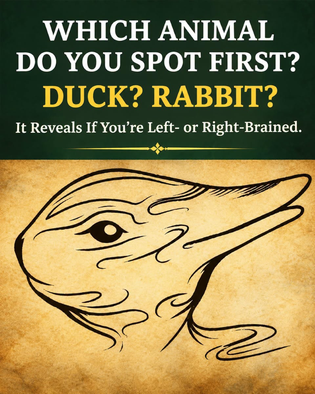
At first glance, this classic optical illusion seems like a simple visual puzzle. Look at the image, and you may immediately see a duck. Look again, and suddenly the same drawing appears to be a rabbit.
But what does seeing one animal before the other actually mean?
Despite popular claims that these optical illusions can reveal your intelligence, personality, creativity, or financial decision-making abilities, psychology offers a more fascinating explanation. The illusion demonstrates how the human brain actively interprets visual information rather than simply recording what the eyes see.
Why Some People See a Duck First and Others See a Rabbit
The famous duck-rabbit illusion is an example of an ambiguous image. Its visual features can be interpreted in two different ways, depending on how the brain organizes the shapes and lines.
When you first look at the drawing, your brain quickly settles on one interpretation. The same lines that form the duck’s bill can also be interpreted as the rabbit’s ears.
Neither interpretation is inherently correct or incorrect. Both are supported by the image.
What changes is the way your brain organizes the information it receives.
Your Brain Doesn’t Simply Record What Your Eyes See
Human perception is not like a camera taking a photograph.
Instead, the brain actively processes visual information, using context, expectations, attention, and previous experiences to help interpret the world.
When you look at an ambiguous drawing, your brain attempts to make sense of the available information. It may initially favor one interpretation, but that perception can change when you shift your attention or become aware of the alternative.
This is why someone who sees a duck first may struggle to recognize the rabbit until another person points it out.
Once the second interpretation becomes apparent, it may become much easier to switch between the two.
What Is Perceptual Flexibility?
One of the most interesting aspects of the duck-rabbit illusion is the ability to switch between its two interpretations.
This is sometimes discussed in relation to perceptual flexibility, the ability to recognize or experience different interpretations of the same visual information.
You can focus on the features that make the image look like a duck, then shift your attention to the features that make it resemble a rabbit.
The drawing itself doesn’t change.
Only your interpretation changes.
This demonstrates how attention can influence what we consciously perceive, even when the visual information remains exactly the same.
Does Seeing a Duck or Rabbit First Reveal Your IQ?
No reliable scientific evidence establishes that seeing a duck first or a rabbit first determines your intelligence, personality, creativity, wealth, or ability to make financial decisions.
These claims are often circulated alongside optical illusions on social media, but they should not be treated as scientifically validated personality tests.
The illusion is better understood as an example of how the human visual system processes ambiguous information.
The order in which you recognize the animals may depend on a variety of factors, including attention, expectations, context, and individual differences in how people interpret visual patterns.
Seeing one animal first is not a measure of superiority or intelligence.
Why This Simple Illusion Is So Fascinating
The duck-rabbit image has fascinated psychologists and philosophers for generations because it illustrates an important feature of human perception: the same visual information can support different experiences.
Once you recognize both animals, you can often switch between interpretations simply by changing what you focus on.
Research on ambiguous figures has explored how attention and cognitive processes influence the way people perceive these images, demonstrating that perception can be more flexible than it initially seems.
The illusion is a small but fascinating demonstration of the relationship between visual information, attention, and conscious interpretation.
A Lesson Beyond the Optical Illusion
The duck-rabbit illusion also offers an interesting metaphor for everyday life.
Two people can encounter the same situation and interpret it differently because they bring different experiences, expectations, and perspectives to it.
That doesn’t mean every interpretation is equally accurate in every situation. But it does remind us that our first impression may not capture the entire picture.
Sometimes, taking a moment to reconsider what we see can reveal an entirely different perspective.
So, the next time you look at the famous illusion, ask yourself whether you can see both animals.
The real fascination isn’t whether you saw a duck or a rabbit first. It’s how your brain can transform the very same image into two entirely different perceptions.