Some people carry their struggles quietly. They don’t always ask for help, explain their circumstances, or reveal how difficult their days have become. Yet sometimes, an ordinary act of kindness reaches them at precisely the right moment.
Research into generosity and human well-being suggests that compassion may benefit not only the people receiving kindness but also those who choose to give it. But beyond scientific findings, everyday life offers countless reminders that patience, attention, and simple gestures can make someone feel less alone.
These stories reflect the quiet power of human connection — from a grocery worker handling someone’s shopping with care to a stranger putting a dollar into a train display for a delighted child.
1. A Grocery Worker Noticed More Than Just the Shopping
A grocery store employee in Louisville, Kentucky, noticed a woman who visited his checkout line every Thursday. She always purchased the same basic groceries: a rotisserie chicken, bread, and eggs. She was consistently polite, offering the same reassuring smile whenever she came through.
One Thursday, however, the employee noticed her hands trembling as she paid.
Rather than drawing attention to her distress, he simply slowed down. He placed heavier items at the bottom of the bags, handled the eggs carefully, and double-bagged them.
When he handed her groceries over, she looked at him and said, “You’re the only person who’s been gentle with me all week.”
He hadn’t done anything extraordinary in the traditional sense. He had simply treated someone with care.
After that, he continued bagging her groceries the same thoughtful way every Thursday. Eventually, the trembling seemed to stop.
Sometimes kindness is not about knowing someone’s problems. It’s about making an ordinary interaction feel safe.
2. Saturday Dinner Became a Lifeline for a Child
A couple noticed that their son’s friend always wanted to stay for dinner whenever he visited on Saturdays.
The boys played together for hours, and the family never thought much about the extra place at the table. They simply welcomed the child and made sure there was enough food.
One afternoon, the boy’s mother arrived late to pick him up and apologized. Then she quietly explained that Saturday dinner was the only full meal her son regularly received during the weekend.
The couple was stunned.
They had assumed he enjoyed their cooking. They had never realized how much the meal meant to him.
From that point forward, they began preparing extra food every Saturday. They also packed a bag for him to take home so he would have something to eat on Sunday.
They didn’t make a public announcement or turn the situation into a conversation about charity. They simply made sure the child had food.
3. A Stranger Helped Someone Through a Financial Crisis
One person recalled being on a bus, desperately worrying about how to afford food for themselves and their fiancé.
At the time, they were working in a commission-based job with unpredictable income. The financial pressure had become overwhelming, and they were close to tears while speaking on the phone.
A stranger nearby noticed the distress and politely pointed out that some money had apparently been dropped.
It was $40.
That money was used entirely to help the couple get through the difficult moment.
The person never had the opportunity to properly thank the stranger. But shortly afterward, they left the unstable job and found something more dependable.
Sometimes an unexpected kindness doesn’t solve every problem. It simply gives someone enough breathing room to take the next step.
4. A Family Recipe Became an Unexpected Gift of Belonging
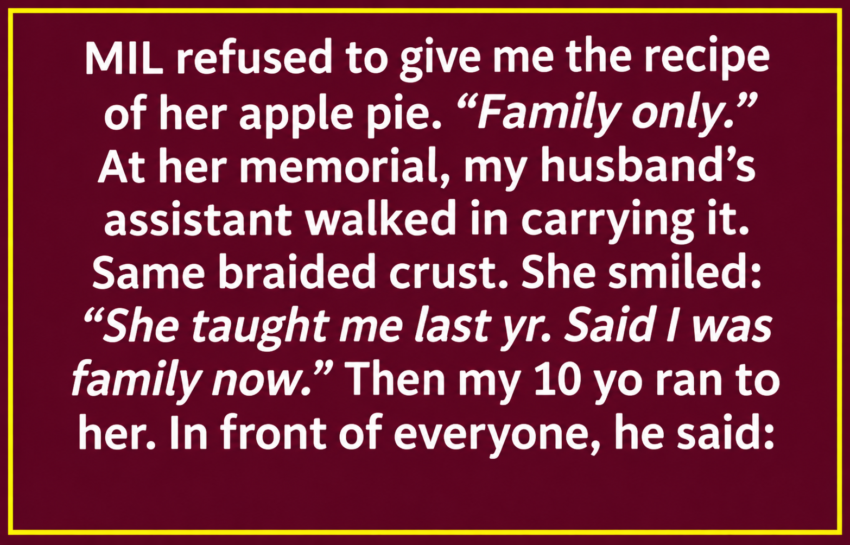
For years, a woman refused to share her famous apple pie recipe with anyone outside her family. Whenever someone asked, she would simply respond, “Family only.”
After she passed away, a woman named Erin arrived at the memorial carrying a familiar pie with its beautifully braided crust.
She explained that the deceased woman had taught her the recipe the previous year, telling her that she was family now.
The revelation surprised the woman’s daughter-in-law, who had never known about the relationship.
Erin explained that after losing her own mother, she had struggled with loneliness. The family matriarch had reached out, inviting her to help peel apples and prepare food on Saturdays.
The invitations continued, and what began as a practical excuse to spend time together became a meaningful friendship.
The pie recipe had been taught during those visits. It was particularly important to Erin because her mother had always made apple pie for her birthday, and the previous year she had struggled to face the occasion alone.
The family matriarch had quietly helped her rebuild that tradition.
When Erin wondered whether she would still be welcome for Saturday lunches, the daughter-in-law invited her back.
Their young son immediately asked whether Erin could stay for lunch, too.
The invitation was more than a meal. It was an acknowledgment that the friendship mattered and that the kitchen door was still open.
5. A Teenager Spent a Dollar to Make a Child Smile
A parent once took their young son to a shopping mall. The child, around two or three years old, was fascinated by a model train display inside a glass case.
The machine required a dollar to make the trains move. The parent, struggling financially and rarely carrying cash, couldn’t afford to activate it.
Fortunately, the child was content simply watching the stationary trains.
A group of teenagers passed by, making noise as they walked. One of them suddenly turned back, approached the display, and inserted a dollar.
The trains began moving.
The teenager smiled and said, “I always liked watching trains too,” before quickly returning to his friends.
The little boy’s excitement was unforgettable.
The parent had never expected such a gesture from a teenager who was simply passing through the mall. But that small act transformed an ordinary outing into a cherished memory.
6. A Neighbor Kept a Porch Light On
Someone who worked late noticed that their neighbor always left the porch light on until they arrived home.
The street was dark, and the person often had to walk home late at night. Initially, they didn’t realize the light was being left on specifically for them.
After noticing the pattern for several months, they finally mentioned it.
The neighbor replied, “Dark streets are longer than lit ones. You shouldn’t have to walk the long version.”
For more than a year, the neighbor continued the routine. He waited until the person had entered their home before switching the light off.
It was a simple bulb, but behind it was a thoughtful habit that helped someone feel safer.
7. A Diary Revealed Forty Years of Quiet Love
After her mother passed away, a woman discovered an old diary filled with brief daily entries.
Most were ordinary observations about household chores, weather, meals, and everyday events. But scattered throughout the pages was a recurring sentence:
“He looked at me.”
The words appeared occasionally over the years, sometimes once or twice annually.
Her mother never described grand romantic gestures or elaborate declarations of love. Instead, she recorded the moments when her husband looked at her in a way that made her feel seen.
For decades, those small moments had been meaningful enough to preserve in writing.
The diary revealed that love doesn’t always announce itself loudly. Sometimes it lives in the brief, ordinary moments that someone quietly treasures.
8. Kind Customers Helped Someone Recover From a Difficult Day
A worker experienced a particularly unpleasant interaction with customers who became angry after being told that their request could not be accommodated.
The encounter was upsetting enough to leave the worker shaking and crying.
Then came the next customers.
They needed the same thing and were given the same refusal. But rather than becoming angry, they responded with patience, humor, and understanding.
The worker apologized sheepishly, expecting another difficult encounter.
Instead, the customers treated the situation kindly.
Their response was a reminder that one unpleasant interaction doesn’t represent everyone. There are still people who choose patience, even when something doesn’t go their way.
Sometimes kindness helps the person receiving it. Sometimes it also helps someone recover from the emotional weight of a previous encounter.
9. A Cashier Wrote a Birthday Wish for a Man Celebrating Alone
A man visited a grocery store in Dayton, Ohio, purchasing a birthday cake, candles, and a single balloon.
The cashier asked whether someone was celebrating.
He answered, “Just me.”
The cashier wished him a happy birthday. The man’s eyes filled with tears as he explained that she was the first person to say those words to him that day.
He had purchased his own cake, candles, and balloon because no one else had remembered.
The cashier took a moment to write “Happy Birthday” on his receipt.
He folded the paper carefully and placed it inside his wallet.
The birthday wish may have taken only seconds to write, but the man apparently considered it meaningful enough to keep.
10. A Woman Continued Answering a Phone That Barely Rang
A woman noticed that her mother still answered the landline, even though almost nobody called it anymore.
The phone rang perhaps once a month, usually with a telemarketing call.
Her mother nevertheless answered with the same formal greeting every time.
“Hello, this is June.”
Her daughter eventually asked why she continued answering a phone that was almost always useless.
Her mother explained that her husband had once called that number. Hearing herself answer in the familiar way was the only thing in the house that still sounded like the past.
The greeting was not really about the callers.
It was about memory, love, and the small rituals that remain after someone is gone.
11. A Child’s Drawings Helped Two Parents Reconnect
A couple had begun drifting apart. They rarely talked meaningfully, and their nights were marked by silence and distance.
Their seven-year-old daughter started leaving drawings on their pillows.
The pictures were not of the entire family. Instead, they repeatedly showed just her parents, holding hands.
The drawings continued night after night for approximately two weeks.
Eventually, one evening, the wife reached across the bed and took her husband’s hand.
Neither said much. But both understood the gesture.
Their daughter may not have known that her parents were struggling. She simply kept drawing the picture of the relationship she hoped they would have.
Her drawings became a gentle reminder that sometimes the simplest expressions of love can encourage adults to reconnect.
12. A Daughter Wore Her Father’s Shirts After He Passed Away
After a woman’s husband died, she couldn’t bring herself to touch his side of the closet.
His shirts remained hanging there for a year, untouched.
Then their teenage daughter began wearing his flannel shirts to school. She wore them one after another, rotating through the collection.
Initially, her mother nearly asked her to stop.
But she gradually understood that her daughter was doing something meaningful.
The shirts were no longer simply clothes sitting in a closet. They were being worn, moved, and used. They remained part of everyday life rather than becoming untouched reminders of loss.
When people asked about them, the daughter simply called them vintage.
The shirts helped her carry a piece of her father with her, while her mother slowly began to let go of the closet’s silence.
13. A Husband Closed the Distance During His Wife’s Grief
After a woman lost her mother, she stopped sleeping peacefully. She spent weeks lying awake, staring at the ceiling.
Her husband struggled to find words that could help. Everything he thought of saying seemed inadequate.
Eventually, he stopped trying to explain her grief.
Instead, every night he moved a little closer. He didn’t demand conversation or try to force her to feel better. He simply offered his presence.
His knee touched hers. His hand rested near her shoulder.
After several weeks, she finally spoke about what she had noticed.
“You haven’t said anything,” she told him.
He answered that he didn’t know what the right words were.
She replied that she had noticed something else: he had been getting closer every night, and she had felt every inch.
He couldn’t remove her grief, but he could remind her that she wasn’t facing it alone.
Sometimes comfort doesn’t require the perfect words. It requires someone willing to stay.
The Quiet Power of Kindness
These stories share a common thread: the people involved didn’t necessarily know how much their actions would matter.
A grocery worker handled bags more carefully. A family prepared extra food. A teenager spent a dollar. A neighbor kept a light on. A cashier wrote a birthday wish.
None of these gestures required extraordinary resources or complicated plans.
They required attention.
Kindness often begins with noticing something others might overlook — a trembling hand, a child who stays for dinner, someone walking home in the dark, or a person celebrating a birthday alone.
And perhaps that is what makes everyday compassion so powerful.
It reminds us that people don’t always need grand solutions. Sometimes they need someone to notice, to be patient, to offer a meal, or simply to make them feel that they matter.
The smallest acts can leave the deepest impressions when they arrive at the right moment.