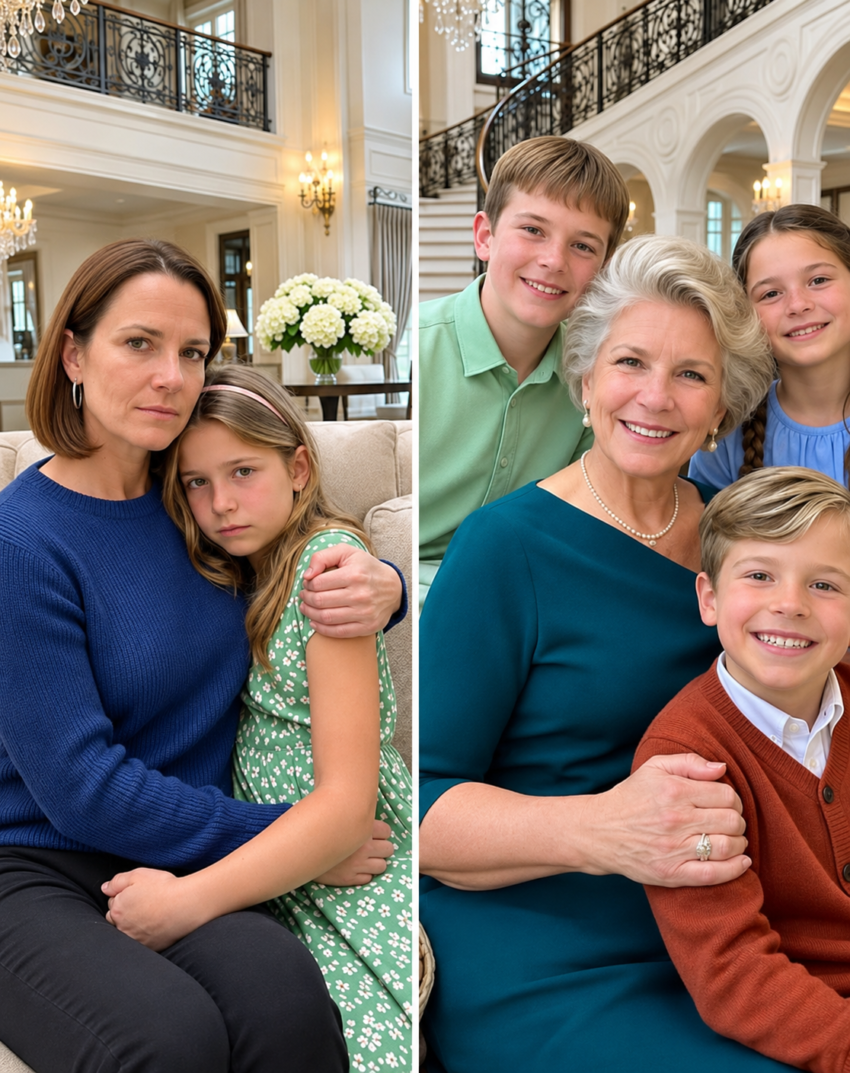
For years, my mother-in-law had perfected the art of making me feel unwelcome without ever saying anything openly offensive. I had learned to tolerate her subtle insults, her judgmental smiles, and the way she always made me feel like I was somehow beneath her.
But the afternoon she made my eight-year-old daughter eat alone in the garage because she spilled a glass of water, everything changed.
I was no longer willing to ignore her cruelty.
When I married Daniel, his mother, Evelyn, greeted me at our wedding reception with a handshake that felt more like a formal introduction than a welcome into her family.
She was wealthy, polished, and exceptionally good at saying things that sounded perfectly innocent to everyone else.
At our wedding, she glanced at my dress, smiled politely, and remarked, “Well. Daniel has always been full of surprises.”
The guests laughed.
I laughed too, even though I understood exactly what she meant.
I was young, deeply in love, and already discovering that confronting Evelyn only made me appear overly sensitive.
Over the years, her comments became a familiar part of family gatherings.
If I brought dessert, she called it “homey.” If I dressed nicely, she remarked that I looked “so confident.” She enthusiastically praised everyone else’s education, careers, connections, and accomplishments, but somehow always found a way to make me feel like I was standing outside a room I wasn’t permitted to enter.
Whenever I complained, Daniel would simply sigh and say, “That’s just how she is.”
I eventually stopped arguing.
Then Lily was born, and I briefly hoped that becoming a grandmother might soften Evelyn’s attitude.
She adored appearances, and having a granddaughter seemed to fit perfectly into the image she wanted to maintain. She bought expensive blankets, organized elegant birthday celebrations, and proudly commented on Lily’s manners and posture.
But her affection often felt conditional.
She appreciated Lily as long as she behaved according to her expectations.
Every summer, Evelyn invited her grandchildren to spend a week at her estate. The older children played outside, while the younger ones usually ate on the back terrace with their cousins and the nanny.
Lily was eight years old. She was gentle, observant, and still believed that most adults knew what they were doing. She loved drawing, disliked tomatoes, and slept with a stuffed rabbit she pretended was only decorative.
Lately, though, she had begun noticing Evelyn’s changing expressions whenever I walked into a room.
That summer, Evelyn was also hosting an important lunch for several guests she hoped to impress.
I wasn’t particularly enthusiastic about sending Lily there.
While I packed her bag, Daniel stood nearby and insisted that his mother would be fine.
“She’ll be fine,” he said.
I zipped Lily’s suitcase and replied, “Your mother has important guests coming. That usually makes her worse.”
“She isn’t going to do anything to Lily.”
“No,” I said. “She’ll do what she always does. She’ll make her feel small in a way that sounds reasonable.”
Daniel didn’t respond.
Then Lily appeared in the doorway, holding her stuffed rabbit by one arm.
“Mom?”
“Yeah, sweetie?”
“Do I have to wear the blue dress?”
“The one Grandma likes?”
She nodded.
I told her she could wear whatever she wanted.
She looked relieved, but that relief quickly faded.
“Grandma likes me, right?”
I immediately smiled.
“Of course she does.”
I didn’t want my daughter to carry the weight of the complicated relationship I had with her grandmother.
That morning, I drove Lily to Evelyn’s estate. My mother-in-law greeted us on the front steps wearing cream linen, looking as though she had carefully arranged herself for a magazine photograph.
She kissed Lily on the cheek.
“Mind your manners today, darling. We have guests for lunch.”
There was no warm greeting, no expression of excitement about seeing her granddaughter.
Just a reminder to behave.
I almost turned around and took Lily home.
Instead, I kissed her forehead and told her to call me if she needed anything.
She nodded, as though the idea of needing help from her own grandmother seemed ridiculous.
Three hours later, my phone rang.
The moment I heard Lily crying, my stomach dropped.
“Mommy, please come get me.”
I stood up so quickly that my chair tipped over.
“Lily, what happened? Are you hurt?”
“No,” she sobbed. “I spilled water.”
I grabbed my keys.
“Where are you?”
She struggled to explain between tears.
At lunch, Lily had asked to sit inside with the adults rather than eat with the younger children on the back terrace. Evelyn had allowed her to join the table for the first course.
Then Lily accidentally bumped a water glass.
That was all.
A spilled glass of water.
“Grandma got mad,” Lily whispered.
“How mad?”
There was a pause.
Then she said, “She moved my plate.”
I tightened my grip on the phone.
“What do you mean, she moved your plate?”
“She said I didn’t belong at the table with the guests.”
I stopped moving.
Evelyn had always understood the power of exclusion. She knew how to make someone feel unwanted without raising her voice or creating an obvious scene.
But this time, the person she had humiliated was my daughter.
“Where exactly are you, baby?”
Lily began crying again, quietly.
“In the attached garage.”
I closed my eyes.
“The garage?”
“She had them put a little table out here.”
I immediately called Daniel.
“Your mother put Lily in the garage.”
There was a moment of silence.
“What?”
“She told Lily she didn’t belong at the table with the guests.”
His voice changed.
“I’m leaving now.”
Daniel had spent years defending his mother, explaining away her behavior, and asking me to tolerate things that hurt. But hearing Lily’s voice had finally made it impossible for him to dismiss what was happening.
He met me on the way and followed my car up the long gravel driveway.
We didn’t enter through the front door.
We went directly to the side garage.
Inside, beside stacks of folding chairs and cases of sparkling water, stood a small round table covered with a white cloth.
A plate of lunch sat almost untouched.
And there was Lily.
She was sitting with her hands folded in her lap, her stuffed rabbit pressed against her stomach, trying to make herself as small as possible.
When she saw us, relief appeared on her face.
Then embarrassment.
That expression hurt more than anything else.
I dropped to my knees and wrapped my arms around her.
“You did nothing wrong,” I whispered. “Nothing at all.”
Daniel crouched beside us. His face was unusually serious. For once, he didn’t seem to have an excuse prepared for his mother.
“Lily,” he said gently. “Look at me.”
She lifted her eyes.
“You are never being left like this again.”
She nodded and began crying harder.
We took her outside. Daniel climbed into the back seat with her, and she refused to let go of his hand.
I closed the car door.
Then I turned around and walked back into the house.
Evelyn was sitting at the head of the dining table, smiling at her guests.
The room looked exactly as she had intended it to look. Beautiful flowers, polished silver, immaculate linens, sunlight streaming through the windows, and polite conversations unfolding over lunch.
It was a beautiful room designed to conceal an ugly moment.
Evelyn looked up when she saw me.
“Claire,” she said. “We’re having lunch.”
“I can see that.”
Everyone at the table looked in my direction.
I recognized Margaret Leland, the head of Saint Bartlett Academy. Evelyn had spent months trying to impress her because she hoped to secure a place at the prestigious school for another family member.
I looked around the table.
“I’m sorry to interrupt,” I said calmly. “But I think everyone here should know where Evelyn put my daughter.”
Evelyn said my name in a warning tone.
I ignored her.
“Lily accidentally bumped a water glass. Evelyn removed her plate and told her she didn’t belong at this table with the guests.”
The room became silent.
“She was then sent to eat alone in the attached garage.”
Evelyn straightened in her chair.
“That is not what happened,” she said. “She was careless, she was upset, and she needed a moment to settle down.”
I kept my voice steady.
“She is eight years old. She spilled water. She wasn’t disrespectful, she wasn’t deliberately disruptive, and she wasn’t doing anything that justified humiliating her.”
Margaret Leland looked directly at Evelyn.
“You put a child in the garage?”
Evelyn lifted her chin.
“It is attached to the house.”
Margaret stared at her for a moment before setting down her napkin.
“I see.”
That was all she said.
But I noticed the change in Evelyn’s expression.
She knew exactly what Margaret had witnessed. She knew that no carefully chosen words could turn the situation into something respectable.
Margaret stood up.
The other guests began following her. Chairs shifted, quiet apologies were exchanged, and the lunch ended with a sudden rush of uncomfortable politeness.
No one seemed interested in remaining at that table.
As Margaret passed me, I asked, “Would you mind saying hello to Lily before you leave?”
She paused and nodded.
Outside, she leaned toward the car window and spoke to my daughter softly.
I caught only one sentence.
“One spilled glass should not decide where a child belongs.”
Lily looked at her and nodded.
Margaret gently squeezed her shoulder before leaving.
Inside the house, everything had become quiet.
That evening, Daniel called his mother from our kitchen.
“We won’t be coming back for the rest of the summer,” he said.
He sounded ashamed.
“No. Not for weekends either.”
He listened for a moment.
Then he continued.
“When you treated Claire badly, I told myself it was just how you were. I kept making excuses because I didn’t want to confront you.”
He paused.
“But I won’t say that about what you did to Lily.”
I looked at him as he spoke.
For years, I had wanted him to understand that his mother’s behavior wasn’t harmless simply because she never shouted or used openly insulting words.
That night, he finally seemed to understand.
Three days later, Evelyn came to our house.
She stood in the living room with her purse held tightly in both hands.
There were no flowers, no gifts, and no carefully rehearsed gestures.
“I never meant for it to become what it became,” she said.
I stared at her.
She tightened her grip on the purse.
“I handled it badly.”
“You humiliated an eight-year-old.”
Her eyes moved toward the hallway, where Lily’s drawings were taped to the wall.
Evelyn’s mouth tightened.
For a moment, I thought she might simply leave.
Instead, she said quietly, “I know.”
I waited.
“I was focused on the lunch,” she continued. “How it looked. Who was there.”
“That isn’t an explanation.”
She nodded.
I told her she wouldn’t receive credit for regret that only appeared when other people witnessed the consequences of her actions.
Evelyn didn’t argue.
She simply stood there, looking toward the hallway.
It was the first time I had seen a visible crack in the polished facade she had maintained for so many years.
I couldn’t tell whether she truly understood the damage she had caused.
But I knew the boundaries we had established weren’t going to disappear.
Months later, Lily’s school held an art-show fundraiser in the gymnasium.
Paintings lined the walls, each with a bid sheet beneath it. Parents wandered between the artwork, stopping to admire the children’s creations.
Lily showed us her painting.
It was a long dinner table with every member of the family sitting together.
At the end of the table was one empty chair.
Beneath the painting, she had written in careful block letters:
Room for Everyone.
Evelyn had attended the event quietly.
She stood in front of Lily’s painting for a long time before writing her name on the bid sheet.
She bought it.
Daniel later told me she had hung the painting in her formal dining room, where guests would see it the moment they sat down.
I don’t think Evelyn became a kind person overnight.
A week after the art show, Lily asked if she could invite two quiet girls from her class to sit with her at lunch.
“Of course,” I told her.
She shrugged as though it were nothing important.
But I knew what she was doing.
My daughter had experienced what it felt like to be excluded, and instead of allowing that experience to make her cruel, she was making room for other people.
I don’t know whether Evelyn ever fully changed.
But she had finally been forced to look at herself.
And Lily would never again have to wonder whether she belonged.
She had already begun making sure other people knew they belonged, too.