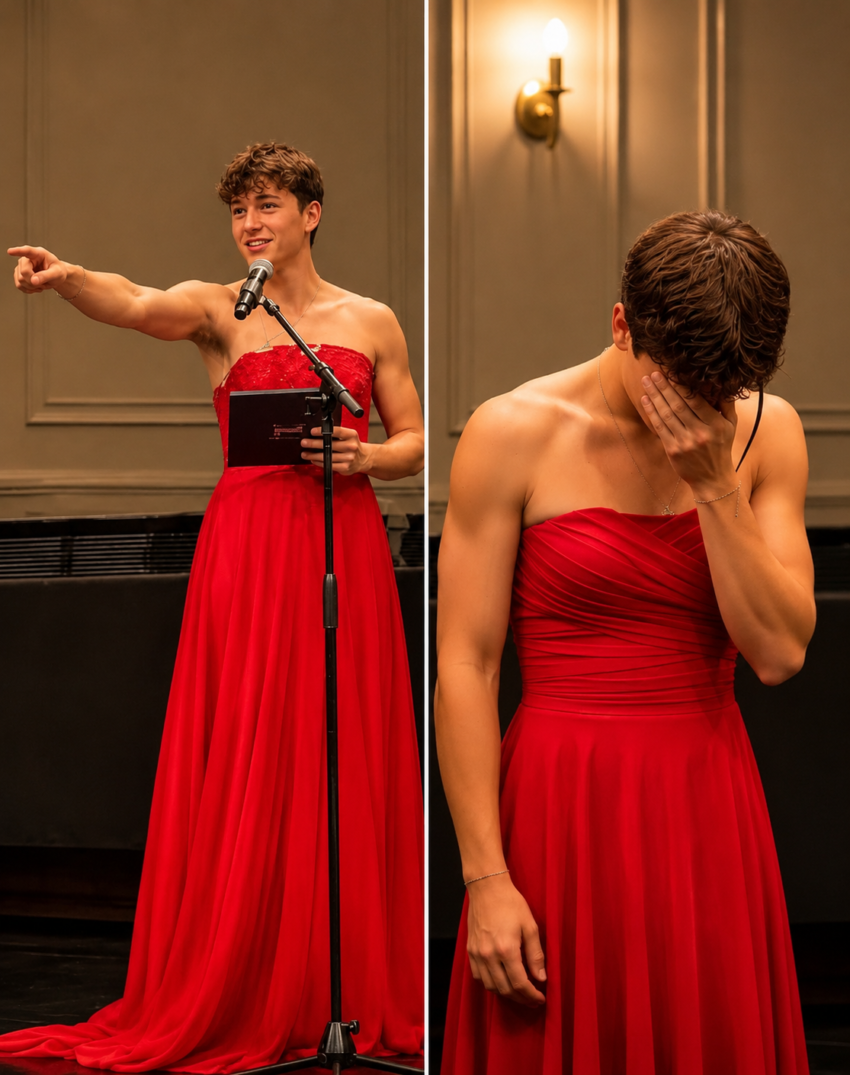
The whispering began before my son even reached the principal.
Then came the laughter.
Someone behind me didn’t bother lowering their voice.
“What is wrong with that guy?”
My fingers tightened around the graduation program resting in my lap.
Aaron didn’t flinch.
He continued walking across the stage, wearing a bright red dress.
The dress fell just below his knees, its fabric moving gently as he walked beneath the auditorium lights. It looked even brighter than it had when I first saw it at home.
Too bright, I thought.
Too noticeable.
Exactly what I had feared.
Aaron reached the principal, shook her hand, accepted his diploma, and turned toward an auditorium filled with nearly 600 people.
Some were staring.
Others were laughing.
Several students had their phones raised, recording him.
I saw one boy leaning toward his friend, grinning as he filmed Aaron walking down the stage steps.
My son noticed every one of them.
Still, he kept walking.
I was sitting in the third row, and I was the only person in that room who knew why he had chosen to wear that dress.
Two weeks earlier, Aaron had told me what he planned to do.
It was nearly two in the morning. Neither of us had been sleeping properly for weeks.
I found him sitting at the kitchen table with a mug of tea that had gone untouched. The house felt unusually quiet, and every room seemed to remind us of someone who was no longer there.
A piece of red fabric lay folded across his knees.
I immediately recognized it.
“Aaron.”
He looked up. His eyes were exhausted.
At eighteen, he had always looked remarkably like his twin sister. Sometimes, the resemblance was so strong that looking at him still hurt.
“What are you doing with that?”
He glanced down at the fabric.
“I want to wear it to graduation.”
For a moment, I thought I had misunderstood him.
“You want to what?”
He unfolded the dress.
I recognized every detail.
It was the red dress Mary had chosen herself.
“I’m wearing it,” he said.
I pulled out the chair across from him.
“No.”
“Mom.”
“No, Aaron.”
His expression remained steady.
I lowered my voice.
“Do you understand what people are going to do?”
“Yes.”
“They’ll laugh.”
“I know.”
“They’ll take pictures.”
“I know.”
“They’ll post them online.”
“I know.”
I leaned across the table.
“They’ll eat you alive.”
Aaron met my eyes.
“I know, Mom.”
Then he added, “It doesn’t matter.”
“It matters to me.”
His expression softened, but he didn’t put the dress away.
“Aaron, please. You’ve already been through enough.”
We both knew what I meant.
Only a few months earlier, our family had looked completely different.
Mary and Aaron had spent most of their childhood competing over everything imaginable. They argued about grades, breakfast, front seats in the car, and countless other things.
But beneath all the teasing, they were inseparable.
Then Mary became seriously ill.
Everything changed faster than we could comprehend.
Graduation plans became hospital appointments. College discussions turned into medication schedules. The dress Mary had been excited about remained hanging inside a garment bag.
And then we lost her.
Afterward, Aaron stopped talking about graduation.
He stopped talking about almost everything.
His father, Dean, struggled with grief in his own way. He became angry at doctors, at me, at himself, and seemingly at the entire world.
Eventually, Aaron became a target of that anger, too.
So when Aaron told us what he intended to wear, Dean reacted exactly as I had expected.
“Absolutely not.”
Aaron stood in the living room, holding the dress against his chest.
“It’s my graduation.”
“Then dress like you’re graduating.”
“I am.”
Dean stared at him.
“What are you trying to prove?”
“Nothing.”
“Then don’t turn the ceremony into a spectacle.”
Aaron’s expression tightened.
“This isn’t about you.”
Dean stood up.
“And it shouldn’t be about your sister either.”
I saw Aaron recoil at those words.
Dean must have noticed, but he didn’t take them back.
He pointed toward the dress.
“I’m not sitting there while people laugh at my son.”
Aaron answered quietly.
“Then don’t come.”
Dean’s face changed.
For one terrible moment, I hoped he would apologize.
Instead, he grabbed his keys.
“Fine.”
He didn’t attend graduation.
Aaron’s closest friend, Ben, reacted almost as badly.
At first, he thought Aaron was joking.
Then Aaron showed him the dress.
By the following day, Ben had stopped responding to his messages.
When I asked Aaron about it, he shrugged.
“He doesn’t want to be part of it.”
“Doesn’t that hurt?”
“Of course it hurts.”
He looked away.
“But it doesn’t change what I’m doing.”
The school found out about his plan on graduation morning.
I still don’t know who told them.
At 9:10 a.m., my phone rang. The assistant principal introduced herself and spoke carefully.
“We understand Aaron intends to wear something unconventional to today’s ceremony.”
“He does.”
“We’re not trying to interfere with his personal expression,” she explained. “But we simply want the day to remain focused on the graduating class. We can offer Aaron a more appropriate option.”
I already disliked where the conversation was going.
“What kind of option?”
“We have an extra graduation outfit available.”
“He already has clothes.”
There was a pause.
“We’re trying to prevent a difficult situation.”
Aaron was standing near the stairs and could hear every word.
He held out his hand for the phone.
I gave it to him.
He listened briefly before responding.
“Thank you, but I’m wearing the dress.”
Another pause.
“No. I understand.”
He ended the call.
I stared at him.
“You can still change your mind.”
He picked up the garment bag.
“I won’t.”
Then he told me something I hadn’t known.
“I already sent them Mary’s graduation photo. I asked them to put it on the screen when I give the signal.”
“Does the school know why?”
“About Mary, yes. About the dress, no.”
By the time we reached the auditorium, I could barely breathe.
People noticed almost immediately.
Some students stared. A few laughed. One mother looked at Aaron and whispered something to the woman sitting beside her.
Both glanced in our direction.
Aaron stood with his classmates as though nothing was happening.
But I knew my son.
His shoulders were too stiff.
His jaw was clenched.
He heard every word.
I wanted to take him home. I wanted to stand between him and every phone in that auditorium.
Instead, I remained in the third row because he had asked me to.
“Whatever happens,” he had told me before joining his classmates, “stay where I can see you.”
So I stayed.
Name after name was announced.
The whispers grew louder whenever Aaron appeared in someone’s camera frame.
Then the principal finally called his name.
My heart stopped.
He walked across the stage.
The laughter followed him.
He accepted his diploma.
Then he turned.
Instead of heading toward the classmates or photographers waiting nearby, Aaron descended the steps and started walking down the center aisle.
Toward me.
The auditorium grew noisier.
Someone laughed again.
A girl nearby whispered, “Is he seriously doing this?”
Aaron kept walking.
When he reached the third row, he stopped directly in front of my seat.
For the first time that day, his composure began to crack.
His eyes were wet.
“This is for you,” he said quietly.
Then he swallowed.
“Both of them.”
My breath caught.
Aaron reached into the pocket of the red dress and pulled out something small, flattened, and carefully wrapped in tissue paper.
The laughter continued for a few seconds.
Then he unfolded the paper.
The moment I saw what was inside, I stopped hearing the crowd.
It was a dried yellow daisy.
One of its petals was missing.
The stem had darkened with age, and the flower had been pressed almost flat.
But I knew exactly where it had come from.
I covered my mouth.
“Oh, Aaron.”
The auditorium disappeared around me.
Suddenly, I was back in the hospital months earlier.
Mary had still been strong enough to leave the hospital for a few hours that day.
She had spent the previous week complaining about hospital walls, hospital food, and everyone treating her as though she might break.
She wanted something normal.
So I took her shopping.
Graduation was still months away, but Mary had made me promise that we would find her dress.
“No depressing colors,” she insisted as we walked into the store.
“You haven’t even looked yet,” I told her.
“I already know.”
She headed straight for the racks.
Aaron came along, pretending he was bored.
Mary held up several dresses before finding the red one.
The moment she stepped out of the fitting room, she smiled.
It wasn’t the tired smile she had learned to give doctors and worried relatives.
It was her real smile.
She spun once in front of the mirror.
“This one.”
Aaron laughed.
“You look like a fire alarm.”
Mary threw a price tag at him.
“You have no taste.”
We bought the dress.
On our way back to the hospital, Mary asked me to stop near the small garden beside the entrance.
Yellow daisies were blooming along the walkway.
She bent down and picked one.
I told her she probably wasn’t supposed to.
She grinned.
“Arrest me.”
Later, from her hospital bed, she tucked the flower into a book.
I had completely forgotten about it.
Until that moment.
Aaron held the same flower in his palm.
My hands began shaking.
“Where did you get this?”
He looked down.
“Mary gave it to me.”
I stared at him.
“What?”
He carefully unfolded another piece of tissue paper.
A small note was tucked beneath the flower.
My daughter’s handwriting covered one side.
I knew it immediately.
Aaron’s voice trembled.
“She gave this to me three days before she died.”
I looked at him.
“You never told me.”
“She made me promise.”
People around us had stopped laughing.
Students and parents were turning in their seats, trying to understand what was happening.
Aaron handed me the note.
I could barely unfold it.
At the top, Mary had written my name.
My vision blurred before I reached the next line.
Aaron crouched beside my chair.
“Read it.”
I tried.
The words kept swimming in front of me.
Finally, Aaron placed one hand over mine and read quietly with me.
Mary had written that she knew she probably wouldn’t make it to graduation.
She hated admitting it.
She hated imagining Aaron walking across that stage without her.
But she didn’t want her absence to turn his graduation into another sad day.
Then I reached the part that made me break.
She wrote that the red dress was supposed to be part of one of the happiest days of her life.
If she couldn’t wear it, she didn’t want it hanging untouched in a closet, like something everyone was afraid to remember.
She wanted it there.
She wanted us to see it.
And she wanted me to know that even if one seat was empty, both of her children had made it to graduation.
I pressed the note against my chest.
A sound escaped me that I couldn’t control.
Aaron wrapped his arms around me.
I clung to him.
For weeks, I had tried not to fall apart in front of my son. I had convinced myself that he had already lost his sister and needed his mother to remain strong.
But in that auditorium, with Mary’s dress and the flower she had picked that day between us, I finally broke.
Aaron whispered, “She wanted you to have the flower.”
I shook my head against his shoulder.
“Why didn’t you tell me?”
“Because you would’ve stopped me.”
He was right.
“I almost did anyway.”
“I know.”
A few seats away, one of the mothers who had laughed earlier lowered her eyes.
Another covered her mouth.
Then someone behind us quietly asked, “Was that his sister’s dress?”
The question spread through the auditorium.
His twin sister.
She died.
It was her graduation dress.
She asked him to wear it.
The whispers that had humiliated Aaron moments earlier suddenly changed.
I looked over his shoulder.
A boy who had been recording Aaron onstage slowly lowered his phone.
Another student stared at the floor.
Near the aisle, a girl began crying.
Then I saw Ben.
Aaron’s best friend stood near the back wall.
I hadn’t even known he was there.
His face had gone pale.
He walked toward us slowly.
Aaron saw him and stood.
For a moment, neither spoke.
Ben looked at the dress.
Then at the flower.
“I didn’t know,” he said.
Aaron’s expression hardened.
“You didn’t ask.”
Ben swallowed.
“I thought you were trying to make some kind of statement.”
“I was.”
Aaron looked down at Mary’s dress.
“Just not the one you thought.”
Ben’s eyes filled with tears.
“I’m sorry.”
Aaron didn’t immediately forgive him.
Some apologies deserve to sit in the air for a while.
Then the principal stepped down from the stage.
The auditorium was almost completely silent.
She approached Aaron.
“This morning, we asked you to consider something more appropriate.”
Aaron said nothing.
The principal took a breath.
“I’m sorry.”
Several parents heard her.
So did the students gathered nearby.
She turned toward the auditorium.
“We’re going to pause for a moment.”
No one objected.
She looked back at Aaron.
“Would you be comfortable telling them who the dress belonged to?”
Aaron glanced at me.
I nodded.
He returned to the front of the auditorium.
This time, no one laughed.
He stood beneath the same lights where people had mocked him minutes earlier.
His hands trembled, but his voice remained steady.
“My twin sister, Mary, was supposed to graduate with me today.”
The silence deepened.
“She picked this dress after one of her hospital appointments. She died before she could wear it.”
I heard someone begin to cry.
Aaron continued.
“Before she died, she made me promise that I wouldn’t let this dress stay in a closet. She wanted Mom to see both of us graduate.”
He held up the pressed flower.
“She picked this outside the hospital on the day we bought the dress. She asked me to give it to our mom today.”
Aaron looked across the audience.
“I knew some of you would laugh.”
Several students lowered their heads.
“I almost didn’t do it because of that.”
Then he looked toward me.
“But Mary was more afraid of being forgotten than I was afraid of being laughed at.”
That was the moment the entire room changed.
No one needed to be told to be quiet.
No one needed to be reprimanded.
The same crowd that had mocked my son now sat completely still.
Aaron looked toward the principal and gave her a small nod.
The auditorium screen changed.
Mary’s name appeared alongside what would have been her graduation photograph.
In Memoriam.
The room filled with applause.
That mattered to me.
Aaron closed his eyes for a moment and held Mary’s flower carefully between his fingers.
When he returned to me, I pulled him into my arms again.
“You shouldn’t have had to endure that,” I whispered.
He shook his head.
“It was worth it.”
After the ceremony, people approached us one by one.
Some apologized.
Others told Aaron they admired what he had done.
Ben remained nearby.
He didn’t ask Aaron to forgive him again.
He simply helped carry our things to the car.
That meant more than another apology.
As we reached the parking lot, my phone buzzed.
It was Dean.
Someone had sent him the video.
His message contained only five words.
“I should have been there.”
I stared at the screen for a long time.
I didn’t answer.
Not yet.
Aaron noticed the name.
“Dad?”
I nodded.
He looked toward the auditorium doors.
Then he said quietly, “He made his choice.”
There was no anger in his voice.
That somehow made his words heavier.
At home, I placed Mary’s pressed flower inside a small frame.
Underneath it, I wrote the date.
May 14.
The day she bought the red dress.
The day she picked a yellow daisy outside the hospital and joked that someone should arrest her for stealing it.
The day we still believed she would wear that dress herself.
Aaron stood beside me as I hung the frame near a photograph of the two of them.
In the picture, they were eight years old, missing teeth and leaning into each other.
For months, every photograph of Mary had felt like evidence of what we had lost.
That night, something changed.
The picture still hurt.
But it also reminded me that she had been here.
She had laughed.
She had loved us.
And somehow, on Aaron’s graduation day, she had found her way into an auditorium filled with people who had never known her.
They remembered the dress.
They remembered the flower.
But most of all, they remembered the brother who loved his sister enough to walk through their laughter, carrying her with him.
When honoring someone you love means risking ridicule, rejection, and judgment, do you hide what matters to protect yourself, or do you stand tall and show the world that real love is stronger than embarrassment?
Sometimes, the bravest act isn’t standing up to a crowd.
It’s refusing to let someone you love disappear from a moment they were supposed to share.