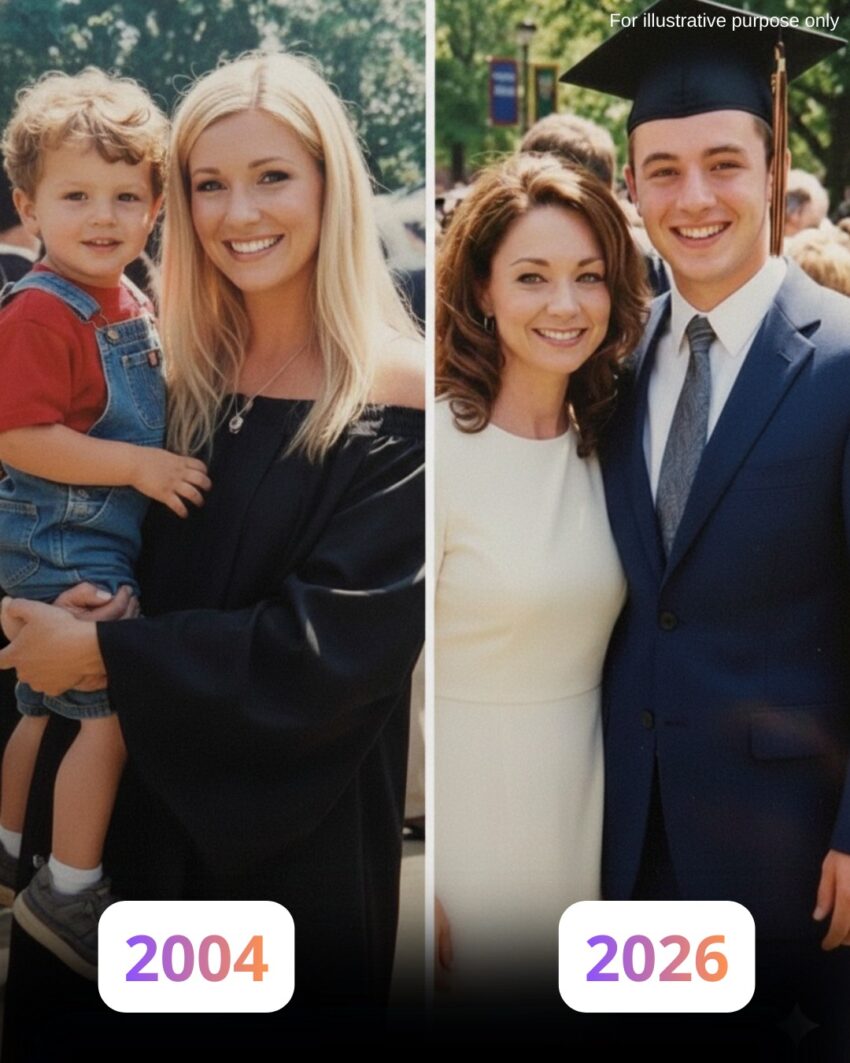
I always believed my mom was my entire support system—until a stranger walked up to me at my college graduation and said something that shattered everything. In a single moment, the story my mother had told me my whole life began to fall apart.
My name is Evan. I’m 22 years old. Last spring, I graduated from college.
For as long as I can remember, I thought I knew exactly who I was and where I came from. That certainty stayed solid—until suddenly, it didn’t.
My mom’s name is Laura. She raised me alone from the day I was born.

Growing up, I heard the same story over and over about how she got pregnant at 20, during her junior year of college. She told it simply—or at least, what I believed was the truth. She’d laugh softly, saying she balanced a diaper bag on one arm and her cap and gown on the other as she walked across the stage to earn her degree.
There was no father in the picture. No stepdad. No uncles, cousins, or nearby grandparents to fill the gap. It was always just the two of us. And for a long time, I believed that was enough.
When I was younger, I asked about my dad with curiosity, not obsession. My mom’s answers were always the same.
“He wasn’t ready,” or “It didn’t work out,” or “He left when he found out I was pregnant.” Simple, neutral sentences, delivered so calmly they felt final. Safe. She never spoke badly about him or cried over the past. She shut that chapter and never opened it again.
So I accepted the idea that he knew I existed and chose to leave. It didn’t hurt as much as people might expect.
I had a mother who did everything—worked full-time, paid the bills, studied, fixed the sink in our small rented apartment, read to me at night, taught me how to shave, parallel park, and stand up for myself. I never saw her cry about being alone. She never made me feel like a burden.
By high school, I stopped asking about my father. I thought I already had the answers.
I didn’t. Not even close.
Graduation day arrived on one of those crisp spring mornings where the sun is bright, but the air still bites. The campus overflowed with people—parents holding cameras, siblings clutching balloons, graduates in gowns snapping selfies in front of buildings they swore they’d never miss.
I woke up feeling like the entire day was unreal. Not just because I’d finished college, but because it felt like I was stepping into something new, leaving everything familiar behind.
My mom arrived early, as always. She wore a soft light-blue dress and the pearl necklace she saved for every major moment in my life—recitals, award ceremonies, high school graduation. Her hair was curled the way she always did when she wanted to look her best.
She looked radiant.
When she spotted me, her face lit up. She waved like I was the only person in the crowd. And honestly, if I could’ve chosen just one person to be there, it would’ve been her.
The ceremony passed in a haze—long speeches, rustling gowns, names echoing through the speakers. When mine was called, I crossed the stage, careful not to trip, and searched for her in the crowd.
She was easy to find. Standing, clapping hard, already wiping tears from her eyes.
Afterward, we moved into the courtyard with everyone else. Hugs, laughter, endless photos. My mom kept adjusting my cap and brushing imaginary lint off my gown.
“Evan, hold still—you look lopsided again,” she said, smiling as she snapped another picture. “Just one more, I promise!”
She said “just one more” at least five times.
That’s when I noticed a man standing off to the side, near a bench a few yards away. He wasn’t clapping or standing with anyone. He wasn’t watching the ceremony or other families.
He was watching me.
It wasn’t aggressive or unsettling—more like he was studying me. Like he was gathering courage. He looked around 45, well-dressed, hair neatly combed.
I turned away, assuming he was one of my classmates’ dads.
Then I felt a tap on my shoulder.
“Evan?”
I turned, confused. “Yeah?”

He stepped closer. His face felt strangely familiar, though I couldn’t place why.
“I’m sorry to interrupt,” he said, glancing at my mom. “But I need to talk to you. It’s important.”
My mom’s hand was still resting on my shoulder. I felt it tighten. Her face went pale instantly. She didn’t say a word, but her entire body stiffened.
I looked back at him, confused.
He took a breath. “Son, hi. I’ve been looking for you for a long time. I’m your biological father. Could we talk, please?”
I laughed—short, sharp, nervous. I couldn’t stop myself.
“I’m sorry, what?”
He didn’t smile. He looked completely serious.
“I know this isn’t the place. But I had to come. I had to tell you why I wasn’t there.”
My mom finally found her voice, sharp and low. “No. You don’t get to do this. Not today.”
I looked between them. “What’s going on?”
He exhaled. “Your mother lied to you your entire life. You deserve to know the truth. You have to listen to me.”
The air drained from my lungs. My stomach twisted. Around us, people laughed and hugged. A champagne bottle popped nearby.
All I could hear was the rush of blood in my ears.
“What are you talking about?”
“She told me she lost the baby,” he said. “She said there was no baby. That’s what I believed for years.”
I turned to my mom.
“That’s not true,” she said, tears filling her eyes, her voice shaking. “That’s not the whole story.”
“I didn’t know the truth until recently,” he said. “But once I did, I couldn’t stay silent. You deserve to know.”
I didn’t want this conversation in the middle of a crowd. I asked if we could step away.
We moved to a quiet patch of grass near the edge of the parking lot.
“My name is Mark,” he said. “Your mom and I dated in college. Nothing serious, but I cared about her. When she told me she was pregnant, I was scared. I was immature. I didn’t know how to handle it. But I didn’t run.”
He looked at her. “Not at first.”
My mom stayed quiet.
“A few weeks later,” he continued, “she told me she’d had a miscarriage. That it was over.”
“And you just believed her?”
“I did. But what I didn’t know was what happened before that. My parents—especially my mother—went behind my back to see her. They didn’t want the baby. They said it would ruin my life. They offered her money. Pressured her to have an abortion. Threatened custody battles if she kept the child.”
“I never took their money,” my mom whispered. “But I was terrified.”
Mark nodded. “I didn’t know. I couldn’t protect you because I didn’t know I needed to.”
She finally looked at me.
“I told him the baby was gone because I didn’t know what else to do,” she said. “I thought if I told them I kept you, they’d come after you. I thought if I disappeared, I could raise you in peace.”
Mark pulled a business card from his wallet and handed it to me.
“I’m not here to change your life,” he said. “I’m not asking for anything. I just couldn’t let you believe I abandoned you. That I didn’t want you. I only found out six months ago. A mutual friend told me everything.”
I took the card, my hand shaking.
“If you ever want to talk,” he said softly, “call me. No pressure. I’ll wait.”
He nodded once and walked away, blending into the crowd like someone who already knew he didn’t belong there.
I stood there staring at his name and number, as if they might rearrange themselves into something that made sense.
My mom hadn’t moved. She looked like all the strength had drained out of her.
“I never wanted you to find out like that,” she said quietly. “Not on your graduation day.”

I couldn’t answer. My head felt overloaded, like 22 years of missing context had been dumped into it all at once. The story I’d lived by my entire life had just collapsed.
We took more photos afterward, but I barely remember them. I smiled, nodded, thanked people, congratulated myself—like I was watching someone else go through the motions.
That night, the apartment felt heavy and quiet. My cap and gown hung over a chair, forgotten. We sat at the kitchen table with mugs of tea that went cold.
“I should’ve told you,” my mom said eventually. “Every year made it harder.”
I really looked at her then—and saw exhaustion. Not weakness. The kind that comes from carrying a secret for decades.
“They scared me,” she said. “His parents. Powerful people. Lawyers. Donors. They made it sound like they could take you from me. I was young. Alone. I didn’t know how to fight them.”
“So you ran,” I said, gently.
“I protected you the only way I knew how,” she replied. “I disappeared.”
I reached across the table and took her hand.
“You didn’t abandon anyone,” I said. “You chose me.”
She broke down, crying like she’d finally set something down after holding it for too long.
I held her—and for the first time, our roles shifted just a little.
I didn’t call Mark right away. I needed time. To process the anger, confusion, and strange relief of finally knowing the truth.
But I kept his card in my wallet.
A few weeks later, I texted him.
“This is Evan. You gave me your number at graduation.”
He replied immediately.
“Thank you for reaching out. I’m here whenever you’re ready.”
We started slowly. Monthly coffee. Safe conversations. He talked about his job, his divorce, his regrets. He never blamed my mom.
Over time, the anger softened. It didn’t vanish—but it stopped controlling everything.
I realized the absence I’d felt my whole life wasn’t from being unwanted. It came from silence, fear, and decisions made under pressure.
Months later, my mom glanced at my phone when it buzzed.
“Is that Mark?” she asked.
“Yeah. Just checking in.”
She smiled. “I’m glad you’re talking.”
“You’re okay with it?”
“Whatever you decide, I trust you.”

She meant it.
I didn’t suddenly gain a father. There were no dramatic reunions. No instant bond.
Just honesty. Conversation. Time.
But I did gain something I didn’t know I was missing.
The truth.
And it changed everything.