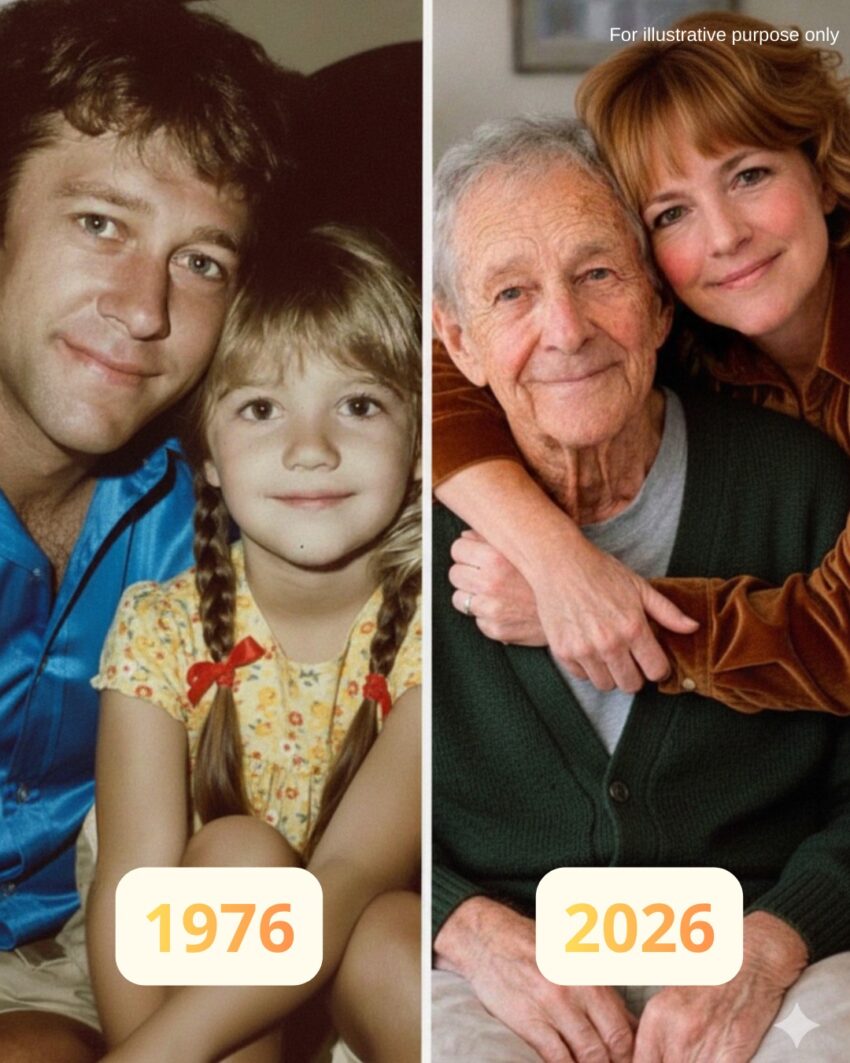
When my stepdad passed away, I lost the only parent I had ever truly known. But at his funeral, a stranger drew me aside and said one sentence that changed everything. What I discovered in the bottom drawer of his garage tore apart the story I’d been told — and rebuilt something even deeper. There’s something unsettling about watching people mourn someone you loved quietly.

They hold you a little too long, call you sweetheart as if they’ve known you forever, and speak in that hushed tone people use when they think grief has made you fragile.
I lost my stepdad, Michael, five days ago. I lost him to pancreatic cancer — it was swift and merciless; 78 years old and gone like smoke. “You were everything to him, Clover,” someone whispered, gripping my hand as if I might drift away.
I nodded. I kept saying thank you — and I meant it. But none of it truly registered. I stood beside the urn, next to the photo of Michael squinting in the sunlight, grease smudged across his cheek.
That picture had rested on his nightstand for years, and now it felt like a substitute, a stand-in for the man who taught me how to change a tire and sign my name with pride. “You just left me… alone,” I whispered to the photo.
Michael met my mom, Carina, when I was two. They married in a small, quiet ceremony. I don’t remember the wedding or even life before him.
My earliest memory is perched on his shoulders at the county fair, one sticky hand clutching a balloon, the other tangled in his hair. My mom died when I was four — that’s a sentence I’ve carried my entire life. When Michael became sick last year, I moved back into the house without hesitation. I cooked for him, drove him to appointments, and sat beside his bed when the pain made him quiet.
I didn’t do any of it out of duty.
I did it because he was my father in every way that mattered.
After the funeral, the house hummed with polite conversation and the soft clatter of cutlery. Someone laughed too loudly in the kitchen, and a fork scraped against a plate sharply enough to draw attention.
I stood near the hallway table, holding a glass of lemonade I hadn’t touched. The furniture still carried his scent — wood polish, aftershave, and the faint hint of that lavender soap he always insisted wasn’t his.
Aunt Sammie appeared beside me as if she’d always been there. She wrapped me in a tight hug.
“You don’t have to stay here alone,” she murmured. “You can come home with me for a while.”
“This is my home.”
Her smile stayed in place. “We’ll talk later then, sweetie.” My name came from behind me. “Clover?”
I turned.
An older man stood there — maybe in his late 60s. Clean-shaven but lined deeply with age. His tie was cinched too tight, like someone else had tied it for him. He held his cup in both hands as if it might slip.
“I’m sorry…” I said carefully. “Did you know my dad from work?” He nodded once. “I’ve known him a long time, honey. I’m Frank.”
I studied his face, but nothing clicked.
“I don’t think we’ve met.”
“You weren’t meant to,” he said, his voice low and gravelly. That made me still. “What do you mean?”
He stepped closer, close enough that I caught the scent of engine grease and peppermint. He scanned the room — once, twice — then leaned nearer.
“If you want to know what really happened to your mom,” he said, “check the bottom drawer in your stepfather’s garage.”
“I… what?”
“I made him a promise,” he went on. “This was part of it.”
“Who are you?” I asked, my pulse quickening.
“I’m sorry, kid,” he said, pressing his business card into my hand. “I wish your parents were here for you.”

Then he disappeared into the crowd as if he’d never existed.
I stood motionless, his words louder than the organ music drifting from the living room.
Check the bottom drawer. I waited until the house was empty that night before returning. I didn’t switch on the lights when I stepped through the front door. The darkness felt softer somehow… The garage door groaned as it opened. The air inside was still, heavy with oil and cedar from the workbench cabinets Michael had built years earlier. My footsteps echoed across the concrete as I approached, each step heavier than the last.
The bottom drawer was deeper than the others, built differently.
It resisted at first, then slid open with a quiet groan. Inside lay a sealed envelope, my name written across it in Michael’s familiar blocky handwriting.
Beneath it rested a manila folder filled with legal documents, letters, and a single journal page.
I sank onto the cold floor and opened the envelope. “Clover,
If you’re reading this, it means Frank kept his promise. I asked him not to tell you until I was gone. I didn’t want you carrying this while you still had me. Frank used to work with me, and I always joked he’d outlive us all…
I never lied to you, kiddo. But I didn’t tell you everything. Your mom died in a car accident, yes — but she wasn’t simply running errands. She was driving to meet me. We were going to sign the guardianship paperwork that day. You know… to make it official.
But she panicked.
And your Aunt Sammie had threatened court. She didn’t believe I was fit to raise you. She said blood mattered more than love. Your mom didn’t want a fight. She was afraid of losing you.
I told her to wait… to let the storm pass. But she got in the car anyway. I should’ve stopped her.
After the crash, Sammie tried again. She sent letters, hired a lawyer, and claimed I had no right to you. But I had the paperwork. I had this letter from Carina — you’ll see it.
‘If anything happens, don’t let them take her.’
I kept you safe, Clover. Not because the law granted me the right, but because your mom trusted me to. And because I loved you more than anything. I didn’t want you growing up feeling like someone’s contested property. You were never a case file.
You were my daughter.
But I want you to be careful with Sammie. She isn’t as kind as she wants you to think.
I hope you understand why I stayed silent.
Love always,
Dad.” The page trembled in my hands.
The envelope also held a draft of the guardianship forms, signed by both Michael and my mother. The notary stamp marked the bottom, crisp and complete — as if everything had been ready.
Then came the letter — Aunt Sammie’s sharp, formal handwriting covering the page.
She claimed Michael wasn’t stable. That she’d consulted attorneys.
That “a man with no relation to the child cannot provide proper structure.” It wasn’t about protection; it was about power.
And then the journal page. On a single torn sheet were my mother’s words: “If anything happens, don’t let them take her.”
I pressed the paper against my chest and shut my eyes.
The floor felt cold beneath me, but the ache in my chest eclipsed it.
He had carried all of that alone. And he never let it reach me. The meeting at the attorney’s office was set for eleven, but Aunt Sammie called at nine.
“I know that your father’s will is being read today. I thought maybe we could walk in together,” she said. “Family should sit together, don’t you think?” “You never sat with us before,” I replied, unsure what else to say. There was a pause — long enough to remind me she hadn’t hung up.
“I just… I know things were tense back then,” she continued. “But your mother and I… we had a complicated bond. And Michael — well, I know you cared for him.”
“Cared?” I asked. “I adore him, Aunt Sammie. He was everything to me.”
Another silence.
“I just want today to go smoothly. For everyone.” When Aunt Sammie arrived, she greeted the lawyer by name and shook his hand like an old friend. She kissed my cheek, and the scent of rose hand cream lingered long after she stepped away.
She wore pearls and soft pink lipstick, her blonde hair twisted into a bun that made her look younger.
As the lawyer read the will, she dabbed at her eyes with a tissue she hadn’t touched until someone glanced her way. When he finished and asked if there were questions, I rose.
“I’d like to say something.”
The room stilled, and I met my aunt’s gaze. “You didn’t lose a sister when my mother died. You lost control.”
A cousin at the far end of the table gave a small, shocked laugh. “Sammie… What did you do?”
The lawyer cleared his throat. “For the record, Michael retained correspondence related to an attempted custody action.” “Clover, what are you —”
“I know about the letters and the threats. And the lawyers. You tried to take me from the only parent I had left.”
“But—”
“Michael didn’t owe me anything,” I went on. “But he gave me everything. He wasn’t handed the right to be my dad — he earned it. I don’t know why you’re here. Did you think my father would leave you something? He left the truth.”
Aunt Sammie looked away. That night, I opened the box labeled “Clover’s Art Projects” and pulled out the macaroni bracelet I made in second grade. The string was worn, the glue hardened, but flecks of yellow paint still clung to the edges.
I traced my finger over the beads, remembering how proud Michael had been when I gave it to him. He wore it all day — even to the grocery store — pretending it was solid gold. I slipped it onto my wrist. It barely fit, the elastic pressing lightly into my skin.
“Still holds,” I whispered.
At the back of the box, beneath a paper-mâché volcano, was an old Polaroid. It showed me, missing a front tooth, sitting on his lap. He wore that ridiculous flannel shirt I always borrowed when I was sick.
The same one still hanging on the back of his bedroom door.
I took it down and slipped it on, then stepped out onto the porch.
The night air was cool. I sat on the steps, arms wrapped around my knees, the bracelet snug against my wrist. I pulled out my phone and Frank’s business card. To Frank: “Thank you. For keeping the promise. I understand everything so much better now. I also understand how loved I am.”
No reply came, but I hadn’t expected one — men like Frank don’t need to answer. They just appear when it counts.
The screen dimmed, and I lifted my gaze again.
“Hey, Dad,” I said softly. “They tried to rewrite the story, didn’t they?”
I stayed there a long while, holding the Polaroid until my thumb warmed its corner. Then I went back inside and placed Michael’s letter on the kitchen table where it belonged. “You didn’t just raise me,” I whispered. “You chose me. Over everything. And now I get to choose how the story ends.” Inside, my bag waited packed. Tomorrow, I’ll begin the paperwork to restore his name on my birth certificate. I’d already contacted the clerk’s office.
It wasn’t about legal labels; it was about truth. It was about claiming the man who never walked away — even when everyone said he should.
He hadn’t only kept a promise; he had created a legacy… for me.
And now, at last, I was old enough — and strong enough — to carry it forward.