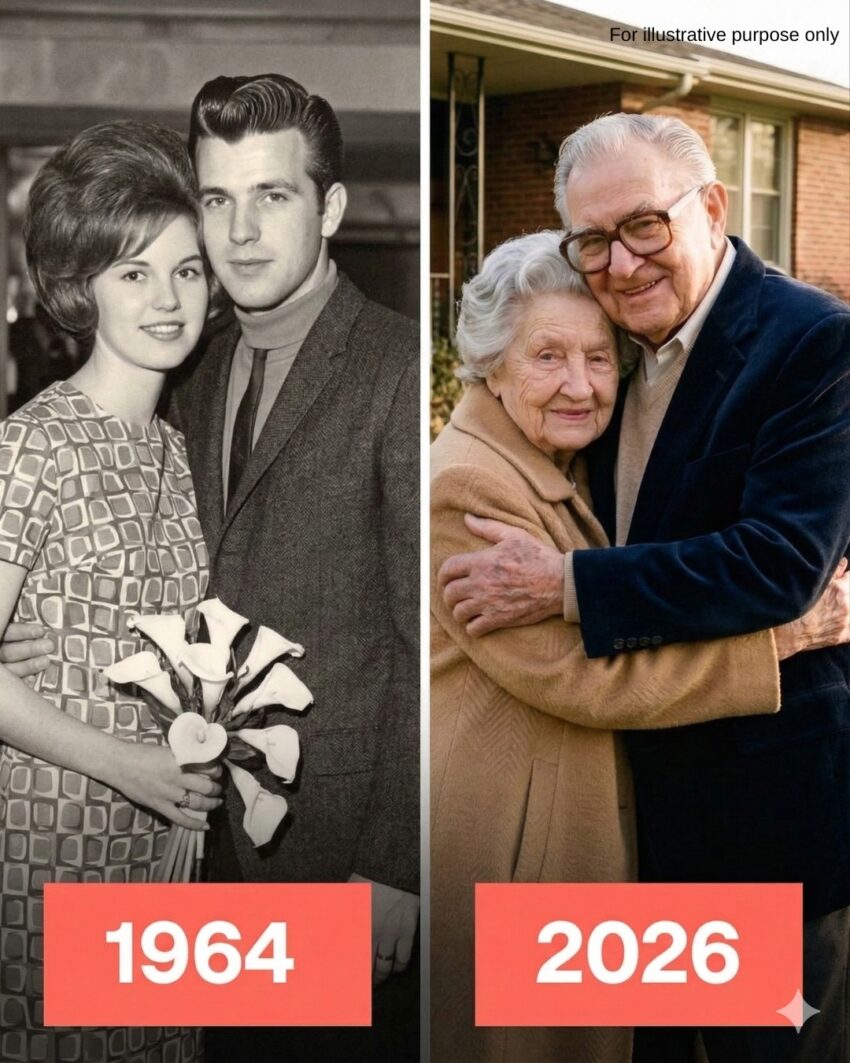
Harold and I spent 62 years together, and I believed I knew every part of the man I married. Then a girl I had never seen before walked into his funeral, handed me an envelope, and ran before I could ask her anything. Inside that envelope was the beginning of a story my husband never found the courage to tell me himself.

I barely managed to get through the service that day.
Harold and I had been married for 62 years. We met when I was 18 and married within a year. Our lives had become so deeply connected that standing in that church without him didn’t feel like simple grief—it felt like trying to breathe with only half a lung.
My name is Rosa, and for six decades Harold had been the most constant thing in my life. Our sons stood beside me, one on each side, and I leaned on their arms as we made it through the ceremony.
People were beginning to leave when I noticed her.
A girl, maybe 12 or 13, and not someone I recognized. She moved through the thinning crowd, and when her eyes found mine, she walked straight toward me.
“Are you Harold’s wife?” she asked.
“I am.”
She held out a plain white envelope. “Your husband… he asked me to give this to you on this day. At his funeral. He said I had to wait until this exact day.”
Before I could ask her name, how she knew Harold, or why a child was delivering a message from a man who had been ill for months, she turned and ran out of the church before I could say another word.
My son touched my arm. “Mom? You okay?”
“Fine… I’m fine.”
I slipped the envelope into my purse and said nothing else about it.
That evening, after everyone had gone home and the house had settled into the deep silence that follows a funeral, I opened it at the kitchen table.
Inside was a letter in Harold’s handwriting and a small brass key that clinked softly against the table when I tipped the envelope over.
I unfolded the letter.
“My love,” it began. “I should’ve told you this years ago, but I couldn’t. Sixty-five years ago, I thought I’d buried this secret forever, but it followed me my whole life. You deserve the truth. This key opens Garage 122 at the address below. Go when you’re ready. Everything is there.”
I read it twice.
I wasn’t ready.
Still, I put on my coat, called a taxi, and went.
The garage was on the edge of the city, a long row of identical metal doors in a lot that looked like it hadn’t changed since the 1970s. I found number 122, slid the key into the padlock, and lifted the door.
The smell reached me first—old paper and cedar, the closeness of a sealed space.
In the center of the concrete floor stood a massive wooden box, taller than I was, covered with cobwebs and dust that suggested it had been there for a very long time.
I wiped the front with a cloth from my pocket, found the latch, and opened the lid.
Inside were children’s drawings tied with faded ribbons, birthday cards addressed to “Dear Harold,” school certificates, and dozens of carefully preserved letters.
Every single one ended with the same name: Virginia.
At the bottom lay a worn folder. I opened it slowly.
Documents from 65 years ago showed that Harold had quietly taken responsibility for a young woman and her infant daughter after the child’s father disappeared. He paid their rent, later covered school expenses, and sent a modest monthly allowance for years. Every letter the woman wrote to him had been carefully saved as if it were precious.
One thought haunted me.
Harold had another Family. A life he had hidden from me for six decades.
I sat down on the garage floor and pressed both hands over my mouth.
“Oh, God,” I whispered. “Harold, what have you done?”
I heard tires crunch on gravel outside.
A bicycle skidded to a stop. When I turned toward the open door, the girl from the funeral stood there, slightly out of breath, her cheeks flushed from riding.
“I thought you might come here,” she said.
“You followed me?”

She nodded without embarrassment. “I rode behind the taxi. When I felt the key in the envelope, I couldn’t stop wondering what it opened. When Harold asked me to give you the envelope, he said it was the most important thing I’d ever do. He said I had to wait until that exact day.”
“I don’t understand. Who are you? How do you know my husband? What’s your mother’s name?” I asked.
The girl stepped closer and looked at the box with the curiosity children have when they discover something mysterious.
“My mom’s name is Virginia. I’m Gini, by the way!”
“Did she ever say who Harold was to her?”
Gini’s expression softened.
“She called him the man who made sure we were okay. She said he had been very close to my grandma. But Mom never called Harold her father.”
If Harold wasn’t Virginia’s father, why had he supported her life for decades? The question sat heavy in my chest, and I needed to know.
“Gini,” I said gently, “can you take me to your mom?”
The girl looked down at her shoes for a moment.
“My dad left when I was little. My mom is in the hospital right now. I stay with my neighbor most of the time. That’s how I found out Harold had died. She showed me the obituary in the paper and told me when the funeral was.”
“What happened to your mother?”
“She needs heart surgery,” Gini said quietly. “But it costs too much.”
“I want to see your mother.”
We loaded Gini’s bicycle into the taxi trunk. On the way, she mentioned that Harold had given it to her shortly before he died, and that detail caught me off guard. Then we continued on to the hospital.
Her mother lay in a narrow bed on the third floor, pale and thin, tubes running from her arm. She looked younger than her circumstances, the way illness can strip a person down to something fragile.
“She’s been here two months,” Gini said softly from the foot of the bed. “Harold used to come by sometimes to check on us. The last time I saw him, he gave me that envelope and made me promise to give it to you.”
“Did he say why?”
Gini shook her head. “I asked where he was going. He just smiled and said his health wasn’t very good anymore.”
Her words stayed with me as I stepped into the hallway and found the doctor on duty.
“The surgery is urgent,” he told me. “Without it, her chances aren’t good. The problem is the cost. Right now, the hospital doesn’t have the funding to move forward.”
I stood there in the hallway thinking about Harold in the months before he died—writing a letter, arranging a key, and trusting a child to deliver it to me on a specific day.
He had known.
He knew exactly what I would discover and exactly what he was asking me to do.
I squeezed Gini’s hand.
“I’ll be back in two days,” I told her and the doctor.
I returned with the money for the surgery.
Harold and I had always been careful with our savings, and what I spent came from what we had built together. Using it felt less like making a decision and more like completing something Harold had begun.
The surgery lasted six hours.
It was successful.
When Gini’s mother was strong enough to sit up and receive visitors, I came to her room and introduced myself as Harold’s wife, Rosa.
She looked at me for a long moment. Then her face crumpled.
“Your husband saved us,” she said. “My daughter and I wouldn’t be here without him.”
I held her hand and said little, because one question still lingered in my mind.
Harold had supported these people throughout his life. He had loved me faithfully for 62 years.
And he had never told me a word about it.
Why?
A few days later, after Gini’s mother had returned home, she invited me to their house.
She brought out an old photo album she had kept for years. I turned the pages slowly, watching a childhood unfold through photographs: a girl growing up, school pictures, holiday snapshots.
Then I turned one more page, and the breath left my body.
It was a photograph of a young Harold standing in front of what looked like a boarding house. Beside him stood a teenage girl holding a newborn baby, both squinting into the sunlight.
I knew that girl.
I had grown up in the same house as that girl.
It was my older sister, Iris.
The one who left home when I was 15 and never came back. The one my parents spent the rest of their lives refusing to talk about because the pain was too deep.
“That’s my mother,” Gini’s mother, Virginia, said softly. “She passed away 12 years ago.”
The photo slipped from my hands as tears filled my eyes.
“Are you all right?” Virginia asked, reaching out to steady me before I could collapse.
I closed the album.
“I need to go home,” I said.
Harold’s study looked exactly as he had left it: papers stacked neatly, the old desk lamp, and the leather-bound diary he had written in every night for as long as I could remember.
I sat in his chair and opened it to entries dated 65 years ago.

In Harold’s careful handwriting, the truth slowly came together like a photograph developing in a darkroom.
He had found my sister one rainy evening beside an old trailer at the edge of town. She was 19, holding a newborn baby girl in her arms. The man who had promised to marry her had already disappeared.
At first, Harold didn’t realize who she was. It wasn’t until later, when he noticed the small locket she always wore—the one that held a photograph of my sister and me—that he realized the girl he had helped was the very sister my FAMILY had lost.
For three years Harold brought food, helped her find temporary work, and quietly appeared whenever she needed help, never expecting anything in return. He wrote about her with the quiet concern you carry for someone living on the edge.
But he also knew something else.
He had already begun courting me.
Harold knew how deeply my parents had been wounded by my sister’s disappearance. He knew that if they ever discovered where she was or how hard her life had become, it would reopen wounds they had spent years trying to heal.
So Harold did what he always did.
He helped quietly.
He supported my sister and her baby from a distance, making sure they had enough to survive while never telling anyone the burden he carried. And he continued doing it for the rest of his life.
I closed the diary and held it against my chest.
Harold hadn’t hidden a betrayal.
He had hidden a kindness so great that it cost him a lifetime of silence.
The next day I returned to see Gini and her mother.
We sat at their kitchen table, and I told them everything: about my sister, the diary, what Harold had done, why he had kept it secret, and what it meant for all of us now.
Gini’s mother cried.
Gini sat very still, staring at the table before finally lifting her eyes to me, her face full of shock and hurt.
“Virginia,” I said, turning to Gini’s mother. “You are my sister’s daughter.” Then I looked at Gini. “And that makes you my great-niece.”
The kitchen fell silent for a moment.
Then Gini slid off her chair, walked across the small space between us, and wrapped both arms around me without saying a word.
I held her and thought about Harold—about the weight he had carried alone and the quiet grace with which he had carried it.
My husband hadn’t simply kept a secret.
He had kept a family—two families—whole.
“He really was something,” Gini said quietly into my shoulder.
“Yes,” I said, resting my cheek on the top of her head. “He really was.”
Harold carried the secret alone for 65 years so no one would get hurt.
And in the end, the secret he kept brought everyone home.