For illustrative purposes only
Share
For three years, I knelt beside my son’s grave apologizing for surviving the accident that killed him.
Then a stranger approached me in a hospital parking lot and whispered:
“Your son is alive.”
That was the moment my grief turned into something far more terrifying.
Because children don’t accidentally come back from the dead.
Someone had hidden him from me.
The first thing I remember after the crash was pain.
Not sharp pain.
Everywhere pain.
The kind that lives inside bone and blood and thought itself. Machines beeped around me while voices floated somewhere far away like I was underwater listening to strangers speak through walls.
Then slowly, someone said my name.
“Emma… can you hear me?”
I turned my head weakly.
Daniel.
My husband sat beside the hospital bed looking destroyed. His eyes were swollen red, his face hollow like grief had physically carved pieces out of him while I slept.
And suddenly memory came back all at once.
Rain slamming against the windshield.
Oliver singing loudly in the back seat.
Headlights.
Screaming brakes.
Metal crushing inward.
I tried to sit up instantly.
“Oliver?”
Daniel broke apart right there beside me.
He covered his face with both hands and sobbed so violently the hospital bed shook.
That was how I learned my seven-year-old son was supposedly dead.
The doctors later explained I’d spent months in a coma.
My left leg was shattered badly enough that walking again became uncertain for a while. Every movement afterward felt like dragging someone else’s damaged body behind me.
But physical pain stopped mattering quickly.
Because grief swallowed everything else first.
Every morning, I woke up expecting to hear Oliver sprinting down the hallway in his dinosaur pajamas asking impossible questions about sharks or astronauts or whether turtles could survive in space.
Instead—
silence.
The kind that slowly poisons a house from the inside.
Daniel became my caretaker after that.
He cooked.
Cleaned.
Drove me to physical therapy appointments.
Helped me shower when I couldn’t balance alone.
And every Sunday, without fail, he drove me to the cemetery.
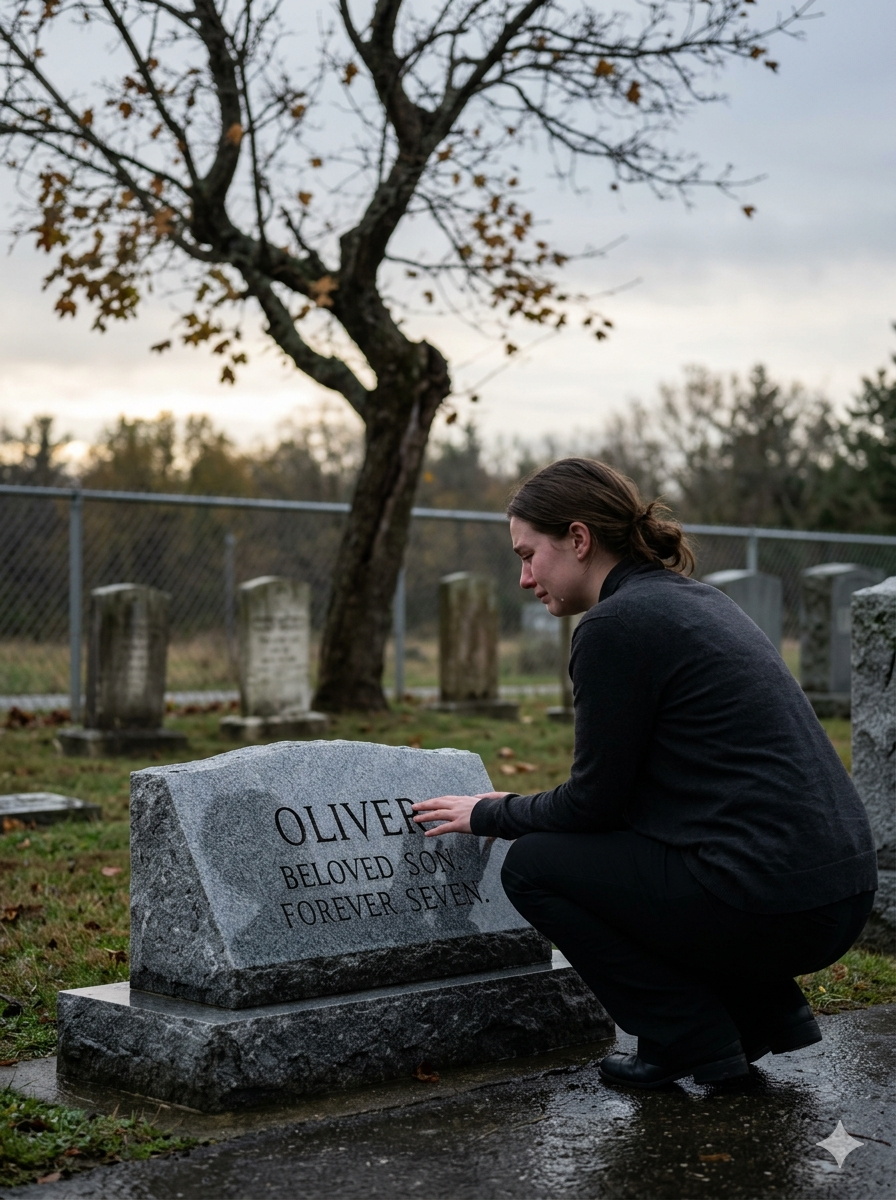
Oliver’s grave sat beneath a maple tree near the back fence.
Beloved Son. Forever Seven.
I traced those words so many times I eventually memorized every crack in the stone itself.
But even during the worst parts of my grief…
something always felt wrong.
There were never flowers.
No toys.
No little soccer balls or superhero figures left behind by visiting relatives.
Nothing that looked connected to a little boy’s life.
And Daniel…
Daniel never stayed long beside the grave.
He usually stood several feet away with his hands buried inside his coat pockets staring down at the dirt like he physically couldn’t force himself closer.
Sometimes I whispered:
“Do you think he knows I’m sorry?”
Daniel always answered too quickly.
“It wasn’t your fault.”
But deep down, I could still see blame hiding somewhere inside him.
And worse
I blamed myself too.
Because I was driving.
Because I survived.
Because mothers are experts at finding ways to turn tragedy into self-punishment.
For three years, I existed like that.
Not truly living.
Just surviving grief one day at a time while pretending the pain might someday soften enough to breathe around.
Then one rainy Thursday afternoon, everything shattered.
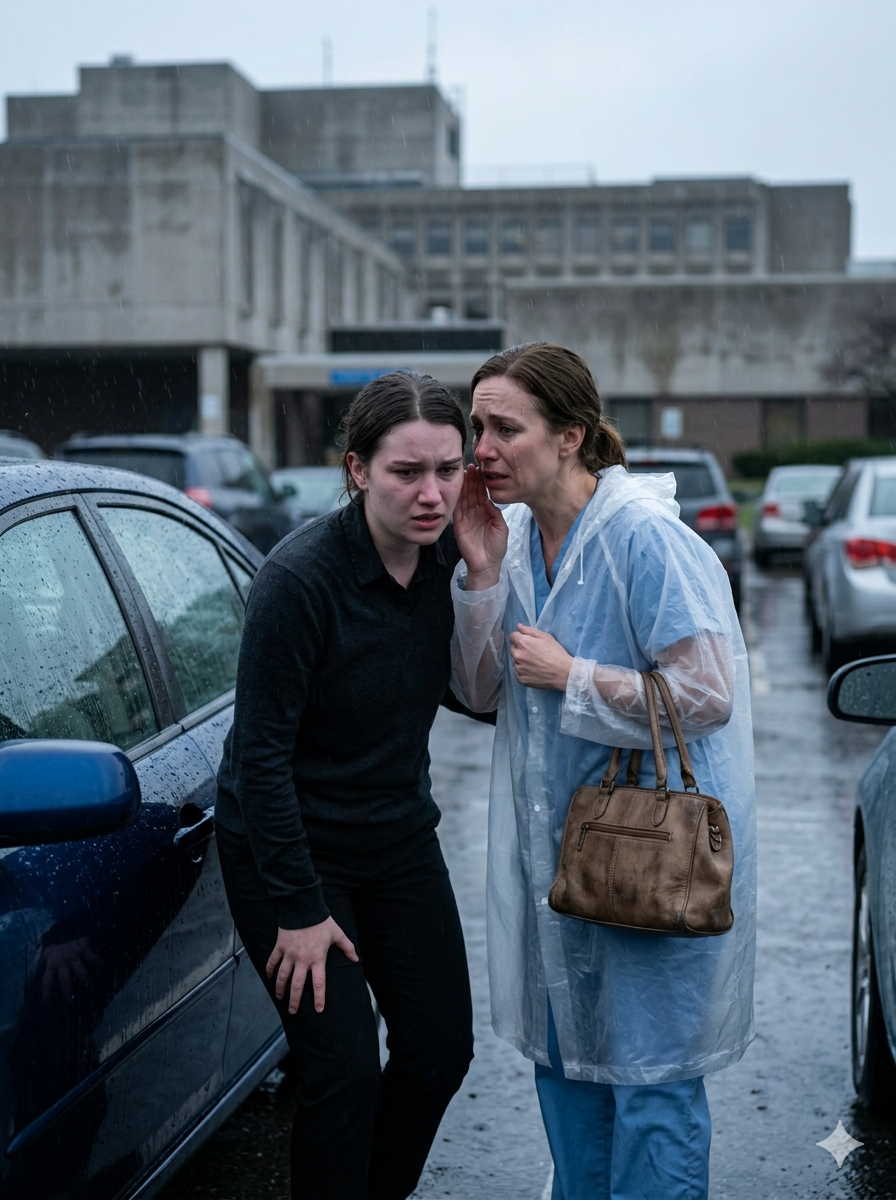
I had just finished physical therapy when a woman approached me in the hospital parking lot.
She looked nervous.
Terrified, honestly.
Her hands clutched her purse so tightly her knuckles looked bloodless.
“Emma?”
I nodded slowly.
The second she saw my face clearly, tears filled her eyes.
“My name is Claire,” she whispered. “I was a nurse at St. Mary’s Hospital the night of your accident.”
Something inside my stomach tightened instantly.
“I know this sounds impossible,” she said shakily, “but your son survived.”
The world stopped moving.
I stared at her unable to process the sentence.
“No.”
“He lived.”
My knees gave out immediately.
I hit the wet pavement hard enough to feel pain shoot through my bad leg again, but none of it mattered.
Because suddenly reality itself no longer made sense.
I remember screaming.
Not words.
Just raw sound tearing out of me while Claire cried beside me.
Then slowly, piece by piece, she explained everything.
After the crash, Oliver survived with only minor injuries. Bruises. A concussion. Nothing life-threatening.
But Daniel completely fell apart emotionally.
The doctors warned him I might need years of rehabilitation if I even woke up fully at all.
And somewhere inside his fear and grief, Daniel made a decision entirely on his own.
He sent Oliver away.
His sister Rebecca lived several hours from the city. Daniel convinced himself Oliver would be safer there while I recovered because he blamed me for the accident—even if he never admitted it aloud directly.
Claire begged him not to do it.
Argued with him repeatedly.
But legally, Daniel was Oliver’s father.
And I was unconscious.
Voiceless.
Unable to fight for my own child.
“He told everyone you knew,” Claire sobbed. “Even hospital staff. He said you agreed Oliver should stay hidden while you healed.”
Hidden.
The word nearly made me vomit.
For three years, I mourned a child who wasn’t dead.
For three years, I kissed a gravestone while my son grew taller somewhere else believing his mother abandoned him.
And my husband allowed it.
I drove home shaking so badly I almost ran a red light.
When Daniel walked through the front door that evening, I was waiting in the kitchen.
“You lied to me.”
The color disappeared from his face instantly.
For several seconds, neither of us moved.
Then slowly, he sat down and buried his face in his hands.
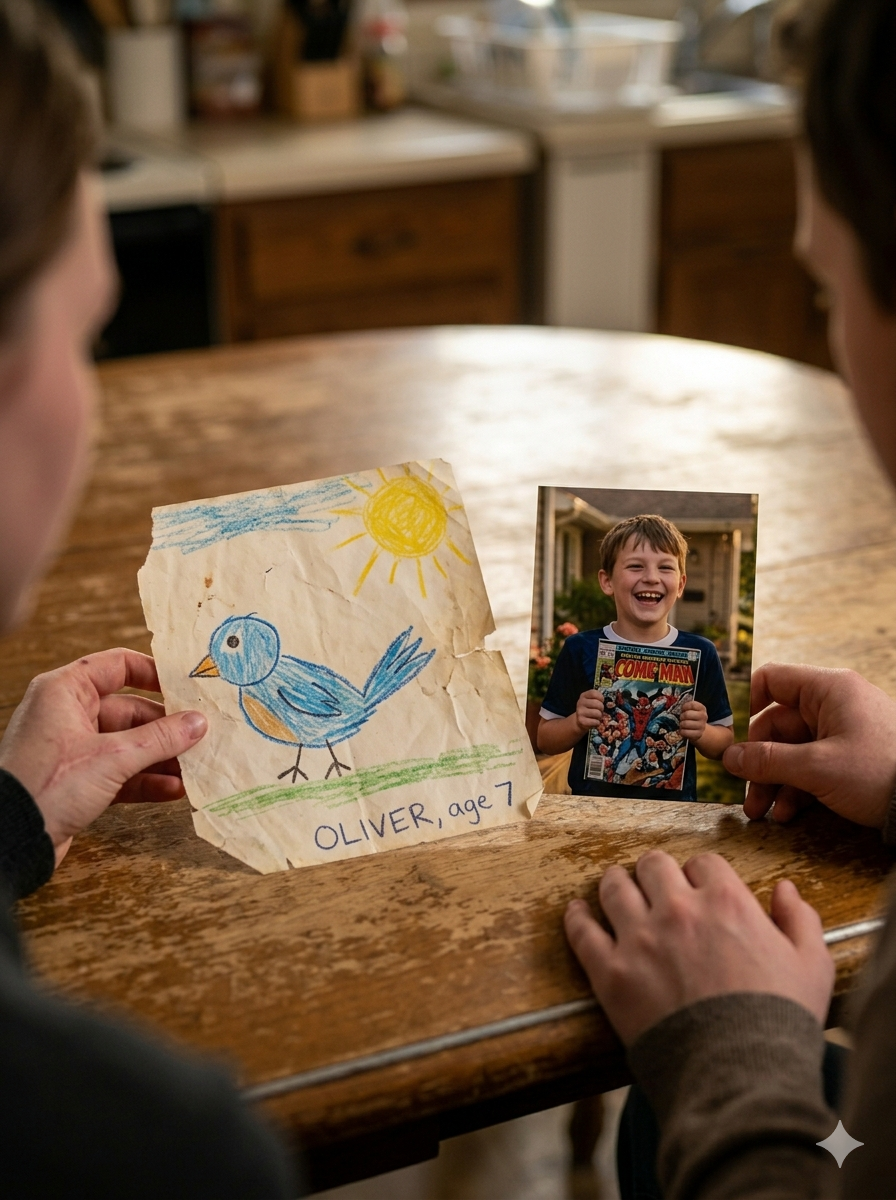
“He was supposed to come back,” he whispered.
My chest tightened violently.
“You let me believe our son was dead.”
“I thought you’d break completely if I brought him back too soon.”
“You decided I wasn’t his mother anymore.”
Daniel started crying immediately.
Real crying.
Broken crying.
“I lost control,” he whispered. “Emma, I thought I was protecting him. I thought I was protecting both of you.”
I wanted to hate him.
God, part of me absolutely did.
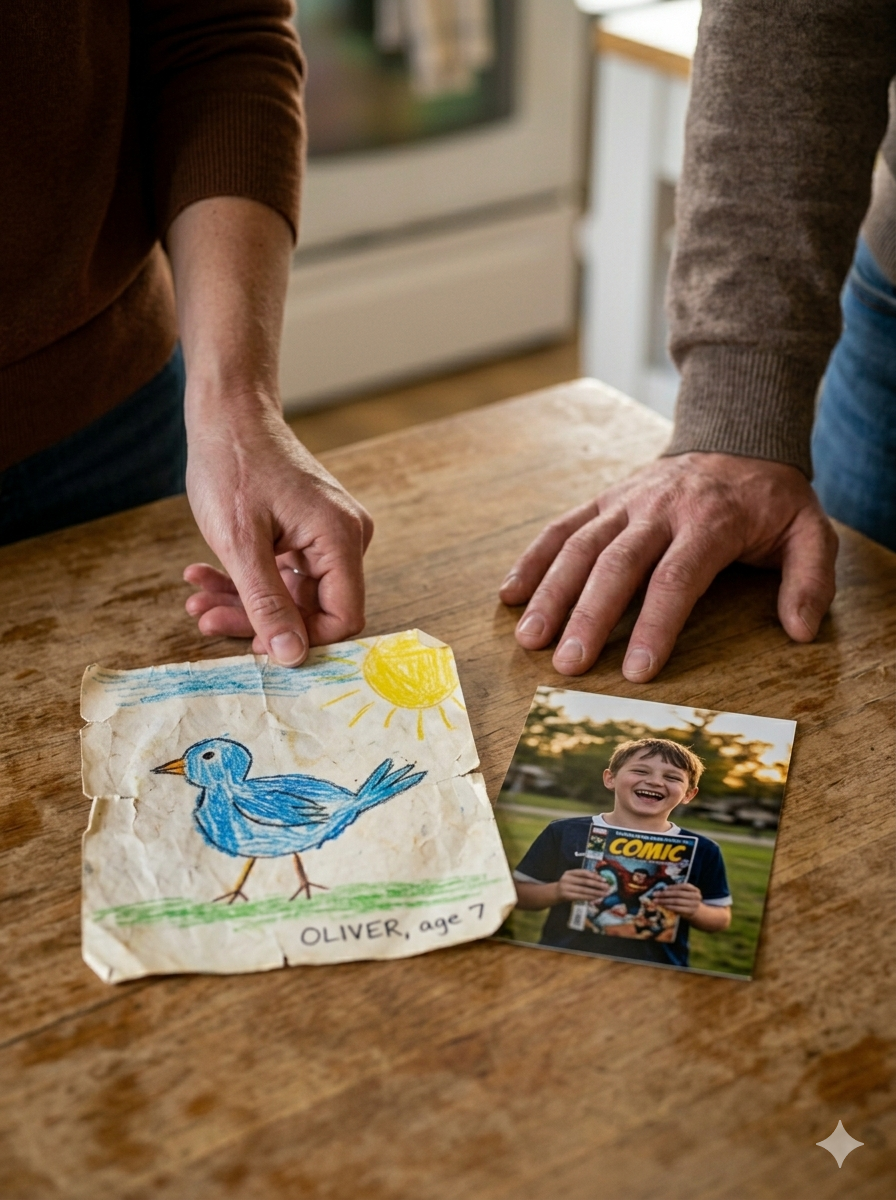
But another part saw the same thing Claire probably saw years earlier:
a man destroyed by fear making monstrous choices while convincing himself they were temporary.
That didn’t excuse anything.
But grief rarely creates clean villains.
Just broken people hurting each other while trying to survive impossible pain.
The next morning, I drove to Rebecca’s house before sunrise.
My hands shook the entire drive.
When Rebecca opened the front door and saw me standing there, confusion crossed her face instantly.
“Emma?”
Then somewhere inside the house, a little voice shouted:
“Aunt Becky! Where’s my soccer ball?”
My entire body stopped functioning.
And then—
there he was.
Oliver.
Taller now.
Older.
Alive.
For one impossible second, neither of us moved.
Then his eyes widened completely.
“Mom?”
I started crying before he even reached me.
He ran straight into my arms so hard we almost collapsed together onto the porch floor.
And the second I held him against my chest—
warm,
breathing,
real—
something inside me came back to life too.
Rebecca cried immediately after realizing the truth.
She genuinely believed I knew everything all along. Daniel convinced her I agreed Oliver should stay there temporarily while I recovered emotionally and physically.
That revelation shattered all of us in different ways.
The months afterward were ugly.
Therapy.
Screaming fights.
Silences heavy enough to suffocate rooms.
Oliver struggling to understand why his mother disappeared from his life for years.
Daniel drowning in guilt so severe he barely slept.
Trust didn’t magically rebuild.
It had to be reconstructed painfully one conversation, one apology, one honest moment at a time.
And honestly, part of me will probably always carry scars from what he stole from us.
But eventually I realized something difficult:
forgiveness isn’t the same thing as approval.
What Daniel did was unforgivable in many ways.
But carrying hatred forever would’ve poisoned the fragile life Oliver and I fought so hard to reclaim together.
Today, Oliver is ten years old.
He loves soccer, comic books, and terrible knock-knock jokes that somehow get worse every year.
Rebecca remains one of the closest people in our lives.
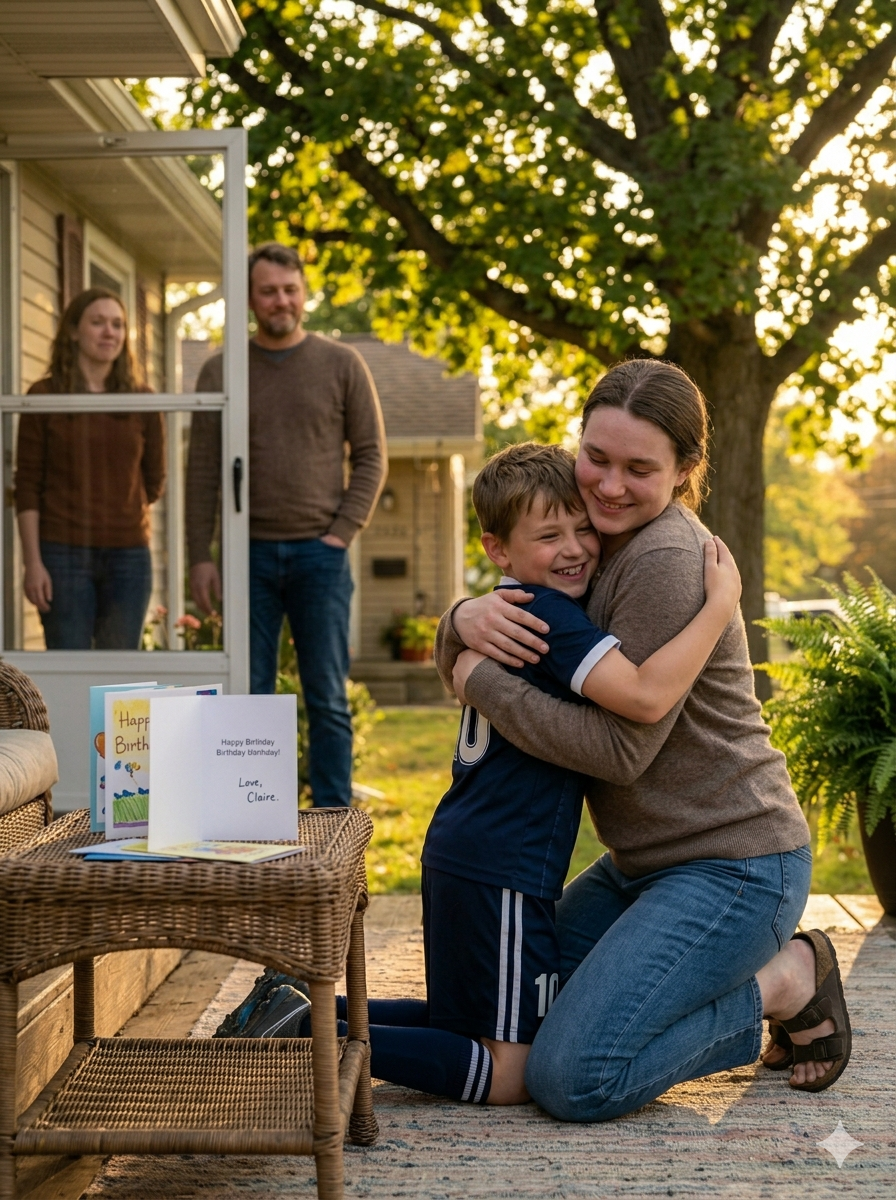
And Claire—the nurse who finally chose truth over silence—still mails Oliver birthday cards every single year.
She always insists she isn’t a hero.
But she is.
Because sometimes the bravest thing a person can do isn’t saving someone dramatically.
Sometimes bravery is simply refusing to let another human being continue suffering inside a lie.