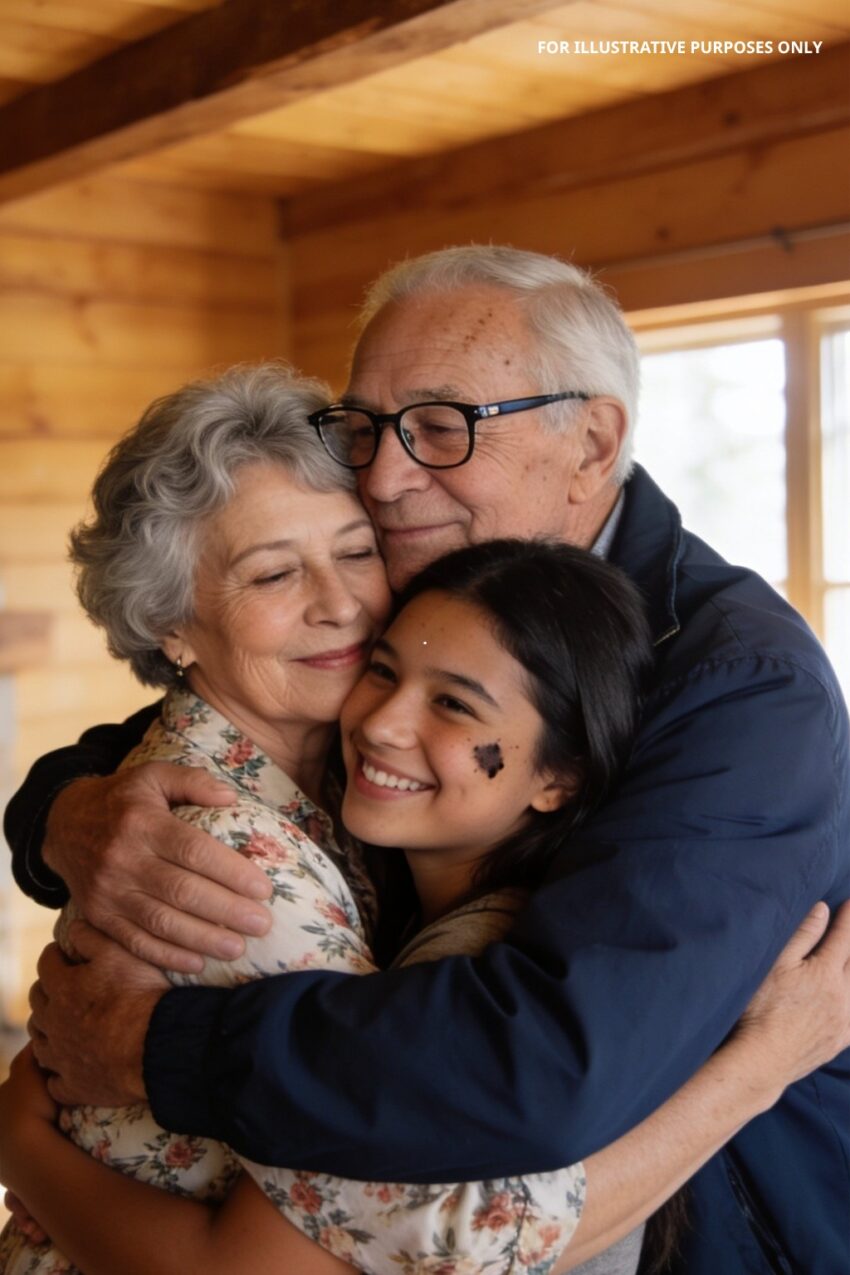
For most of my life, I believed motherhood simply wasn’t meant for me.
My name is Margaret. I’m 75 years old now, and my husband Thomas and I have been married for more than fifty years.
For decades, it was just the two of us.
We tried everything to have children. Doctors. Treatments. Hormones. Endless appointments filled with cautious hope and quiet heartbreak.
Then one afternoon, a doctor folded his hands and said gently:
“I’m sorry. Your chances are extremely low.”
And just like that, the dream ended.
No miracle.
No second option.
Only silence.
Eventually, we stopped talking about nurseries and baby names. We learned how to continue living around the emptiness instead of through it. By the time I turned fifty, we had convinced ourselves we’d made peace with never becoming parents.
Then one conversation changed everything.
A neighbor, Mrs. Collins, mentioned a little girl living at the local children’s home.
“She’s been there since birth,” she told me softly. “Five years now.”
“Five years?” I repeated.
Mrs. Collins nodded sadly.
“Families ask for pictures. Some even schedule visits. But once they see her face… they disappear.”
I frowned. “Why?”
“She has a large birthmark,” she said quietly. “It covers most of one side of her face. People decide it’s too difficult.”
Then she added words I never forgot:
“She’s been waiting her whole life for someone to choose her.”
That night, I sat across from Thomas at the kitchen table and brought her up.
I expected practical concerns.
We were older. Slower. Tired.
Instead, he looked at me carefully and said:
“You can’t stop thinking about her, can you?”
I shook my head.
“She’s been waiting her whole life.”
Thomas leaned back in his chair.
“If we do this,” he said slowly, “we’ll be in our seventies by the time she’s grown.”
“I know.”
“There’ll be school, expenses, college…”
“I know.”
A long silence passed between us before he finally smiled.
“Then let’s meet her.”
Two days later, we walked into the children’s home.
A social worker led us toward a small playroom.
“She knows visitors are coming,” the woman explained carefully. “But we didn’t promise anything. We try not to build expectations we can’t keep.”
Inside the room sat a tiny girl coloring carefully at a child-sized table.
Her dress was too big for her, like it had belonged to several children before reaching her.
And her birthmark—
It stretched across most of the left side of her face, dark and impossible not to notice.
But her eyes were what stayed with me.
They weren’t childish eyes.
They were cautious.
Watchful.
The eyes of someone who had already learned disappointment too young.
I knelt beside her.
“Hi,” I said softly. “I’m Margaret.”
She glanced at the social worker first before answering.
“Hi.”
Thomas squeezed himself into a tiny plastic chair across from her.
“I’m Thomas.”
She studied him seriously for several seconds before asking:
“Are you old?”
Thomas burst out laughing.
“Older than you.”
Then she asked the question that shattered my heart.
“Will you die soon?”
The room went silent.
But Thomas didn’t hesitate.
“Not if I can help it,” he said gently. “I plan on being a problem for a very long time.”
For the first time, a tiny smile escaped her before she quickly hid it again.
That was Lily.
Careful with hope.
Suspicious of kindness.
Always waiting for people to leave.
The adoption process took months.
But the day it became official, Lily walked out of the children’s home carrying a worn stuffed rabbit and a tiny backpack she held like it contained her entire world.
On the drive home, she stared quietly out the window.
Then she asked:
“Is this really my house now?”
“Yes,” I told her.
“For how long?”
Thomas turned toward her.
“For always,” he said. “We’re your parents now.”
She looked between us carefully.
“Even if people stare at me?”
I felt my chest tighten.
“People stare because they’re rude,” I said firmly. “Not because there’s something wrong with you. Your face does not embarrass us. Not ever.”
She nodded slowly, like she was storing the words away for later testing.
Because Lily didn’t trust love immediately.
She studied it first.
The first few weeks broke my heart in small ways.
She asked permission for everything.
Can I sit here?
Can I drink water?
Can I turn on the light?
Can I use the bathroom?
It was as if she believed existing too loudly might get her returned.
One evening, I finally sat beside her and said:
“Lily… you don’t have to ask permission to exist here.”
Her eyes filled instantly.
“What if I’m bad?” she whispered. “Will you send me back?”
I held her little face gently in my hands.
“You might get grounded someday,” I said softly. “You might lose television privileges. But we will never send you away. You are ours.”
She cried so hard that night she fell asleep in my lap.
School, unfortunately, was harder.
Children noticed her birthmark immediately.
And children can be cruel.
One afternoon, she climbed silently into the car after school with red swollen eyes and her backpack pressed tightly against her chest.
Finally she whispered:
“A boy called me ‘monster face.’ Everyone laughed.”
I pulled the car over immediately.
“Listen to me carefully,” I said. “You are not a monster. Anyone who says that is the ugly one—not you.”
She touched the side of her face quietly.
“I wish it would go away.”
My heart shattered.
“I know,” I whispered. “But I don’t wish you were different.”
That moment changed something in her.
Slowly, year by year, Lily stopped shrinking.
At thirteen, she finally asked about her biological mother.
“Do you know anything about her?”
“We know she was very young,” I said honestly. “And that’s all.”
Lily stared down at her hands.
“So she just left me?”
I chose my words carefully.
“I don’t think any mother forgets the child she carried.”
She didn’t answer.
But I saw the pain settle deeper inside her. As she got older, though, something extraordinary happened.

Instead of becoming bitter, Lily became strong.
When strangers stared, she stopped hiding.
“It’s a birthmark,” she’d say calmly. “No, it doesn’t hurt. Yes, I’m okay.”
At sixteen, she announced she wanted to become a doctor.
Thomas nearly choked on his coffee.
“That’s a very long road.”
“I know,” she replied confidently.
“Why medicine?” I asked.
And Lily answered with words that still make me emotional.
“Because I want children who feel different to look at someone like me and realize they aren’t broken.”
She studied harder than anyone I’d ever seen.
College.
Medical school.
Residency.
Failure never stopped her. It only sharpened her determination.
By the time she became a doctor, Thomas and I were slowing down ourselves.
More medications on the counter.
More naps.
More doctors’ appointments.
But Lily called daily.
Visited weekly.
And scolded me constantly about salt intake like I was one of her patients.
We thought we knew her whole story.
Then the letter arrived.
Plain white envelope.
No stamp.
No return address.
Only my name written neatly across the front.
Inside were three pages.
The first line stole the air from my lungs.
“My name is Emily. I am Lily’s biological mother.”
I sat frozen at the kitchen table while Thomas read over my shoulder.
Emily explained that she had been only seventeen when she became pregnant.
Her parents were strict, controlling, deeply religious people who believed Lily’s birthmark was some kind of punishment from God.
“They refused to let me bring her home,” she wrote.
My hands shook.
Emily said she had been pressured into signing adoption papers immediately after birth.
She was young.
Terrified.
Penniless.
Alone.
“So I signed,” she wrote. “But I never stopped loving her.”
Then came the sentence that broke me completely.
“When Lily was three, I visited the children’s home once and watched her through a window. I was too ashamed to go inside.”
Tears blurred the page.
Emily explained that when she returned later, Lily had already been adopted by “an older couple who looked kind.”
She said she cried for days afterward.
Then the final page revealed why she was writing now.
Cancer.
Terminal.
She didn’t want custody.
Didn’t want forgiveness.
Only one thing:
“I need Lily to know she was always wanted.”
Thomas looked at me quietly after finishing the letter.
“We tell her,” he said.
So we did.
Lily arrived straight from work still wearing scrubs, clearly expecting bad news.
I slid the letter toward her.
Whatever you feel, I wanted her to know one thing first.
“We are with you.”
She read every word in silence.
Then one tear fell onto the paper.
“She was seventeen,” Lily whispered finally.
“Yes.”
“And her parents forced her to give me up?”
“Yes.”
For years, Lily had secretly believed she had been abandoned because of her face.
Now the truth was infinitely more painful—and somehow gentler too.
“It wasn’t that simple,” she whispered.
“No,” I said softly. “Life rarely is.”
Then she looked up suddenly.
“You and Thomas are still my parents.”
Relief hit me so hard I almost cried myself.
“We’re not losing you?”
Lily actually laughed through tears.
“I’m not trading you two for anybody. You’re stuck with me.”
A week later, we met Emily at a small coffee shop.
She was thin from treatment, pale, wearing a scarf over her head.
But the moment she walked in—
I saw Lily’s eyes staring back at me.
The resemblance was undeniable.
Lily stood slowly.
“Emily?”
The woman nodded, already crying.
“You’re beautiful,” she whispered.
Lily touched the birthmark on her face.
“I still look the same.”
Emily’s voice cracked.
“And I was wrong for letting anyone convince me that made you less.”
Then came the hardest question.
“Why didn’t you come back for me?”
Emily broke completely.
“Because I was scared,” she admitted. “Because I had no money, no support, and no idea how to fight them. None of that excuses what happened. I failed you.”
Lily sat quietly for a long moment.
Then she whispered:
“I thought I’d hate you.”
Emily lowered her eyes.
“But mostly,” Lily continued softly, “I just feel sad.”
“Me too,” Emily whispered back.
The meeting didn’t magically heal everything.
No dramatic movie ending happened.
No perfect reconciliation.
Just truth.
Messy, painful, human truth.
On the drive home, Lily stared silently out the window for a long time before suddenly breaking down in tears.
“I thought meeting her would fix something,” she sobbed.
I climbed into the backseat and held her the way I had when she was five years old.
“The truth doesn’t always fix things,” I whispered. “Sometimes it just ends the wondering.”
She buried her face against my shoulder.
“You’re still my mom.”
“And you’re still my girl,” I told her.
That part never changed.
Now, years later, Lily and Emily speak sometimes.
Sometimes months pass without contact.
Their relationship is complicated.
Real life usually is.
But one thing changed forever after that letter arrived.
Lily no longer calls herself unwanted.
Because now she understands something she spent her whole life doubting:
She was wanted twice.
First by a frightened seventeen-year-old girl who loved her but couldn’t protect her.
And then by two older people who heard someone call her “the girl nobody wanted”— and knew immediately that the world was wrong.