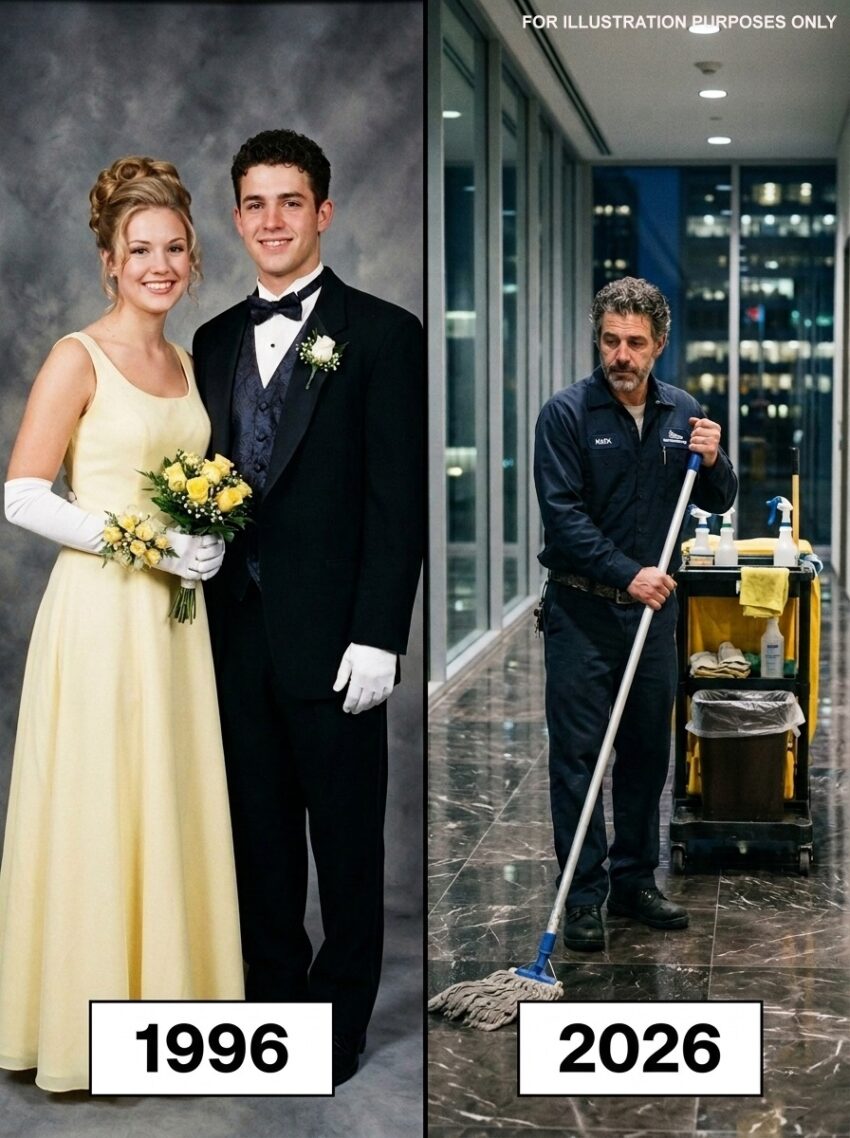
The last person I expected to find mopping the marble floors of my company at midnight was my father.
Not that I had ever known him.
Not really.
For thirty years, he existed only as a faded photograph tucked inside my mother’s Bible—a young man with an easy smile, standing beside a pregnant woman in a blue graduation gown, his arm wrapped around her waist as if he planned to stay forever.
According to my mother, he disappeared before I was born.
According to family stories, he walked away without looking back.
And according to the angry little boy I once was, he never cared enough to return.
So when I found a sick, exhausted cleaner dragging a mop across the executive floor of my headquarters one rainy night, the last thing I expected was for him to become the answer to a question that had haunted my entire life.
The building was nearly empty.
Most employees had gone home hours earlier.
Only a handful of security guards and cleaning crews remained.
I was working late, reviewing logistics reports, when I noticed movement near the executive elevators.
An older man stood beside a bucket, slowly mopping the polished marble floor.
At first, nothing seemed unusual.
Then he doubled over coughing.
Not a normal cough.
The kind that seemed to come from somewhere deep inside his chest.
The kind that made me stop walking.
He quickly straightened when he noticed me.
“Sorry, sir,” he said nervously. “I’ll have this cleaned before the morning crew arrives.”
I studied him carefully.
His boots were held together with tape.
His uniform hung loosely from his thin frame.
Sweat glistened on his forehead despite the building’s cold air conditioning.
And his hands wouldn’t stop trembling.
“You’re sick,” I said.
He forced a smile.
“No, sir. Just tired.”
“That wasn’t a question.”

He looked away.
“I’m working.”
The answer irritated me more than it should have.
Because it wasn’t an answer.
It was the response of someone who had learned that being honest could cost them a paycheck.
I moved closer.
“Do you need a doctor?”
The man laughed quietly.
“Doctors are for people with insurance.”
My jaw tightened.
“Your employer doesn’t provide coverage?”
“Contract workers don’t get benefits.”
Then he tried to stand too quickly.
His knee buckled.
The mop slipped.
The bucket tipped over.
Dirty water spread across the marble floor and splashed onto my shoes.
The old man immediately panicked.
“Please,” he said. “Don’t report me.”
I stared at him.
He wasn’t worried about the spill.
He was terrified of losing his job.
“It’s just water.”
“I’ll clean it.”
“Leave it.”
“Please don’t tell my supervisor.”
The fear in his voice stopped me cold.
Nobody should be this afraid over a bucket of water.

“What’s your name?”
“Raymond.”
“Last name?”
He hesitated.
“Just Raymond.”
That answer felt strange.
Like a man trying to make himself smaller.
Less noticeable.
Less important.
I pulled out my phone.
His eyes widened immediately.
“Please don’t call my supervisor.”
“I’m not calling your supervisor.”
I glanced back at him.
“I’m calling someone who can explain why a sick man is cleaning my building without healthcare.”
Then I walked into my office and called my assistant.
By sunrise, I wanted answers.
Not just about Raymond.
About every worker in the building.
After the call ended, I found myself staring at a framed photograph sitting on my desk.
It showed my mother helping me blow out a single candle on a cupcake during my first birthday.
We didn’t have much money.
We never had much money.
But somehow she always made me feel rich.
She worked endless shifts.
Skipped meals.
Took extra jobs.
And still found a way to smile.
That photograph was the reason I built my company.
Because I never wanted hardworking people to be invisible.
And suddenly, Raymond felt invisible.

The next morning, I called him into my office.
He arrived clutching an old cap in both hands.
The poor man looked terrified.
“Sir, if this is about the spill—”
“It isn’t.”
He stopped speaking.
“Sit down.”
He glanced around nervously.
“I’ve cleaned outside this office for years,” he admitted. “Never been inside.”
I slid a folder across the desk.
“Your contractor doesn’t provide benefits.”
He nodded.
“So I changed that.”
His forehead creased.
“Changed what?”
“Every night cleaner assigned to this building now gets emergency medical coverage and paid sick leave while we review the contract.”
Raymond stared at me.
Then at the folder.
Then back at me.
“For everybody?”
“For everybody.”
His eyes filled unexpectedly.
“Why?”
“Because nobody should have to choose between getting treatment and keeping their job.”
For a long moment, he couldn’t speak.
Then his gaze drifted toward the framed photograph on my desk.
And everything changed.
His face suddenly went pale.
“That woman,” he whispered.
I frowned.
“What about her?”
His eyes remained locked on the photograph.
“What’s her name?”
My pulse slowed.
“Claudette.”
The cap slipped from his hands.
For several seconds, he simply stared.
Then he whispered:
“She had the baby.”
A strange feeling settled into my chest.
I opened a drawer.
Pulled out the old graduation photograph my mother had kept for decades.
And placed it on the desk.
The effect was immediate.
Raymond’s entire body seemed to collapse.
His hands began shaking.
His eyes filled with tears.
“Oh God.”
I looked from the photograph to the man sitting across from me.
And suddenly I knew.
“You’re Raymond.”
He closed his eyes.
“Yes.”
The room felt impossibly small.
“You’re my father.”
For years, I imagined this moment.
Usually it involved shouting.
Accusations.
Anger.
Instead, I felt numb.
Because the man sitting in front of me wasn’t the monster I’d imagined.
He looked exhausted.
Broken.
Ashamed.
And very, very old.
“You left her,” I said.
His head dropped.
“Yes.”
“While she was pregnant.”
“Yes.”
“You disappeared.”
His voice cracked.
“Yes.”
The honesty somehow hurt more than excuses would have.
“Then explain.”
And for the first time in thirty years, he did.

He told me he was nineteen.
Scared.
Poor.
Unprepared.
He admitted leaving.
Admitted running.
Admitted failing.
Then he told me something I never expected.
Three months later, he came back.
He went looking for my mother.
But his own mother told him she had lost the baby.
Told him she moved away.
Told him she wanted nothing to do with him.
And he believed it.
Not because it made sense.
Because it was easier than facing his fear.
“I should’ve looked harder,” he whispered.
“I should’ve searched everywhere.”
“Yes,” I said coldly.
“You should have.”
For a moment, neither of us spoke.
Then I asked the question that mattered most.
“Is that really what happened?”
He looked me straight in the eye.
“Yes.”
And somehow, I believed him.
That evening, I drove straight to my mother’s house.
When I told her I’d found Raymond, she nearly dropped the dish towel she was holding.
“Raymond?”
“He works in my building.”
The color left her face.
Then I told her the rest.
About his mother.
About the lie.
About the baby who supposedly died.
My mother’s expression changed instantly.
Not sadness.
Not shock.
Rage.
Pure rage.
“Take me to her.”
“Tonight?”
“Tonight.”
I’d never seen my mother move so fast.
We found Raymond’s mother living in an assisted-living facility across town.
She looked harmless.
Small.
Fragile.
Elderly.
Until she admitted everything.
Yes.
She told him the baby died.
Yes.
She lied.
And yes.
She did it deliberately.
“I was protecting my son.”
Those five words echoed through the room.
My mother stared at her.
Then quietly replied:
“No.”
Her voice shook.
“You were protecting yourself.”
The old woman tried defending her decision.
Tried explaining.
Tried justifying.
But there are some wounds too deep for explanations.
And thirty years of stolen time was one of them.
When we left, my mother looked exhausted.
Not physically.
Emotionally.
Like she had just carried thirty years of grief back to the surface.
But she wasn’t finished.
“Take me to him.”
So I did.
Raymond was waiting in my office.
The second he saw her, he stood.
“Claudette.”
My mother stopped several feet away.
“Don’t say my name like you protected it.”
The words hit him like a punch.
And for the next hour, I watched two people confront three decades of pain.
No screaming.
No dramatic breakdowns.
Just truth.
Raw.
Uncomfortable.
Necessary truth.
My mother told him about the years he missed.
The birthdays.
The school events.
The nights she cried after I fell asleep.
The sacrifices.
The loneliness.
The fear.
And Raymond listened.
Because for once, there was nothing left to hide behind.
No lies.
No misunderstandings.
No missing information.
Just consequences.
And regret.
When she finally finished, Raymond looked at the floor.
“I’m sorry.”
My mother nodded.
“I know.”
“I’m not asking you to forgive me.”
“Good.”
The honesty in that exchange felt more powerful than any apology.
Because forgiveness wasn’t owed.
Trust wasn’t automatic.
And thirty years couldn’t be repaired in a single afternoon.
But something else happened.
Something smaller.
Something real.
A door opened.
Before leaving, I handed Raymond the folder containing his medical appointment information.
“Your first doctor’s visit is tomorrow.”
He looked surprised.
“You’re still helping me?”
I considered the question carefully.
Then answered honestly.
“I’m not helping you because you’re my father.”
His face fell slightly.
“I’m helping you because nobody should be treated like they’re disposable.”
He nodded slowly.
And for the first time all day, I saw a tiny spark of dignity return to his eyes.
Thirty years earlier, Raymond walked away from my mother promising he’d come back.
He never did.
Thirty years later, I didn’t give him forgiveness.
I didn’t give him a fresh start.
I didn’t erase the damage.
What I gave him was something far smaller.
And far more difficult.
Tomorrow.
A chance to show up.
A chance to tell the truth.
A chance to earn whatever came next.
Because some wounds never fully heal.
But sometimes, after decades of silence, the truth finally arrives.
And that is where healing begins.