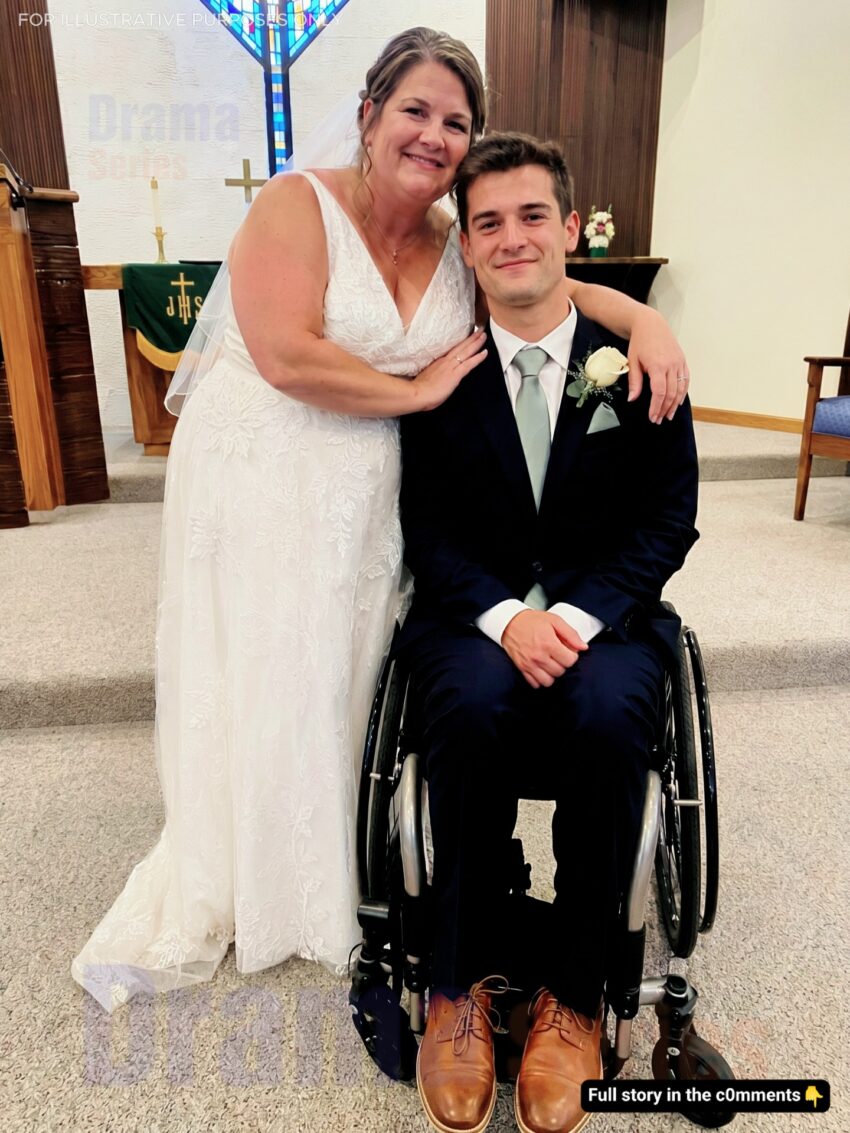
I married the paralyzed twenty-year-old millionaire I had been caring for.
And on our wedding night, behind his locked bedroom door, he looked at me with tears in his eyes and said, “There’s no way back now. I’ll tell you why I really married you.”
Then he handed me a crimson envelope with my daughter’s name written across the middle.
Lisa.
For a moment, I forgot how to breathe.
My daughter had been in a coma for almost a year.
A car accident had taken her laughter, her voice, and the bright future she used to talk about every morning over burnt toast and cheap coffee. She was nineteen, but when I sat beside her hospital bed, brushing her hair and telling her about the weather, she looked heartbreakingly small.
The doctors had tried everything they could.
Then one afternoon, Dr. Wallace pulled me aside.
“If you can’t find the money for this experimental treatment, ma’am,” he said gently, “Lisa may never wake up at all.”
I nodded because crying in front of him would not change the price.
After that, I became a woman made of errands, night shifts, and prayers. I cleaned offices before sunrise, washed dishes in the back of a restaurant at night, and cared for elderly patients when I could get referrals.

Then I was hired at the Hawthorne estate.
Adrian Hawthorne was only twenty, but grief had aged him in strange ways. His parents had died in the same crash that left him paralyzed from the waist down. He was the sole heir to Hawthorne Industries, one of the largest companies in the country, but the mansion felt less like a home and more like a museum of silence.
The first week, I burned his soup.
I stood there, mortified, holding the tray like a guilty child.
“I’m so sorry, sir.”
He looked at the bowl, then at me, and pushed it away.
“Don’t call me sir,” he said. “You make me feel like an antique vase.”
I laughed before I could stop myself.
It was the first time I had laughed in months.
Adrian was not easy to care for, but he was never cruel. Some days, pain made him sharp. Some nights, migraines trapped him in darkness, and I would sit beside him reading old novels in a soft voice until his breathing steadied.
He asked about Lisa once.
I told him only the basics. My daughter. The accident. The coma. The treatment I could not afford.
He listened without pity, which somehow felt kinder.
For six months, I helped him dress, changed his bandages, prepared his meals, and watched him slowly return to the world in small pieces. He began sitting in the garden again. He started asking for music in the morning. Once, I found him laughing at a terrible old comedy show, and the sound startled me so much I almost dropped the laundry.
Then, one rainy Thursday, he rolled into the kitchen while I was scrubbing coffee off my sleeve.
“Marry me,” he said.
I froze.
“Adrian, don’t joke like that.”
“I’m not joking.”
I stared at him. “I’m forty-three.”
“I know.”
“I’m old enough to be—”
“You’re not my mother,” he cut in, his voice suddenly strained. “And I’m not asking because of romance.”
That hurt less than it should have, because I already knew.
He looked down at his hands. “I need someone I can trust. You need money for Lisa. If you marry me, you’ll never have to worry about her treatment again.”
Every sensible part of me screamed no.
But that night, I went to the hospital and saw another bill waiting on the chair beside Lisa’s bed. I held her limp hand and whispered, “What should I do, baby?”
She did not answer.
So I said yes.
The wedding was quiet, almost secret. No guests except Adrian’s lawyer, his driver, and the housekeeper who cried into a handkerchief as if she were witnessing something either beautiful or tragic. There were no flowers except the ones his driver bought at a gas station. No kiss. Just Adrian’s cold fingers tightening around mine when the officiant pronounced us husband and wife.
That night, the mansion seemed larger than ever.
Adrian asked everyone to leave.
Then he rolled into his bedroom and waited for me to follow.

The moment I stepped inside, he shut the door.
His face had gone pale.
“There’s no way back now,” he whispered. “I’ll tell you why I really married you.”
My stomach twisted.
He reached into the drawer beside his bed and handed me the crimson envelope.
Lisa’s name was written across it in careful black ink.
“What is this?” I asked.
“Open it.”
My hands trembled as I broke the seal.
Inside was a hospital document.
At first, the words blurred. Then one line struck me like lightning.
Approved donor match: Adrian James Hawthorne.
I looked up slowly.
“What does this mean?”
Adrian’s eyes filled with tears. “It means I’m the donor Lisa needs.”
I shook my head, confused. “But the doctors said the treatment required a rare biological match. They searched the registry. They said—”
“They never searched me,” he said. “Because I wasn’t in the public registry. My parents kept my medical records private after I was a child. But after you told me about Lisa, I asked my doctor to compare my profile.”
My knees weakened. “Why didn’t you tell me?”
“Because my guardian would have stopped it.”
“Your guardian?”
“My uncle Victor.”
I knew the name. Victor Hawthorne had visited the estate twice, always wearing expensive suits and a smile that never reached his eyes. He controlled parts of Adrian’s inheritance until Adrian turned twenty-one.
Adrian swallowed hard. “If I remained unmarried and something happened to me, Victor would gain control over almost everything. He has been trying to have me declared mentally unfit since the accident.”
“That’s horrible.”
“He found out I was planning to help Lisa. He told me donating would be reckless. Then he threatened to remove you from the estate and bury your daughter’s application in legal delays.”
I pressed the envelope against my chest.
“So you married me to protect Lisa?”
“To protect both of us,” Adrian said. “As my wife, you have legal standing. You can authorize parts of my care if Victor challenges me. You can’t simply be dismissed as an employee.”
I stared at him, overwhelmed by fear, gratitude, and disbelief.
“Adrian, this is too much. You’re only twenty.”
“And I have spent the last year being treated like a broken object in my own house,” he said, his voice shaking. “You were the first person who spoke to me like I was still alive.”
For a long moment, neither of us spoke.
Then he added softly, “I didn’t marry you because I expected you to love me. I married you because Lisa deserves a chance. And because I finally wanted to make one decision that was mine.”
The next morning, Victor Hawthorne arrived before breakfast.
He stormed into the sitting room with two lawyers behind him, his face dark with rage.
“This marriage is absurd,” he snapped. “A caretaker taking advantage of a disabled young man? Shameful.”
I flinched, but Adrian did not.
He rolled forward, calm and pale.
“No, Uncle Victor. What’s shameful is threatening a hospital to delay a young woman’s treatment.”
Victor’s expression changed.
Adrian placed a recorder on the table.
His uncle went silent.
“I recorded our last conversation,” Adrian said. “Every word. Including the part where you said my parents’ company would be better off if I stayed helpless.”
One lawyer stepped back.
Victor’s confidence cracked.
Adrian looked at me. “Call Dr. Wallace.”

Three days later, Lisa was transferred to the specialist center.
I barely slept. I stayed beside her until the nurses forced me to rest. Adrian underwent his part of the procedure with quiet courage, though I could see the pain he tried to hide.
Weeks passed.
At first, nothing changed.
Then one morning, while I sat beside Lisa reading the same childhood story I had read a hundred times, her fingers moved.
I stopped breathing.
“Lisa?”
Her eyelids fluttered.
A nurse ran in. Then doctors. Then machines beeped and voices filled the room, but all I saw was my daughter’s eyes opening, slow and confused and alive.
Her voice was barely a whisper.
“Mom?”
I broke.
I held her hand and cried harder than I had cried since the accident.
When Adrian came to visit days later, Lisa looked at him from her hospital bed.
“You’re the one who helped me?” she whispered.
He smiled shyly. “Your mom did most of the work.”
Lisa turned to me. “You got married?”
I wiped my tears, half laughing. “It’s a long story.”
And it was.
A strange story. A desperate story. A story born from fear, sacrifice, and two people who had both been cornered by life.
Victor Hawthorne was later removed from all control over Adrian’s affairs. The recording, along with financial evidence uncovered by Adrian’s lawyer, ended his influence for good.
Months passed. Lisa learned to walk again, one small step at a time. Adrian began therapy too, not because anyone promised miracles, but because he had started believing his life could still move forward.
Our marriage did not become a fairy tale overnight.
There were awkward silences. There were hard questions. There were days when I wondered what the world saw when they looked at us.
But slowly, something real grew between us.
Not the reckless romance of young lovers.
Something quieter.
Trust.
Respect.
A bond forged in the darkest hallway of our lives.
One evening, Lisa sat in the garden wrapped in a blanket, laughing at something Adrian said. The sunset turned the mansion windows gold.
I stood behind them, watching.
Adrian looked back at me and smiled.
Not like a millionaire.
Not like a patient.
Not like a boy trapped by tragedy.
Like a man who had chosen hope.
And for the first time in years, I did not feel like I was surviving.
I felt like I had come home.
Note: This story is a work of fiction inspired by real events. Names, characters, and details have been altered. Any resemblance is coincidental. The author and publisher disclaim accuracy, liability, and responsibility for interpretations or reliance. All images are for illustration purposes only.