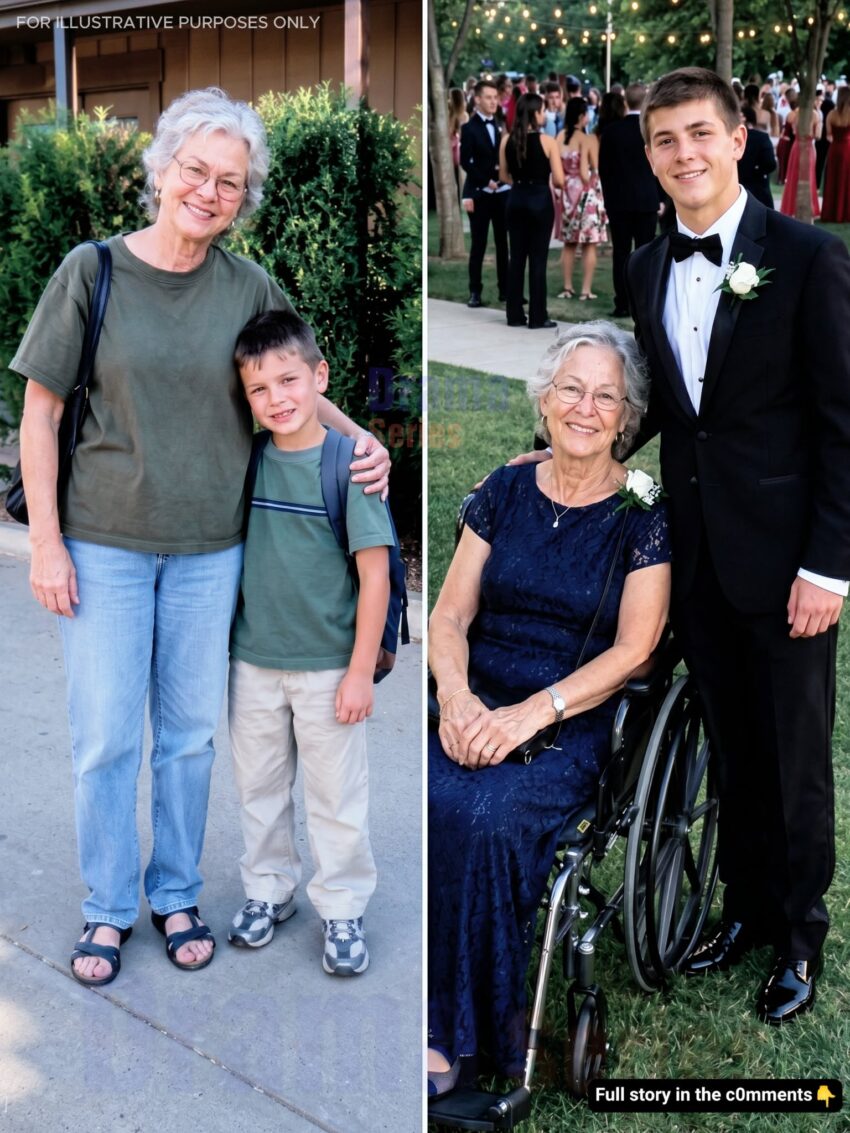
My classmates laughed when my 70-year-old mother entered prom in a wheelchair. What they didn’t know was that before the night ended, everyone in that ballroom would be forced to face a truth they had ignored for years.
The Night Everything Changed
The evening began beneath golden chandeliers, with crystal glasses clinking and whispers floating through the room.
“Is that his mom?” someone muttered.
“No way,” another voice replied, followed by a cruel laugh. “That’s his grandma.”
I stood at the entrance in a rented black suit, gripping the handles of my mother’s wheelchair so tightly that my hands hurt. Mom sat quietly in front of me, dressed in a navy-blue gown with tiny silver beads around the collar. Her white hair was neatly brushed back, and her thin hands rested on the purse in her lap. She looked smaller than she once had, but her eyes remained bright, warm, and comforting—the safest place I had ever known.
“Julian,” she whispered. “You don’t have to do this.”
I leaned closer.
“Yes, Mom. I do.”
She squeezed my hand gently.
That simple gesture carried eighteen years of memories—scraped knees, lonely lunches, forced smiles, and school hallways that often felt more like courtrooms than places of learning.

Growing Up Different
My name is Julian, and my mother, Evelyn, gave birth to me when she was fifty-two years old. By the time I entered first grade, she was sixty-two.
To me, she was simply Mom.
She smelled like lavender soap and peppermint tea. She hummed old songs while making pancakes. Every night she called me “my miracle boy” before tucking me into bed.
But to everyone else, she was a joke.
The first time it happened, I was six years old. We had just finished a Thanksgiving program.
Ryan pointed at my mother.
“Why is your grandma here?” he asked.
“She’s not my grandma. She’s my mom.”
Ryan looked genuinely confused.
“Your mom? She’s old.”
Several children laughed.
Then Brianna whispered, “Maybe his real mom left.”
I looked at my mother, waiting for her to defend herself.
Instead, she simply smiled, took my hand, and said, “Come on, sweetheart. Let’s go home.”
That was the beginning.
At first, I believed the teasing would fade away.
It didn’t.
The nickname “Grandson” followed me everywhere—through classrooms, cafeterias, birthday parties, concerts, and sports events.
Whenever Mom showed up to support me, someone found a new joke.
“Does she remember dinosaurs?”
“Does she need subtitles when people talk?”
“Careful, Julian, don’t make your mom walk too fast.”
As the years passed, the teasing became crueler. By high school, edited photos of us appeared online. People circled her wrinkles, added captions, and shared them for laughs.
Meanwhile, I sat alone in bathroom stalls, staring at my phone while anger burned inside my chest.
Yet through all of it, Mom never stopped showing up.
Every game.
Every ceremony.
Every parent meeting.
Every milestone.
Taking the Microphone
So when senior prom arrived and the laughter started again, I finally decided enough was enough.
I pushed Mom toward the center of the ballroom, walked straight to the MC, and said:
“Give me the microphone.”
The room immediately fell silent.
Some students looked curious.
Others looked amused.
A few looked confused.
Mom looked worried.
“Julian, what are you doing?” she asked softly.
I rested a hand on her shoulder.
“Something I should have done a long time ago.”
Then I faced the crowd.
“My mother is 70 years old,” I began. “And for most of my life, that’s all many of you have ever seen.”
The room remained silent.
“When I was six years old, people started calling me ‘Grandson.’ Some of you are sitting in this room right now, and you know exactly who you are. At first, I thought the jokes would stop. Instead, they got worse every year.”
Several students shifted uncomfortably.
“People laughed when she came to school events. They made comments when she picked me up after class. They edited photos of us and posted them online. They treated my mother like a joke.”
My voice tightened.
“For a long time, I let those comments get to me. I was angry. I was embarrassed. Sometimes I even wished my family looked like everyone else’s.”
Mom lowered her eyes.
“I’m sorry for that, Mom,” I said quietly.
The Slideshow
I nodded toward the projector.
The lights dimmed.
The first image appeared on the screen—a photograph of six-year-old me standing on a school stage holding a construction-paper turkey.
In the audience sat my mother, smiling as though I had just won an Academy Award.
Then another photo appeared.
A soccer game.
A science fair.
A spelling bee.
A middle-school concert.
A basketball tournament.
Again and again, the same pattern appeared.
No matter the event, Mom was there.
Sometimes standing.
Sometimes using a cane.
Sometimes sitting in a wheelchair.
But always there.
“I spent weeks gathering these photos,” I told the crowd. “Do you know what I discovered? My mother never missed a single school event. Not one.”
Nobody spoke.
“Not when games were three hours away. Not when concerts ended late at night. Not when she was tired. Not when she was sick.”
Another image appeared.
Mom sat on rain-soaked bleachers beneath an umbrella.
“That game was during a storm. Most people watched from their cars. She sat outside because she wanted me to see her cheering.”
More photos followed.
“Some of these pictures were taken right after doctor’s appointments. Some were taken while she was dealing with health problems that most of you never knew about.”
I looked directly at her.
“She spent years in pain and still showed up for me.”
The ballroom was so quiet that the projector’s hum sounded loud.
“While people were laughing at her age, she was working extra hours so I could afford field trips, sports programs, and summer activities. While people were making jokes online, she was driving hundreds of miles every year so I could have opportunities they thought I didn’t deserve.”
Several parents exchanged uncomfortable glances.
A teacher wiped away tears.

The Truth Everyone Had Ignored
Then the slideshow changed.
This time, the photos weren’t focused on me.
They were focused on the people around us.
Students pointing and laughing.
Students whispering.
Students mocking my mother behind her back.
The atmosphere in the room shifted immediately.
Ryan’s face turned pale.
Brianna stared at the floor.
One by one, people recognized themselves.
“I didn’t include these pictures to embarrass anyone,” I said. “I included them because they’re part of the story.”
No one spoke.
“For 18 years, my mother kept showing up. And for 18 years, some people kept finding new ways to make fun of her. The amazing thing is that she never stopped coming.”
I looked at Mom.
“Not once.”
For the first time in my life, nobody saw her as a punchline.
They saw her for who she really was.
The Apology
The final image remained on the screen.
It had been taken only months earlier during senior awards night.
I stood onstage holding a certificate.
Mom sat proudly in the front row.
Her smile looked exactly the same as it had in every other photograph.
Proud.
Steady.
Full of love.
I lowered the microphone.
Mom’s eyes filled with tears.
“You never told me you kept all these pictures,” she whispered.
I smiled.
“You never told me how much you sacrificed.”
She squeezed my hand.
Then applause began.
Principal Harper stood first.
A few teachers joined.
Then parents.
Then students.
Soon the entire ballroom was applauding.
Not for me.
For her.
For the woman they had ignored, mocked, and misunderstood for years.
Mom shook her head.
“Oh, goodness,” she murmured. “They don’t have to do this.”
“Yes, they do,” I answered.
The applause only grew louder.
Mrs. Dawson approached first.
“Evelyn,” she said through tears, “you raised an incredible young man.”
Then another voice broke the silence.
Ryan stood up.
His confidence was gone.
“I… I’m sorry.”
The room froze.
Ryan glanced at the screen.
“I honestly never thought about how it felt,” he admitted. “I was a kid, and then everyone kept doing it, and I just…” He paused. “I’m sorry.”
Then Brianna stood.
Then another student.
Then another.
One by one, people apologized.
And my mother did something remarkable.
She forgave them.
Not because they deserved it.
Not because the pain had been small.
But because forgiveness was simply who she was.
Real Love
As the night continued, something felt different.
Nobody called me “Grandson.”
Nobody laughed.
Nobody whispered.
For the first time, people spoke to my mother with genuine respect.
Later, as prom came to an end, I wheeled her toward the exit.
Cool night air drifted through the open doors.
She smiled softly.
“You know, I always worried those kids would only remember me as the old woman in the wheelchair.”
I knelt beside her.
“No, Mom. Now they’ll remember you for something else.”
She tilted her head.
“For what?”
I glanced back at the ballroom, where people were still discussing the slideshow and everything they had witnessed.
Then I smiled.
“For showing them what real love looks like.”
Mom squeezed my hand.
As we disappeared into the night together, I finally understood something my classmates had failed to see for eighteen years:
The oldest person in the room had never been the weakest.
She had been the strongest all along.
Note: This story is a work of fiction inspired by real events. Names, characters, and details have been altered. Any resemblance is coincidental. The author and publisher disclaim accuracy, liability, and responsibility for interpretations or reliance. All images are for illustration purposes only.