The Dream My Husband Couldn’t Let Go
I used to believe love could survive anything.
Pain. Disappointment. Silence. Even the quiet resentment that settles between two people when life gives them a future neither of them expected.
For years, I told myself that if I stayed patient enough, if I loved hard enough, if I carried the weight of our family without complaining, my husband would eventually stop looking at me as though I had ruined his life.
But time did not soften Greg.
It hardened him.
And the person who suffered most was not me.
It was our son, Liam.
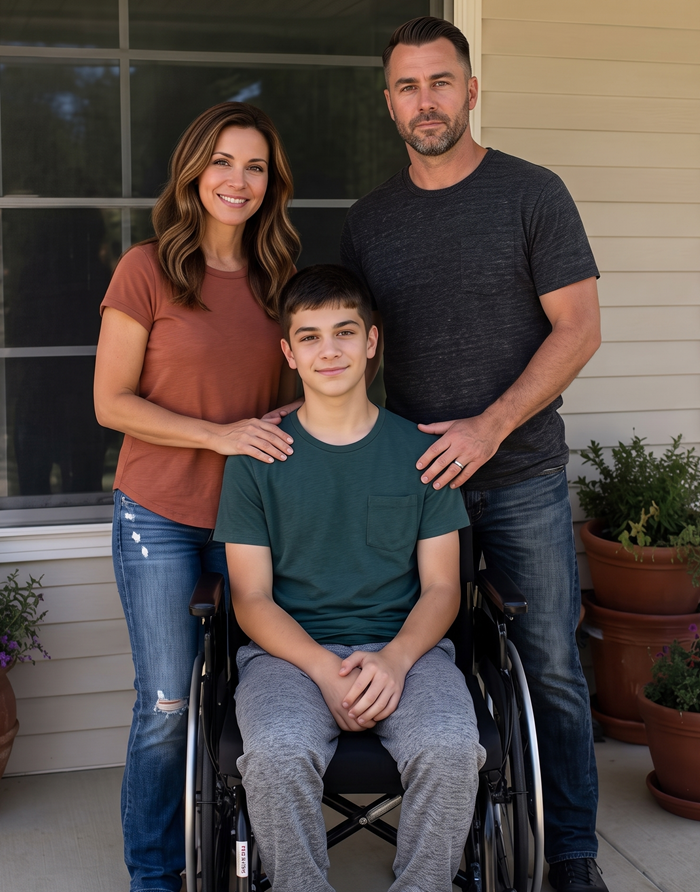
My name is Cyra, and Liam has used a wheelchair since he was a little boy. But from the day he was born, I never once wished he were different.
To me, Liam was never a tragedy.
He was my miracle.
He was bright, funny, thoughtful, and endlessly curious. He had the kind of mind that could untangle problems adults gave up on. He could make a room laugh with one quiet sentence. He noticed when people were sad and always found a way to offer kindness without making them feel small.
But Greg never saw all of that clearly.
He was too busy grieving the son he had imagined.
Greg grew up in a family where football was more than a sport. It was tradition. His father had been a respected high school coach, and Greg had spent his childhood under stadium lights, surrounded by whistles, helmets, and roaring crowds.
When we were dating, he used to tell me, “One day, when I have a son, I’ll teach him everything my dad taught me.”
Back then, I smiled.
It sounded sweet.
I didn’t know those dreams would become a measuring stick our child would never be allowed to meet.
The Diagnosis That Changed Our Family
Liam was three when the doctors finally gave us answers.
Before that, we had spent years moving from one appointment to another, hoping someone would say it was only a delay, something he would grow out of, something that could be fixed with time.
But it wasn’t that simple.
I still remember sitting in that small examination room, my hands clasped so tightly in my lap that my fingers hurt. The doctor spoke gently, carefully, explaining Liam’s condition in words meant to comfort us.
I heard the medical explanation.
Greg heard the death of a dream.
On the drive home, he said almost nothing.
For weeks, he buried himself in work. He came home late, ate in silence, and avoided conversations about therapy, equipment, or school planning.
At first, I thought he was grieving.
Then I realized he was blaming.
Not loudly at first. Not directly.
But little by little, the bitterness began to leak out.
“If you had noticed sooner…”
“If you had pushed the doctors harder…”
“If your family didn’t have so many health problems…”
He rarely finished those sentences.
He didn’t need to.
The accusation always hung in the air.
Somehow, in Greg’s mind, Liam’s disability became something I had caused. Something I had failed to prevent. Something I owed him an apology for.
And for reasons I still regret, I let myself carry that guilt.

A Father’s Cruel Jokes
As Liam grew older, Greg learned how to hide cruelty behind laughter.
When neighbors talked about their sons making sports teams, winning games, or going to practice, Greg would force a chuckle and say, “Well, I guess I won’t be buying football gear anytime soon.”
People would laugh awkwardly.
I would smile tightly, pretending it didn’t hurt.
And Liam would look down at his hands.
Those were the moments that broke me most.
Not the big arguments.
Not the slammed doors.
The small cuts.
The little comments that told our son, again and again, that he was not the boy his father wanted.
At night, when the house was quiet, Greg sometimes stood at the kitchen window and stared into the dark.
One night, he muttered, “You know what hurts?”
I looked at him carefully. “What?”
“I see fathers in the park throwing footballs with their sons.”
I said nothing.
“They don’t even realize how lucky they are.”
My throat tightened. “I know.”
Greg turned toward me, his face cold.
“No,” he said. “You don’t.”
That was all.
Just two words.
But the way he said them made me feel as if I had stolen something from him.
A future.
A legacy.
A son he could be proud of.
I knew, deep down, that none of it was my fault. Doctors had told us that again and again. But when someone you love blames you long enough, a part of you begins to wonder whether maybe they are right.
The Child Who Comforted Me
The only person who kept me from falling apart was Liam.
When he was twelve, Greg made another careless joke in front of relatives. Later that night, I went into Liam’s room and found him reading.
I sat on the edge of his bed and whispered, “I’m sorry, sweetheart.”
He looked up, confused. “For what?”
“For…” My voice cracked. “For everything.”
Liam studied me for a moment, then smiled softly.
“Mom,” he said, “you didn’t do anything wrong.”
Tears filled my eyes before I could stop them.
He reached for my hand and squeezed it.
“You know what Coach Mara told me?” he asked.
I blinked. “Who’s Coach Mara?”
“The adaptive basketball coach from the community center.”
I had almost forgotten he had been helping with the program.
“What did Coach Mara say?” I asked.
Liam grinned. “He said people spend too much time staring at what they can’t do. Then they miss everything they can do.”
I laughed through my tears.
“That’s very wise,” I said.
“I know,” Liam replied proudly.
That was my son.
Even when life hurt him, he still found light.
Even when people disappointed him, he still chose kindness.
And Greg barely noticed.
The Achievements His Father Ignored
By the time Liam reached high school, he had become the kind of student every teacher remembered.
He won academic awards. He volunteered. He mentored younger students. He helped organize accessibility projects at school. He earned scholarships and recommendation letters that made me cry when I read them.
One afternoon, our mailbox was filled with college envelopes.
“Liam!” I called, spreading them across the dining room table.
He rolled in, eyes wide. “Are those all for me?”
I nodded, smiling so hard my cheeks hurt. “They just keep coming.”
He picked up the first envelope with trembling hands.
A few minutes later, Greg walked in from work.
He glanced at the table. “What’s all this?”
“College offers,” I said proudly. “Schools are interested in him.”
Liam looked up, waiting.
For one second, I hoped.
Greg stared at the envelopes, nodded once, and said, “Good.”
Then he walked upstairs.
That was it.
No hug.
No smile.
No “I’m proud of you.”
Just one empty word.
I watched Liam’s face carefully.
He forced a small smile. “Well,” he said quietly, “I guess good is still something.”
My heart shattered.
Later that night, I confronted Greg.
“Could you have shown a little more interest?” I asked.
He loosened his tie. “What are you talking about?”
“Our son has universities reaching out to him. He has worked so hard.”
“I said good.”
“That isn’t enough.”
“It should be.”
Something inside me snapped.
“Would it have been enough if he had scored the winning touchdown?”
Greg’s face tightened. “Don’t start.”
“No,” I said. “This has always been about you.”
He pointed toward the living room, where Liam had been earlier.
“I didn’t ask for this life,” he said.
The words froze the air between us.
For a moment, I couldn’t breathe.
Finally, I whispered, “Neither did Liam.”
Greg looked away.
He did not apologize.
He did not take it back.
And though I didn’t know it then, our son had heard more than either of us realized.

The Birthday Party
Despite everything, Liam graduated at the top of his class.
At the ceremony, his principal praised his courage, discipline, and leadership in front of hundreds of people. Parents stood and clapped. Teachers wiped their eyes. I cried through nearly the entire thing.
Greg clapped politely.
Nothing more.
Liam eventually chose a university known for engineering and assistive technology.
“I want to build things that make life easier for people,” he told me.
I kissed his forehead and said, “You already do that just by being you.”
A few weeks later, his eighteenth birthday arrived.
My sister, Nora, insisted we celebrate properly.
“He’s becoming an adult,” she said. “That deserves a real party.”
So we planned one in our backyard.
I baked Liam’s favorite chocolate cake. Nora decorated with blue and silver balloons. My brother Owen handled the grill. Neighbors came. Relatives arrived. Several of Liam’s teachers stopped by. Coach Mara came too, carrying a wrapped gift and wearing the proudest smile.
For a few hours, the house felt almost normal.
Greg laughed with relatives. He smiled beside me. He even seemed relaxed.
I let myself hope.
Maybe, I thought, he finally sees Liam.
Maybe all these years of bitterness are ending.
Maybe this day will be different.
After dinner, Nora raised her glass of sparkling cider.
“Birthday toast!” she announced.
Everyone gathered around Liam.
Greg stood beside me and placed his arm around my shoulders. For the first time in years, he looked like a proud father.
Then Liam lifted his glass.
And the entire mood changed.
The Toast No One Expected
“I want to make a toast to my parents,” Liam began.
The backyard quieted.
His voice was calm. Too calm.
He looked at me first, then at Greg.
“The truth is,” he said, “I know more about our family than either of you think I do.”
Greg’s smile faded.
Liam continued, “I’ve heard the arguments you thought happened after I went to bed.”
No one moved.
“I’ve heard the jokes Dad made about me.”
Greg shifted uncomfortably.
“I’ve heard Mom trying to defend both of us.”
My chest tightened.
I wanted to stop him. To protect him. To keep him from saying all of this in front of everyone.
But Liam was not breaking.
He was finally speaking.
“I know Mom tried to hide your resentment from me,” he said gently. “But walls are thinner than adults think.”
Greg swallowed. “Liam…”
Liam raised one hand.
“Please let me finish.”
The silence became heavy.
“I know Dad blamed Mom for my disability.”
Several relatives looked down. Nora’s face crumpled. Owen clenched his jaw. Coach Mara folded her arms across her chest.
Greg gave a nervous laugh. “Son, this isn’t the time.”
Liam looked at him steadily.
“I think it’s exactly the time.”
Greg glanced around the yard. “We can talk about this privately.”
“No,” Liam said. “Mom has carried your blame privately for eighteen years. I won’t let her carry it alone anymore.”
My tears began falling.
Liam turned to me and smiled softly.
“It’s okay, Mom.”
Then he faced his father again.
“I know you dreamed of coaching football. I know Grandpa coached you. I know you imagined having a son who would run across a field while you cheered from the sidelines.”
Greg’s face reddened.
“And I know,” Liam continued, “that every time you saw other fathers playing with their sons, you looked at Mom like she had taken that life away from you.”
Greg whispered, “I was disappointed.”
Liam’s voice stayed steady.
“No, Dad. You were cruel.”
The words landed like thunder.
No one spoke.
The Pain Liam Had Hidden
Liam took a slow breath.
“I used to wonder why I wasn’t enough.”
Greg stared at the ground.
“I thought maybe if I got the best grades, you would finally see me.”
His mouth trembled slightly.
“So I became valedictorian.”
The yard was silent.
“I thought maybe if I earned scholarships, you would be proud.”
He looked around at the college envelopes stacked in memory, as if they were still lying on our dining room table.
“So I worked harder.”
His voice cracked for the first time.
“I thought maybe if I volunteered, stayed positive, helped other people, and never complained, you would realize I was still your son.”
I covered my mouth to hold back a sob.
“But eventually,” Liam said, “I understood something.”
He looked directly at Greg.
“The problem was never me. It was the dream you refused to let go of.”
Greg lifted his head, tears forming in his eyes.
“It’s not that I didn’t love you,” he said.
“I know,” Liam replied. “But love shouldn’t be something a child has to guess.”
That sentence seemed to knock the strength out of Greg.
Liam continued, “You told Mom she ruined your life.”
Greg’s face went pale.
“I was angry,” he whispered.
“For eighteen years?” Liam asked.
No one could answer that.
The Letters
Then Liam reached into the pocket attached to his wheelchair and pulled out a folded stack of papers.
“I’ve been keeping something,” he said.
I stared at him. “What is that?”
“Letters,” he answered. “I started writing them when I was ten.”
Greg frowned. “What kind of letters?”
“The kind I hoped I would never need.”
He unfolded the first page.
His voice was quieter now, but every person there heard him.
“Dear Future Me, Dad didn’t come to my game today, but Mom cheered loud enough for both of them. Don’t let that make you believe you are worth less.”
A sob escaped me.
Liam unfolded another page.
“Dear Future Me, if Dad ever says he is proud of you, remember that Mom waited a long time to hear those words too.”
Greg covered his face.
Liam read one more.
“Dear Future Me, don’t become someone who blames others for the life he has. Be thankful for the people who stay.”
By then, several people were crying.
Greg lowered his hands slowly.
“I didn’t know,” he whispered.
Liam folded the letters carefully.
“No,” he said. “You didn’t.”
Then he looked at me.
“Mom spent eighteen years protecting you.”
I shook my head. “I wasn’t protecting him.”
“Yes, you were,” Liam said softly. “You told everyone Dad was stressed. You made excuses because admitting the truth hurt too much.”
He was right.
For years, I had covered Greg’s bitterness with polite explanations. I had softened his words, hidden his coldness, and pretended we were just tired, just overwhelmed, just going through a difficult season.
Because admitting the truth felt like admitting our family was broken.

The Truth Finally Came Out
Liam turned back to Greg.
“I don’t hate you,” he said.
Greg looked up with a flicker of hope.
“But I won’t let Mom carry blame that never belonged to her.”
Greg took one careful step forward.
“I was wrong,” he said.
No one rushed to comfort him.
No one rescued him from the silence.
He swallowed hard.
“I spent years mourning a son I imagined,” he said, his voice shaking. “And while I was doing that…”
He looked at Liam.
“I missed the incredible son right in front of me.”
Liam listened quietly.
Greg turned to me.
“I blamed you because blaming myself was harder,” he admitted. “I couldn’t accept that life didn’t follow the plan I had in my head.”
I had dreamed of hearing those words for almost two decades.
But in that moment, I didn’t feel victory.
I felt exhausted.
“You made me believe I had failed both of you,” I said.
Greg nodded, tears slipping down his face.
“I know.”
“No,” I whispered. “I don’t think you do.”
I wiped my cheeks.
“You watched other people celebrate their sons while you ignored your own. You let Liam wonder whether he was enough. You let me think I deserved your resentment.”
Greg began crying openly.
“I know,” he said again.
But this time, the words sounded different.
Not defensive.
Not empty.
Broken.
Coach Mara stepped forward then.
“I’ve coached hundreds of young people,” she said.
Everyone turned toward her.
“Some became excellent athletes.”
She placed a hand gently on Liam’s shoulder.
“But very few became the kind of person others should try to become.”
Her eyes moved to Greg.
“Your son became that kind of person long before tonight. You should have been proud of him years ago.”
For a second, no one moved.
Then Owen began clapping.
Nora joined.
One by one, the others followed.
The applause was not for the confrontation.
It was for Liam.
For his courage.
For his honesty.
For the young man he had become in spite of every wound he had carried in silence.
Greg stood alone, surrounded by the consequences of every word he had refused to take back.
The Apology I Waited Eighteen Years to Hear
After the guests began leaving, Greg approached us again.
His face looked older somehow.
“I made an appointment,” he said.
I frowned. “With whom?”
“A therapist.”
Liam looked surprised.
Greg’s voice trembled. “I should have done it years ago.”
He turned to me.
“If you’ll allow me, I want to spend whatever time it takes earning back your trust.”
I did not answer right away.
Some wounds do not heal because someone finally says the right words.
They heal when behavior changes.
“I don’t know what happens next,” I said honestly.
Greg nodded. “I understand.”
Then he looked at Liam.
“I’ll understand if you never forgive me.”
Liam was quiet for a long moment.
Then he said, “Forgiveness doesn’t mean pretending nothing happened.”
Greg nodded again.
“I know.”
“But if you really want to change,” Liam said, “start by apologizing to the person who deserved your support from the beginning.”
Greg turned toward me.
Not dramatically.
Not with excuses.
Just with a broken honesty I had never seen from him before.
“I’m sorry, Cyra,” he said.
No explanations.
No blame.
No “but.”
Just the words I had waited eighteen years to hear.
The next morning, before Liam woke up, I found Greg in the garage.
He was surrounded by boxes, tools, and instruction papers. A half-assembled storage cart sat in front of him.
“What are you doing?” I asked quietly.
He looked up.
“I checked the measurements for Liam’s dorm desk online,” he said. “I want to make sure this cart fits underneath so he can reach everything easily.”
For a moment, I didn’t know what to say.
It was not a grand gesture.
It did not erase eighteen years.
But it was the first time in a long time that I saw Greg thinking about Liam’s future instead of grieving the one he had imagined.
Whether our marriage would survive, I honestly didn’t know.
But something inside me had finally shifted.
The guilt I had carried for nearly two decades was no longer mine.
It had never been mine.
The Son Who Was Always Enough
A few weeks later, Liam left for college.
Greg insisted on helping him move into his dorm.
He carried every box he could. He adjusted the furniture so Liam could move freely. He checked the bathroom layout, the desk height, the closet space, and the path between the bed and the door.
He was late.
Years late.
But for once, he was present.
Before we left, Greg hugged Liam tightly.
“I’m proud of you, son,” he said, his voice breaking.
Liam closed his eyes for a second.
Then he smiled.
“Thank you, Dad.”
As I watched Liam roll through the university gates on his first day, his shoulders straight and his face full of quiet confidence, I finally understood something I should have known all along.
Greg had spent eighteen years mourning a son who existed only in his imagination.
But I had been blessed with the son who was real.
The son who taught me strength without bitterness.
Courage without cruelty.
Forgiveness without forgetting.
And love without conditions.
For eighteen years, my husband thought life had taken something from him.
But the truth was, life had given us Liam.
And Liam had always been more than enough.
Note: This story is a work of fiction inspired by real events. Names, characters, and details have been altered. Any resemblance is coincidental. The author and publisher disclaim accuracy, liability, and responsibility for interpretations or reliance. All images are for illustration purposes only.