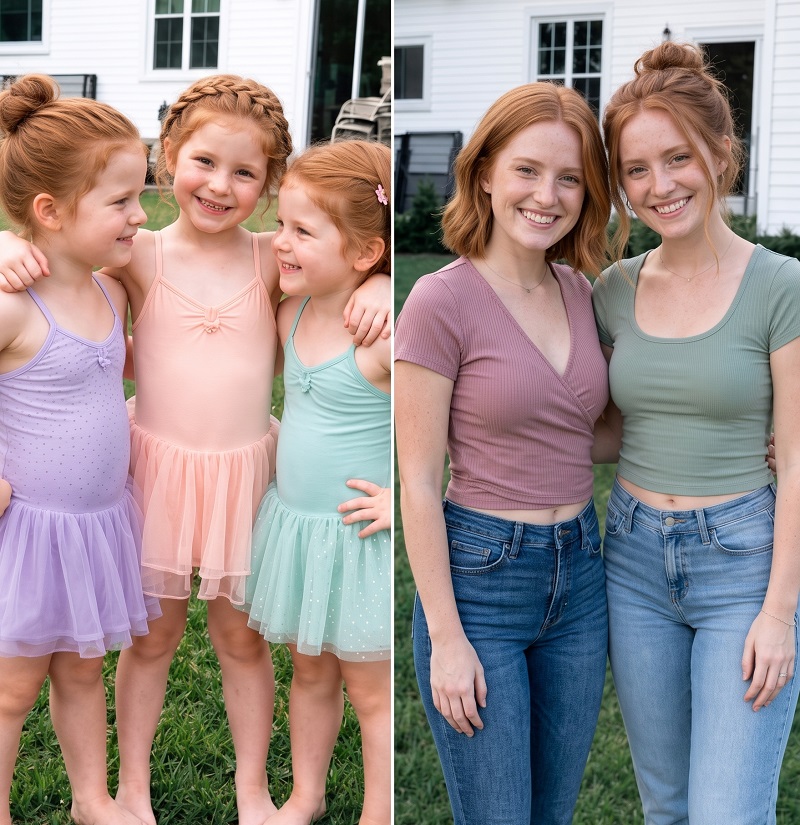
There Used to Be Three of Us
There used to be three of us.
Me, Leila, and Nora.
Now, when people see Leila and me together, they usually call us twins. Most people do. It is easier that way. Easier than explaining that we are the two who survived. Easier than watching our mother’s face crumble whenever someone innocently asks, “Weren’t there three of you girls?”
But Leila and I never felt like twins.
We felt like two broken pieces of something that had once been whole.
Our story did not begin with sadness.
It began with seven minutes.
Nora came into the world first, exactly seven minutes before us, and she used that tiny head start like it made her queen of our little universe.
“I’m the oldest,” she would say proudly. “So I get to choose.”
Leila could not stand it.
“Seven minutes doesn’t mean anything.”
Nora would grin and answer, “It does when you showed up late.”
That was our childhood.
Pillows flying across the room. Bare feet racing down the hallway. Crayons on the walls. Mom pretending to be angry. Dad hiding his smile behind his coffee cup while trying to look stern.
Nora was the center of us.
Whenever Leila and I fought over dolls, sweaters, snacks, or who got to sit by the window, Nora would step between us like a tiny referee.
“I choose peace,” she would announce.
Somehow, that always made us laugh.
Nora was warmth in the shape of a person.
She tied our shoelaces before school, saved Leila the red candies because they were her favorite, and slept between us during thunderstorms because she claimed leaders had to protect everyone.
I still remember one stormy night when thunder rattled the windows.
Leila climbed into Nora’s bed first. A few minutes later, I followed, pretending I was not scared.
Without even opening her eyes, Nora lifted the blanket.
“You two are terrible at being brave,” she mumbled.
“You’re scared too,” I whispered.
“No,” she said sleepily. “I’m in charge.”
And for a long time, that was enough.
Nora was in charge.
So we believed nothing truly bad could happen to us.
When Nora Got Sick
Then Nora got sick.
At first, the adults spoke in whispers, as if lowering their voices could keep the truth from reaching us. But Nora always knew when people were hiding something, especially when they were doing it kindly.
I still remember the first hospital room.
The sharp smell of disinfectant. The cold white lights. The cartoon stickers on the walls that tried and failed to make the place feel less terrifying.
Mom told us Nora was only tired.
Nora, lying beneath thin blankets with tubes taped to her arm, rolled her eyes.
“I’m not a baby, Mom.”
Even then, when she was growing smaller inside that hospital bed, she still tried to make us feel safe.
“Don’t look at me like that,” she told us. “You both look weird when you worry.”
Leila laughed, but it came out broken.
I didn’t laugh at all.
I was angry.
Angry at the doctors. Angry at the hospital. Angry at the machines that kept beeping. Angry at the way Mom cried in the hallway and wiped her face before walking back in. Angry at Dad for staring out the window as if he could find an answer somewhere in the parking lot.
But most of all, I was angry because Nora was still trying to protect us.
She should have been scared.
She should have been allowed to be a child.
Instead, she was eleven years old, lying in a hospital bed, making jokes so the rest of us would not fall apart.
One afternoon, Leila and I had an argument outside Nora’s room. I do not even remember what started it. Maybe I took her sweater. Maybe she blamed me for forgetting Nora’s favorite book. Maybe we were just exhausted and too young to understand that grief sometimes arrives before death does.
Leila snapped, “I hate this. I hate hospitals. I hate everyone acting like we have to be strong. I hate being one of three.”
The words froze in the air.
I saw Nora’s eyes through the half-open door.
She had heard everything.
Leila saw her too.
Her face went pale.
“Nora, I didn’t mean—”
But Nora only smiled faintly and said, “I know.”
Leila never forgave herself for that.
And I never forgot it.
The Silence After
When Nora passed away, our house became quiet in a way that felt unnatural.
Her slippers stayed in the hallway for weeks because Mom could not bring herself to move them. Her toothbrush remained beside ours. Her empty bed turned into a silence none of us knew how to face.
At night, I would wake up and listen for her breathing.
Only there was nothing.
Just Leila crying softly into her pillow on the other side of the room.
I wanted to comfort her.
I wanted her to comfort me.
But something had changed between us.
Before Nora, Leila and I could fight all morning and be best friends by lunch. After Nora, every silence became a wall. Every memory became a sharp edge.
Leila stopped wearing bright colors. I stopped talking about Nora because whenever I said her name, Mom’s hands trembled.
Dad tried to hold us together. He cooked breakfast, drove us to school, and fixed things around the house that were not broken just to keep his hands busy. But even he changed. His laugh became quieter. His eyes carried a tiredness I had never seen before.
For ten years, we blew out candles for two while secretly counting three.
When I was twelve, I wished Nora would come home.
When I was thirteen, I wished Mom would stop crying in the laundry room.
When I was fourteen, I wished Leila would talk to me the way she used to.
By fifteen, Leila and I had learned how to live beside each other without really being together.
We shared a room, then we didn’t.
We shared a birthday, then we celebrated separately.
We shared a face, but not our hearts.
People called us twins, and we let them.
Because explaining Nora meant opening a door neither of us was brave enough to enter.
By the time our twenty-first birthday came, I believed I had learned how to live with the empty space Nora left behind.
I was wrong.

Our Twenty-First Birthday
That morning, Leila and I went to Mom’s house for breakfast.
We arrived five minutes apart, which somehow felt typical of us.
Leila was wearing a cream sweater and had her hair tied back neatly. I was in jeans, late, with a gift bag I had bought on the way because I still did not know how to buy birthday gifts for someone who shared my birthday but no longer shared my life.
We hugged quickly and carefully, the kind of hug that felt more like armor than affection.
“Happy birthday,” she said.
“You too,” I answered.
Mom had decorated the dining room with gold balloons. A small cake sat on the sideboard. Dad stood near the coffee pot, quiet and emotional, pretending to read the label on a jar of honey.
And on the table, there were three plates.
None of us said a word.
For years, that third plate had hurt me. I used to think Mom set it there because she could not accept the truth. Then I got older and understood it differently.
Some people leave so much love behind that removing their place feels like losing them all over again.
We ate slowly.
The eggs went cold. The toast sat untouched. Everyone smiled too much.
Halfway through breakfast, Mom stood up and disappeared down the hallway.
When she came back, she was holding a small wooden box pressed tightly to her chest. Her hands were shaking.
She placed it between Leila and me.
My stomach twisted before I even knew why.
On top of the box sat an old envelope, yellowed with age.
The handwriting made my breath stop.
I would have recognized it anywhere.
OPEN ON OUR 21ST BIRTHDAY.
Leila’s fork slipped from her hand and clattered against her plate.
Mom covered her mouth as tears filled her eyes.
“She made this before she passed,” Mom whispered. “She told me, ‘They’ll still need me when they grow up.’”
For the first time in years, Leila reached for my hand beneath the table.
And for the first time in years, I did not pull away.
With trembling fingers, I opened the box.
Then I gasped.
What Was Inside
Inside the box were three silver bracelets, a folded piece of notebook paper, a tiny brass key tied with a blue ribbon, and three envelopes.
One had my name.
Maya.
One had Leila’s.
And one had both our names written together.
At the bottom was an old DVD with a label written in purple marker.
FOR MY SISTERS, BECAUSE I’M STILL THE OLDEST.
Leila made a sound that was almost a laugh and almost a sob.
Dad turned away, pressing his fist against his mouth.
Mom whispered, “She asked your father to record her one afternoon when she felt strong enough. I never watched it after she passed. I couldn’t.”
I stared at the DVD.
Part of me wanted to run.
Part of me wanted to grab it and never let go.
Leila whispered, “Can we watch it?”
Mom nodded.
Dad brought out the old DVD player from the cabinet, the same one we used for cartoon movies when we were little. His hands shook as he connected the wires.
A few moments later, the screen flickered.
Then Nora appeared.
She was sitting in her hospital bed wearing a pink hat, her cheeks smaller than I remembered, but her eyes bright and mischievous.
“Hello, old ladies,” she said.
Leila broke instantly.
She covered her mouth, tears spilling down her face.
Nora on the screen smiled.
“If you are watching this, that means you are twenty-one. Which is very old. I hope you have jobs. Or at least better hair.”
A wet laugh escaped me.
Nora leaned closer to the camera.
“Okay. I don’t have a lot of time, and Dad says I have to stop talking before I get too tired, which is rude because I am the oldest and should make the rules.”
Dad laughed through his tears.
Then Nora’s expression softened.
“I made this because I know you two. Maya acts tough when she’s sad. Leila acts quiet when she’s scared. And both of you think silence solves things. It doesn’t.”
Leila squeezed my hand so hard it hurt.
Nora looked straight into the camera.
“So here is my birthday rule. You have to open the letters. You have to read them. And then you have to use the key.”
She lifted one finger.
“No arguing. I am still seven minutes older.”
Nora’s Letter to Me
I opened my envelope first.
The paper smelled faintly like the old box and something sweet, like the strawberry lotion Nora used to love.
Dear Maya,
If you are reading this, you are probably pretending you are fine.
Please stop.
You were always the one who tried to be strong by acting like nothing hurt you. But I knew. I always knew.
I need you to do something for me.
Please stop being angry at Leila.
I know you heard what she said outside my room. I heard it too. But she was not saying she hated me. She was saying she hated losing me.
People say ugly things when they are scared.
That does not make them ugly people.
You and Leila are not two broken pieces. You are my sisters. You are still part of me, even when you forget how to stand close to each other.
Take care of her.
And let her take care of you.
Love,
Nora
By the time I finished reading, I could barely see the page.
For ten years, I had carried that hospital hallway inside me. I had told myself I was protecting Nora by staying angry. But Nora had never asked me to protect her that way.
She had asked me to forgive.
Leila was crying beside me.
“I’m sorry,” she whispered. “Maya, I’m so sorry.”
I turned to her.
For a moment, I saw us at eleven years old again. Two frightened girls who had lost the person who knew how to bring them back to each other.
“I thought you meant it,” I said, my voice breaking.
“I didn’t,” Leila sobbed. “I was scared. I was so scared. And after she died, I thought you hated me.”
“I didn’t hate you,” I whispered. “I just didn’t know where to put the hurt.”
Leila leaned into me, and for the first time in years, I wrapped my arms around my sister without holding anything back.
Mom cried quietly.
Dad sat down heavily in the chair across from us, his face wet with tears.
The room that had felt frozen for a decade began to breathe again.
Leila’s Letter
Leila opened her letter next.
Her hands trembled so much that I offered to read it for her, but she shook her head.
“No,” she whispered. “I need to.”
Dear Leila,
You always think everything is your fault.
It is not.
What you said that day did not hurt me the way you think it did. I knew you loved me. I knew you were tired. I was tired too.
I forgive you before you even ask.
But you have to forgive yourself, because I cannot keep sending letters forever.
Also, please stop letting Maya act like she is the boss just because she talks louder. Technically, I was the boss.
Wear red again. Eat the red candies. Laugh loudly. Fall in love if you want to. Be annoying. Be alive.
Do not make your life smaller because mine was shorter.
That would make me very mad.
Love,
Nora
Leila pressed the letter to her chest.
For years, I had watched my sister fade into quiet colors and careful smiles. I thought it was just grief.
I had not understood that she was punishing herself for being alive.
Mom reached across the table and touched Leila’s face.
“My sweet girl,” she said. “You never had to carry that alone.”
Leila closed her eyes.
“I didn’t know how to put it down.”
And that was the truth for all of us.
We had each been carrying a piece of Nora’s absence alone, when maybe we were supposed to carry her memory together.

The Key
Finally, we opened the envelope with both our names.
Dear Maya and Leila,
Now comes the mission.
Go to the old oak tree.
Yes, the one Dad built the birdhouse in.
Use the key.
And remember: seven minutes can change everything.
Love,
Nora
We all looked toward the backyard.
The old oak tree still stood there, taller and wider than it had been when we were children. Dad had built a little birdhouse in it when we were ten because Nora had decided birds needed “proper homes.”
“I thought that birdhouse fell apart years ago,” I said.
Dad wiped his face and stood.
“I repaired it,” he admitted. “Every spring.”
Mom looked at him in surprise.
He gave a small, embarrassed shrug.
“Nora asked me to.”
So we went outside.
The air was cool. The grass was damp. The morning sun touched the branches of the oak tree like a blessing.
For a moment, I saw three little girls running barefoot through the yard.
Nora in front, shouting that she was the leader.
Leila chasing her.
Me yelling that it was not fair because Nora had started first.
Dad reached up and lifted the birdhouse from its hook. Behind it was a small metal compartment built into the wood, almost invisible unless you knew where to look.
The tiny brass key fit perfectly.
Inside was a small tin box.
Leila opened it.
There was another folded paper inside.
Across the top, Nora had written:
THE SEVEN-MINUTE LIST.
Below it were seven promises.
One: Say Nora’s name without whispering.
Two: Forgive each other for surviving differently.
Three: Celebrate with three plates only when it brings love, not pain.
Four: Dance in the kitchen at least once a year.
Five: Help someone lonely, because lonely people need sisters too.
Six: Stop calling yourselves broken.
Seven: Live seven minutes braver every day.
Leila read the last line aloud, and none of us spoke for a while.
Then Dad laughed softly.
“She planned the whole thing.”
Mom smiled through her tears.
“She always did like being in charge.”
Seven Minutes Braver
That afternoon, something changed in our family.
Not loudly.
Not magically.
But honestly.
Leila and I sat on the back steps for hours, talking the way we had not talked since we were children.
She told me about the birthdays she had spent crying in her car before coming inside.
I told her about the nights I almost called her but stopped because I did not know how to begin.
We talked about Nora.
Not like she was a wound.
Like she was a person.
We remembered how she used to put ketchup on rice and insist it was gourmet. How she once cut her own bangs and blamed the dog. How she kept a notebook full of “important laws” for our bedroom, including one that said whoever cried first during a movie got the biggest blanket.
For the first time in ten years, Nora’s name did not break us.
It brought us closer.
Before dinner, Leila went upstairs and came back wearing a red scarf Mom had kept in Nora’s drawer.
“I think she’d want me to wear it,” she said shyly.
I smiled.
“She would say it looks better on her.”
Leila laughed.
A real laugh.
The sound startled me because I had missed it more than I realized.
That evening, we put three plates on the table again.
But this time, it did not feel like we were pretending Nora might walk through the door.
It felt like we were making room for love.
Before we ate, Mom held up her glass.
“To Nora,” she said.
Dad added, “Our oldest girl.”
Leila looked at me.
I looked back at her.
And together, we said, “Our sister.”
What We Built From Her Love
A few weeks later, Leila called me.
“I’ve been thinking about number five,” she said.
“Help someone lonely?”
“Yes.”
That was how Nora’s Seven Minutes began.
At first, it was simple. We brought small birthday boxes to children at the hospital where Nora had been treated. Not expensive things. Just coloring books, soft socks, stickers, little bracelets, handwritten notes.
Each box had a card inside that said:
You are not alone. Today, be seven minutes braver.
The first time we delivered them, I almost could not walk through the hospital doors.
The smell brought everything back.
The lights. The fear. The sound of machines. The memory of Nora smiling when she should have been resting.
Leila reached for my hand.
This time, I held it tightly.
“You ready?” she asked.
“No,” I admitted.
She took a deep breath.
“Me neither.”
Then she smiled, small but steady.
“Seven minutes braver?”
I nodded.
“Seven minutes braver.”
So we went in.
And somewhere between the first room and the last, I understood what Nora had done.
She had not left us a box so we would stay trapped in the past.
She had left it so we could find our way out together.
We Are Still Three
Years have passed since that birthday morning, but I still keep Nora’s bracelet on my wrist.
Leila wears hers too.
Mom keeps the third one in a small frame beside Nora’s picture, though sometimes, on hard days, she takes it out and holds it in her palm.
People still see Leila and me together and call us twins.
For a long time, we let them.
Now, we don’t.
Now, when someone says, “You two must be twins,” Leila smiles gently and says, “Actually, we’re triplets.”
Sometimes people look confused.
Sometimes they apologize.
But I no longer feel the need to make Nora smaller so strangers can feel comfortable.
There used to be three of us.
There are still three of us.
One of us just lives differently now.
She lives in the red candies Leila still saves. In the old oak tree Dad still repairs around every spring. In Mom’s laugh when she tells stories about Nora’s bossy little rules. In every child who opens a birthday box and finds a note telling them they are not alone.
And she lives in me and Leila.
Not as an empty space.
Not as a silence.
But as a love that never stopped being part of us.
On our twenty-first birthday, our mother handed us a box Nora had left behind.
We thought we were ready for anything.
We were not ready for what was inside.
We were not ready for forgiveness.
We were not ready for healing.
We were not ready to learn that our sister, even after all those years, was still bringing us back to each other.
Nora came into the world seven minutes before us.
And somehow, even after she left, she was still leading the way.
Note: This story is a work of fiction inspired by real events. Names, characters, and details have been altered. Any resemblance is coincidental. The author and publisher disclaim accuracy, liability, and responsibility for interpretations or reliance. All images are for illustration purposes only.