The House I Couldn’t Face
I hadn’t stepped inside my mother’s beach cottage in fifteen years—not since the accident took my parents and my younger sister, Margaret, in a single afternoon.
The last time I was supposed to go there, they were driving to meet me for lunch.
Mom had planned it for weeks.
“Elena, please,” she said on the phone. “Just one meal. Sit with your sister. Let this house bring my girls back together.”
Margaret and I hadn’t spoken in months.
The argument had started over something so small that I can barely remember it now. I had criticized one of her decisions. She accused me of always believing I knew what was best for everyone. Voices rose. Old resentments came spilling out.
Then she said, “You don’t know everything about me.”
I answered, “Maybe that’s because you never tell me anything.”
Those were the last words I ever spoke to my sister.
Mom believed one afternoon at the cottage could fix us.
It was the place where Margaret and I had spent every childhood summer building sandcastles, collecting shells, and falling asleep to the sound of waves outside our bedroom window.
So I agreed to come.
Then I was late.
I had left work later than planned. Traffic was worse than expected. When Mom called, I let the phone ring because I was still frustrated and didn’t want another lecture.
By the time I finally returned the call, a police officer answered.
My parents and Margaret never reached the cottage.
After the funeral, I drove there once. I sat in my car at the end of the gravel path, staring at the faded blue curtains.
I couldn’t make myself get out.
A week later, I hired someone to close the house for the season. I told him to lock everything and mail me the key.
For fifteen years, the cottage remained untouched.
I couldn’t sell it.
I couldn’t visit it.
I couldn’t even hold the brass key for more than a few seconds without feeling as though the air had been pulled from my lungs.
But memories don’t stop property taxes from arriving.
Last month, several notices appeared in our mailbox, along with a letter warning that the roof, porch, and exterior needed repairs.
My husband, Daniel, placed the papers on the kitchen table.
“Elena,” he said gently, “you can’t keep bleeding money for a house you refuse to enter.”
“I know.”
“You don’t have to sell it today. But you need to see it.”
The thought made my hands shake.
Daniel reached across the table and covered them with his.
“You won’t walk in alone.”
A week later, we drove to the coast.
The Door Opened
The cottage looked smaller than it did in my memories.
The porch boards had turned gray. Salt had faded the shingles. Wild grass grew around the white fence, and one of the shutters hung slightly crooked.
But the curtains were still blue.
Mom’s old wind chime remained beside the door, its pieces tarnished by years of ocean air.
It shifted gently, even though the morning seemed perfectly still.
Daniel took the key because I couldn’t.
“You ready?” he asked.
“No.”
He gave me a sad smile. “We can do it anyway.”
The lock resisted at first. Then it clicked.
Daniel pushed the door open and stepped into the narrow hallway.
He stopped so suddenly that I walked straight into his back.
“Elena,” he whispered. “Don’t move.”
My heart slammed against my ribs.
“What is it?”
He didn’t answer.
I looked over his shoulder.
A girl stood in the living room.
She appeared to be eighteen or nineteen, with shoulder-length blond hair and pale blue eyes. She was holding a framed photograph against her chest.
For a moment, my mind refused to understand what I was seeing.
The shape of her face.
The slight tilt of her head.
The dimple in her left cheek.
She looked almost exactly like Margaret had looked at that age.
My knees weakened.
Then a tremendous metallic crash exploded behind me.
I screamed and spun around.
An older man stood on the porch, staring at us in shock. A toolbox had fallen from his hand and struck the boards, scattering screws and wrenches around his feet.
“Elena?” he said.
I recognized him slowly.
“Mr. Cole?”
Thomas Cole had owned the cottage next door for as long as I could remember. He had taught Margaret and me how to repair bicycle tires and had rescued more than one kite from his pine trees.
His hair was white now, and his shoulders had become rounded, but his eyes were the same.
“Good heavens,” he murmured. “You finally came.”
The girl inside took one hesitant step toward me.
“Aunt Elena?”
The hallway seemed to tilt.
Daniel caught my arm.
“What did you call me?” I whispered.
The girl’s eyes filled with tears.
“My name is Lily,” she said. “Margaret was my mother.”

The Sister I Never Knew
I wanted to tell her she was mistaken.
Margaret had never had a child.
I would have known.
At least, that was what I had believed.
Another teenage girl emerged from the kitchen. She had dark hair pulled into a loose braid and looked frightened.
“This is my sister, Ava,” Lily explained quickly. “My adoptive sister. We didn’t know anyone would be here. We were only going to stay for an hour.”
“Margaret didn’t have a daughter,” I said.
The words came out sharper than I intended.
Lily flinched.
Daniel stepped closer to me. “Let’s sit down.”
“I don’t want to sit down.”
“Elena.”
“Everyone keeps saying my name as if that will make this reasonable.”
Mr. Cole bent to gather his tools.
“I think you should hear her out,” he said quietly.
I turned on him. “You knew?”
“Only part of it. Your mother told my wife and me years ago that Margaret had placed a baby with another family. She asked us never to discuss it.”
My chest tightened.
“My mother knew?”
“Yes.”
“My father?”
“Yes.”
The betrayal cut through the shock.
My entire family had known.
Everyone except me.
Lily set the photograph on the coffee table. It showed Margaret sitting on the cottage porch with a little girl on her lap. The child was perhaps three years old. They were both smiling.
I picked it up with trembling hands.
Margaret was wearing the silver shell necklace our father had given her for her twenty-first birthday.
The child had that same necklace around her neck now.
“I turned eighteen three weeks ago,” Lily said. “My parents gave me a box Margaret left for me. It had photographs, letters, the necklace, and a key to this cottage.”
“And you decided to let yourself into someone else’s house?”
“I thought it belonged partly to her.”
“It did,” I said. “Then she died.”
Lily lowered her gaze.
Immediately, I hated myself.
She wasn’t responsible for any of this.
But grief is not always gentle. Sometimes it reaches for the nearest person and demands somewhere to land.
“I’m sorry,” Lily whispered. “I didn’t come for the house. I didn’t come for money. I only wanted to see the place she wrote about.”
Ava moved beside her and took her hand.
“We’ll leave,” Ava said.
Lily nodded. “There’s one more thing.”
She reached into a canvas bag and removed a sealed envelope.
Written across the front, in handwriting I knew instantly, were three words:
For my sister.
Margaret’s Letter
I carried the envelope to the back porch.
The ocean stretched beyond the dune grass, calm and blue beneath the morning sky.
Daniel sat beside me but didn’t speak.
For several minutes, I simply held the letter.
The paper was fifteen years old.
Margaret had touched it. Folded it. Written my name on it.
Finally, I broke the seal.
Dear Elena,
There is something I should have told you years ago. Her name is Lily. I had her when I was eighteen, during the semester everyone told you I was staying with Aunt Rose because I was sick.
I chose Laura and Ben to be her parents because they were kind, steady, and ready to give her the life I couldn’t give her then. It was the hardest and most loving decision I have ever made.
I was afraid to tell you. You always seemed so certain about the right way to live, and I was terrified that you would look at me and see only a mistake.
But Lily was never a mistake.
Mom’s lunch at the cottage is my chance to tell you everything. I want you to meet her when Laura and Ben believe the time is right. I want my daughter to know the sister who taught me how to swim and slept beside me during thunderstorms, even when she pretended she wasn’t scared.
I know we’re angry now, but I don’t believe this is the end of us.
Whatever happens, please don’t let this cottage become a place where love is locked away. Open the windows. Let people laugh here again.
You’re still my sister.
Love,
Margaret
By the time I reached the final line, I could no longer see the page.
I pressed the letter against my chest and cried.
Not the controlled tears I had allowed myself at the funeral.
These were loud, aching sobs that seemed to come from every year I had spent refusing to grieve properly.
Daniel wrapped his arms around me.
“She thought I would judge her,” I said.
“You were both young.”
“I wasted so much time being angry.”
“You didn’t know there wouldn’t be more time.”
“I ignored Mom’s call.”
“That didn’t cause the accident.”
“They were on that road because of me.”
Daniel pulled back and looked directly at me.
“They were on that road because they loved you. That is not the same thing.”
Inside the envelope was a smaller piece of paper in my mother’s handwriting.
It was a shopping list.
Bread. Strawberries. Cheese. Lemon pie for Elena.
At the bottom, Mom had written:
Remind Margaret not to be nervous. Her sister may be stubborn, but she has a good heart. Today will be the beginning.
I covered my mouth.
For fifteen years, I had imagined them driving while watching the clock, upset because I was late.
But they had stopped to buy my favorite pie.
They hadn’t been angry.
They had been hopeful.

The Truth About Lily
When I returned inside, Lily and Ava were standing near the door with their bags packed.
“You don’t have to leave,” I said.
Lily studied my face. “Are you sure?”
“No. I’m not sure about anything today. But I’d like you to stay.”
We sat around Mom’s old dining table.
The room smelled of dust, salt, and the faint lavender scent that had somehow survived in the curtains.
Lily told me her story.
Laura and Ben had adopted her as a newborn. From the beginning, Margaret had been allowed to send letters and photographs. When Lily was two, the families began meeting once or twice a year.
The photograph on the porch had been taken during their last visit to the cottage.
“I remember pieces of that day,” Lily said. “A red bucket. A woman singing while she put sunscreen on my nose. This wind chime.”
She touched the silver shell at her throat.
“After the accident, my parents told me Margaret had died. They always spoke kindly about her, but they waited until I was older to give me the letters.”
“What did she write?”
“Mostly ordinary things. Books she liked. Stories about you and her. How you once tried to make pancakes and filled the kitchen with smoke.”
Despite everything, I laughed.
“That happened once.”
“She wrote about it in three different letters.”
“That sounds like Margaret.”
Lily smiled, and the dimple appeared.
For a second, the loss hurt so sharply I had to look away.
Then I realized something.
The resemblance was painful, but Lily was not a copy of my sister. She spoke more softly. She twisted her bracelet when nervous. She listened carefully before responding.
She was her own person.
Ava explained that she had insisted on coming because Lily had been afraid.
“She thought you might reject her,” Ava said.
Lily looked embarrassed. “I didn’t know what Margaret had told you.”
“She told me nothing,” I admitted. “But she was planning to.”
“I’m not angry with her.”
“I was, for about ten minutes.”
Lily gave a small laugh.
“I’m angry that she thought she had to hide,” I continued. “Mostly, I’m angry with myself for making her believe she couldn’t trust me.”
“You didn’t know.”
“That doesn’t erase it.”
“No,” Lily said. “But maybe it doesn’t have to define everything that comes next.”
The wisdom in her words startled me.
It was something Margaret might have said.
The Room Upstairs
After lunch, Lily asked whether she could see the upstairs bedroom.
The staircase creaked exactly as it had when we were children.
Our room remained almost untouched.
Two narrow beds stood beneath the windows. A faded wooden sign with our names hung on the wall.
ELENA & MARGARET—NO BOYS ALLOWED.
Daniel read it and raised an eyebrow.
“I’ll wait in the hallway.”
For the first time that day, all four of us laughed.
Lily sat on Margaret’s bed.
I opened the closet and found summer dresses, old board games, and a cardboard box filled with seashells.
Beneath it was a blue wooden chest.
Inside were photographs, notebooks, postcards, and an unfinished scrapbook.
One page held a picture of Margaret and me as children, standing on the beach with seaweed wrapped around our heads like crowns.
Underneath, Margaret had written:
Elena always walks ahead, but she turns around to make sure I’m following.
I ran my fingers over the sentence.
A folded sheet of paper slipped from the scrapbook.
It was a rough drawing of the cottage. Margaret had added a long dining table on the porch, surrounded by mismatched chairs.
At the top she had written:
Someday, this should be a place where people come back to one another.
Lily leaned against my shoulder.
“I think she wanted you to find that.”
“I think she wanted to tell me herself.”
We sat quietly for a while.
There are losses that never become smaller. You simply build a larger life around them.
For fifteen years, I had refused to build anything around mine.
I had kept the cottage frozen because part of me believed that moving forward meant leaving my family behind.
But sitting beside Lily, I finally understood.
The house had not preserved them.
It had only preserved the moment I lost them.
Margaret had asked me to open the windows.
So I did.
The salty air rushed into the room, lifting the curtains and carrying dust into the sunlight.
Downstairs, the old wind chime began to ring.
This time, the sound didn’t frighten me.
The Decision
The following morning, a real estate agent was supposed to meet us at ten.
At nine forty-five, Daniel found me sitting on the front steps with Margaret’s letter.
“You can cancel,” he said.
“I know.”
“Keeping the cottage won’t bring them back.”
“I know that too.”
“And selling it wouldn’t mean you loved them less.”
I looked toward the dunes.
“I spent fifteen years believing I had only two choices. Keep the house exactly as it was or erase it completely.”
“What’s the third choice?”
“Let it change.”
When the agent arrived, I thanked her for coming and told her the property was no longer for sale.
Mr. Cole volunteered to help repair the porch. Daniel started making a list of contractors. Laura and Ben arrived that afternoon after Lily called them.
Laura hugged me before either of us managed to speak.
“I’ve wanted to meet you for years,” she said.
She and Ben brought another box of Margaret’s letters. They also brought the small red bucket Lily remembered.
We sat around the dining table until evening, sharing stories.
I told Lily about the time Margaret tried to rescue a seagull and chased it halfway down the beach before realizing it wasn’t injured.
Laura told me how Margaret had cried the first time Lily called her “Mama Margaret,” then gently explained that Laura was her mother and she was simply someone who loved her very much.
Ben showed me a photograph of Margaret holding Lily beneath the wind chime.
For the first time, I saw the part of my sister’s life she had hidden.
It didn’t make her a stranger.
It made her larger.

Letting the House Live Again
Repairs began that summer.
We replaced the damaged boards but kept the original porch railing. The shutters were straightened. The kitchen was painted. Lily and Ava chose new curtains in the same faded blue Mom had loved.
We didn’t throw everything away.
Mom’s chipped mixing bowl remained on the counter.
Dad’s fishing hat stayed on its hook.
Margaret’s scrapbook rested in the living room where anyone could open it.
But we also made room for new things.
Ava hung photographs from her school art show.
Lily placed her red bucket on the shelf beside our childhood shell collection.
Daniel added a large table to the porch, just like the one in Margaret’s drawing.
At the end of August, we shared the lunch that had been delayed for fifteen years.
There was bread, cheese, strawberries, and lemon pie.
Before we ate, Lily raised her glass.
“To Margaret,” she said, “who believed people could always come back to one another.”
I looked around the table at Daniel, Lily, Ava, Laura, Ben, and Mr. Cole.
Then I looked at the empty chair beside me.
For years, emptiness had been the only thing I could see.
Now I saw what had grown around it.
“To Margaret,” I said.
One Year Later
The following summer, we gathered again at the cottage.
Before dinner, Daniel set up a camera near the fence.
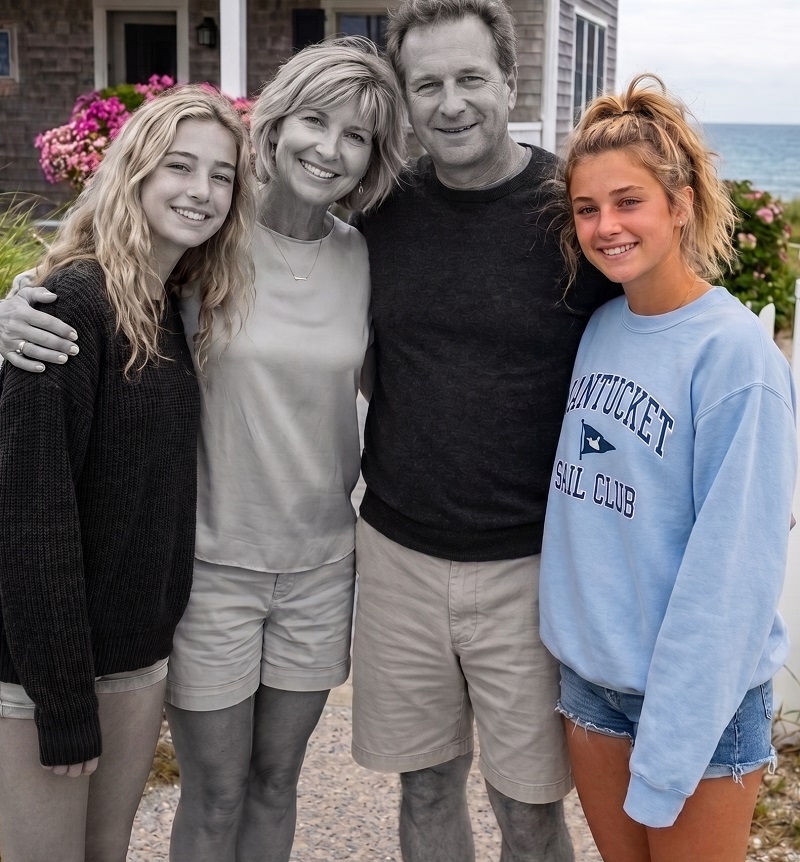
We stood together in front of the porch while the ocean shone behind us.
Lily slipped an arm around my waist. Ava leaned against Laura. Ben tried to make everyone laugh just before the timer flashed.
The photograph now hangs in the hallway.
Beside it is the old picture of Margaret holding three-year-old Lily.
I still miss my parents.
I still wish I could return to that final morning, answer Mom’s call, arrive early, and tell Margaret that no argument could ever make her stop being my sister.
But I no longer believe that being late caused the accident.
And I no longer think the story of our family ended on that road.
I went back to the cottage intending to close a chapter, settle the taxes, and sell the place before my courage disappeared.
Instead, I found a young woman with my sister’s eyes holding a letter that had waited fifteen years to reach me.
I found forgiveness—not the kind that erases what happened, but the kind that allows life to continue.
Most of all, I finally did what Margaret asked.
I opened the windows.
I let the house breathe.
And after fifteen silent years, I let my family come home.
Note: This story is a work of fiction inspired by real events. Names, characters, and details have been altered. Any resemblance is coincidental. The author and publisher disclaim accuracy, liability, and responsibility for interpretations or reliance. All images are for illustration purposes only.