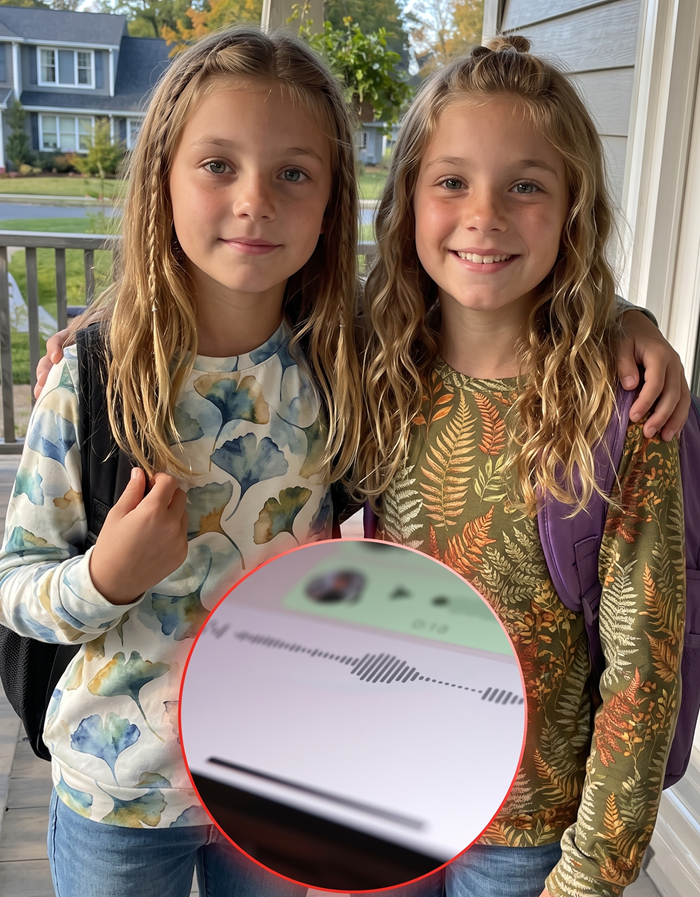
The last time I saw my daughters that morning, they were arguing about a window seat.
Less than an hour later, their school called to tell me the bus had never arrived.
Thirteen children and one trusted driver had disappeared without leaving behind a single tire mark, emergency call, or witness.
For hours, police helicopters searched the mountains while terrified parents waited for news.
Then my daughter’s phone sent me a voicemail from somewhere underground.
Her trembling voice told me they were alive.
But the next words she whispered made the police chief look more frightened than any of us.
The Last Ordinary Morning
At 7:45 that morning, I stood at the end of our driveway and watched my nine-year-old twins, Jennifer and Mary, climb onto Bus 14.
It was the same routine we had followed every weekday for years.
Mary reached the door first, but Jennifer slipped around her and hurried toward the seat beside the window.
“I sat there yesterday,” Mary protested.
Jennifer dropped into the seat and smiled triumphantly.
“Exactly. That means it’s my turn again.”
“That makes no sense.”
“It does according to twin law.”
Arthur, the bus driver, leaned toward the open door and gave me an amused look.
“There are plenty of windows on this bus,” he told them. “Your mother already has enough to handle without negotiating an international agreement before breakfast.”
I laughed.
Arthur had driven the children through our valley for six years. He was quiet, punctual, and almost painfully careful.
Every afternoon, he waited until each child reached the front door before driving away. During winter storms, he called parents personally if the roads looked dangerous. Once, when Mary left her science project on the bus, he drove back after dinner to return it.
No one in our community worried when their children were with Arthur.
“Behave yourselves,” I called.
Mary waved.
Jennifer pressed her face against the glass and crossed her eyes at me.
I shook my head, pretending to be embarrassed, although I was smiling.
The bus pulled away carrying my daughters and eleven other children from our small valley.
I remained beside the road until the bright yellow vehicle disappeared around the bend.
I had no idea that ordinary moment would replay in my mind for the rest of my life.

The Call No Parent Wants to Receive
At 8:30, the school secretary called.
“Ms. Emmy?” she asked carefully. “Were Jennifer and Mary kept home this morning?”
My hand tightened around the phone.
“No. They took Bus 14.”
A pause followed.
It was brief, but it felt enormous.
“The bus hasn’t arrived.”
I looked at the clock above the kitchen counter.
“That can’t be right. Maybe Arthur had engine trouble.”
“We’ve tried contacting him several times. He isn’t answering.”
The uneasiness inside me sharpened into fear.
“Where was the bus last seen?”
“We’re still trying to establish that.”
I was already reaching for my keys.
By the time I arrived at the school, parents were gathering near the main entrance. Some were still wearing work clothes. One mother had come in slippers. A father kept redialing his son’s phone even though every attempt went directly to voicemail.
We soon learned that Bus 14 had departed its final pickup point at 8:03.
It should have reached the main highway seven minutes later.
But the highway cameras never recorded it.
The school’s entrance camera never saw it.
No one had reported a crash.
No guardrail was damaged.
No skid marks led from the road.
There were no broken branches, scattered belongings, or signs that a large vehicle had left the pavement.
A school bus carrying thirteen children had simply vanished.
A Search That Seemed to Be Looking in the Wrong Direction
By ten o’clock, the school gym had become a waiting room filled with panic.
Parents sat on folding chairs, gripping phones and whispering prayers. Some cried openly. Others stared at the doors as if their children might suddenly walk through them.
Police vehicles covered the school grounds.
Helicopters circled above the forest.
Deputies blocked roads leading out of the county.
Search teams were sent toward the mountains north of the valley.
Police Chief Miller stood beneath the basketball hoop with a large map pinned behind him.
He was in his early sixties, broad-shouldered, with silver hair at his temples. People trusted him because he rarely appeared shaken.
That morning, however, his voice was not steady.
“We are treating this as a possible coordinated abduction,” he announced. “We believe the bus may have been forced onto one of the abandoned logging roads north of the highway.”
A woman beside me covered her mouth.
“Abduction?” I demanded. “What evidence suggests an abduction?”
Chief Miller looked directly at me.
“The bus did not complete its route.”
“That doesn’t prove someone took it.”
“We are considering every possibility.”
“Are you searching the farms and back roads in the valley?”
His expression tightened.
“We have teams covering the appropriate areas.”
“How many are searching the valley?”
“Ms. Emmy, please sit down.”
“My daughters are missing.”
“And so are eleven other children,” he replied. “We need everyone here to remain calm.”
Remain calm.
The words felt almost insulting.
He turned back to the map and continued describing the search.
The north logging road.
The mountain trail.
The abandoned quarry.
The forest near the county line.
Again and again, he pointed north.
But Arthur’s bus route ran through the valley.
The mountains were in the opposite direction.
I could not understand why almost every resource was being sent away from the place where the bus had last been seen.
The Driver the Police Wanted Us to Blame
By noon, reporters had gathered outside the school.
Chief Miller stood before the cameras and announced that authorities believed the children might have been deliberately targeted.
A reporter asked whether there had been a ransom demand.
“Not at this time,” he answered.
“Do you have a suspect?”
“We are examining the driver’s history.”
I pushed through the people standing behind the police barrier.
“Arthur would never hurt those children.”
Chief Miller turned toward me with a cold expression.
“You cannot know that.”
“I’ve trusted him with my daughters every school day for six years.”
“People can hide who they really are.”
The way he said it disturbed me.
It did not sound like a general warning.
It sounded personal.
“Do you know Arthur?” I asked.
His jaw tightened.
“I know his record.”
“What record?”
Before he answered, a deputy stepped between us.
“Ms. Emmy, please return inside.”
Chief Miller walked away.
I watched him cross the parking lot and felt a new kind of fear.
It was no longer only the fear that my daughters were missing.
It was the fear that the man directing the search knew more than he was telling us.

The Voicemail from Underground
At 2:14 that afternoon, my phone vibrated.
The number was restricted.
For a moment, I assumed it was another reporter.
Then a weak location notification flashed across the screen.
Jennifer’s phone.
My entire body froze.
I answered immediately.
“Jennifer?”
No one replied.
There was only static.
Behind it, I heard a faint metallic vibration and someone breathing close to the microphone.
“Baby, can you hear me?”
The call ended.
A voicemail notification appeared seconds later.
My hands trembled so violently that I nearly dropped the phone.
I pressed play.
Static crackled from the speaker.
Then I heard Jennifer’s voice.
It was so soft that I had to hold the phone against my ear.
“Mommy, please don’t cry. We’re safe, but we have to stay hidden.”
Relief struck me so suddenly that my knees weakened.
She was alive.
Mary was alive.
They had to be.
People nearby noticed my expression and moved closer.
Jennifer continued speaking rapidly.
“Mr. Arthur says the smoke isn’t really smoke. He brought us to his farm. We’re underneath the old barn. Mary’s with me. Everyone is here.”
A child coughed in the background.
Then I heard Arthur.
“Jennifer, put the phone away. The signal might reveal our location.”
She kept talking.
“Mom, Mr. Arthur says Chief Miller can’t know where we are.”
The relief vanished.
My blood seemed to turn cold inside my veins.
Arthur’s voice returned, closer this time.
“Tell her the tanks failed. Tell her about the south ditch.”
Jennifer inhaled shakily.
“He says Chief Miller knows what happened before because they’re brothers.”
Static swallowed several words.
Then my daughter whispered one final sentence.
“Mr. Arthur says the chief buried people here once.”
The recording ended.
The Chief’s Reaction Told Me Everything
The gym erupted as soon as I replayed the message.
Parents crowded around me.
“Did she say all the children were together?”
“Where is the farm?”
“Did Arthur take them?”
Chief Miller entered from the hallway while the voicemail played again.
The moment he heard Arthur’s voice, every trace of color disappeared from his face.
He moved quickly toward me and extended his hand.
“Give me the phone.”
I stepped backward.
“No.”
“That recording is evidence.”
“You can listen from where you are.”
He lowered his voice.
“Ms. Emmy, refusing to cooperate could place those children in greater danger.”
“My daughter said you were the danger.”
The room fell silent.
Chief Miller glanced around at the watching parents.
“Arthur is manipulating a frightened child.”
“Is Arthur your brother?”
His nostrils flared.
“My half-brother.”
A stunned murmur passed through the gym.
“Why didn’t you disclose that?” I demanded.
“Because our relationship has no relevance to the investigation.”
“It has everything to do with this investigation.”
He reached toward my phone again, but I pressed it against my chest.
“Send rescuers to Arthur’s farm.”
“The property has been abandoned for years.”
“Then search it.”
“The valley could be contaminated.”
The answer came too quickly.
No official report had mentioned contamination. No one had confirmed a chemical leak.
Yet the word seemed ready on his tongue.
“How do you know that?” I asked.
His expression hardened.
“I said it could be contaminated.”
“No. My daughter mentioned strange smoke, and you immediately knew the valley might be dangerous.”
Parents began questioning him from every direction.
Chief Miller turned toward the deputies.
“Clear the gym.”
None of them moved.
One father rose from the bleachers.
“We’re staying right here.”
The chief looked trapped, but he attempted to recover.
“Arthur is not the trustworthy man you believe him to be,” he said. “He has a criminal history involving environmental violations.”
Then I remembered the valley disaster.
It had happened thirty years earlier, when I was still a child.
Industrial chemicals had been illegally released near an old drainage area. Local wells were contaminated, several families became sick, and one employee was blamed.
That employee’s name was Arthur.
The scandal destroyed his life. He vanished from the community for years before returning quietly.
Until that moment, I had never known Chief Miller was his brother.
“You framed him,” I said.
Chief Miller became completely still.
“Choose your words carefully.”
“Jennifer said you covered up what happened here.”
“She is a nine-year-old repeating the claims of a desperate criminal.”
One of the deputies looked uncomfortable.
“Chief, perhaps we should contact the state hazardous-materials unit.”
Miller spun toward him.
“No one enters that valley until I authorize it.”
That was the moment I stopped doubting myself.
He was not trying to find the children.
He was trying to control who reached them first.
The Secret Hidden in the South Ditch
While parents continued arguing with the chief, I slipped into the hallway and called my cousin, who worked for the county environmental office.
I explained what Jennifer had said.
My cousin gave me the direct number of Rosa Alvarez, a federal environmental-crimes agent who had investigated illegal dumping sites throughout the state.
I sent Rosa the voicemail.
She called back less than four minutes later.
“Do not surrender that phone to the local police,” she said.
My skin prickled.
“Why?”
“The phrase ‘south ditch’ appears in a sealed federal report from 1994.”
“What report?”
“An investigation into illegal chemical dumping. The case was closed after the primary witness supposedly withdrew his testimony.”
“Arthur?”
“Yes.”
“He didn’t withdraw it, did he?”
There was a pause.
“We have reason to believe his statement was altered.”
Through the gym doors, I could see Chief Miller directing deputies and trying to restore control.
“What should I do?” I asked.
“Keep the chief occupied. Federal agents and hazardous-material specialists are already on the way.”
“Arthur said the children are hiding underground.”
“That cellar may be the reason they are still alive.”
Rosa explained what investigators believed had happened.
Years of heavy rain had weakened the soil around old chemical drums buried beneath the valley. That morning, a tanker carrying cleanup equipment had crossed unstable ground near the site.
Part of the area collapsed.
A pipe ruptured.
Toxic vapor began drifting over the low fields.
Arthur recognized the smell and warning labels because he had worked near the chemical plant decades earlier.
The bus radio stopped working after debris damaged the antenna. Cell service in the valley was weak and unreliable.
Turning around would have taken the bus directly into the expanding cloud.
Arthur had only seconds to decide.
So he drove the children to the one protected place he remembered—a sealed cold-storage cellar beneath his family’s abandoned barn.
He had not kidnapped them.
He had saved them.
“What Did You Do?”
At 3:05, Chief Miller announced that the search would be expanded farther north.
I walked directly in front of him.
“No.”
His eyes narrowed.
“Step aside.”
“The federal authorities are coming.”
For the first time all day, genuine terror appeared in his face.
“What did you do?”
“I sent them the voicemail.”
His composure shattered.
“You foolish woman!”
The entire gym went silent.
He moved closer to me.
“You have no idea what you’ve started.”
“I started a rescue.”
“You exposed a dangerous area. If federal teams enter without preparation, people could die.”
“Then why didn’t you contact them yourself?”
He had no answer.
I raised my phone.
“Tell everyone the truth.”
His voice dropped.
“You think Arthur is some kind of hero because he hid children in a cellar?”
“I think he knew where the poison came from.”
“He caused the original disaster.”
“No,” I said. “You blamed him for it.”
His expression twisted with anger.
“You know nothing about what happened between us.”
“Then explain it.”
He glanced toward the exits.
Two federal agents had just entered the gym.
Rosa walked between them wearing a dark jacket and carrying a sealed evidence bag.
“Chief Miller,” she said, “step away from Ms. Emmy.”
He straightened and tried to recover his authority.
“This is my jurisdiction.”
“Not anymore.”

Thirteen Children Beneath an Old Barn
The rescue operation began at 3:22.
Hazardous-materials vehicles entered the valley from the eastern ridge, where the wind was carrying the vapor away from the access road.
Fire crews wore protective breathing equipment.
A helicopter mapped the movement of the chemical cloud.
Rosa allowed me to ride with her as far as the command barrier.
Beyond it, the valley appeared strangely peaceful.
There were no flames.
No collapsed buildings.
No dramatic wall of smoke.
Only a thin haze resting close to the fields.
That calmness made it even more frightening.
In the distance, I saw the yellow school bus parked beside Arthur’s barn.
It had been there the entire time.
“Why didn’t the helicopters find it?” I asked.
Rosa looked toward the mountains.
“Because Chief Miller kept them searching in the wrong direction.”
At 4:06, a voice crackled through the radio.
“Cellar located.”
I stopped breathing.
“Thirteen children accounted for,” the responder continued. “One adult accounted for. One child showing respiratory difficulty.”
Mary had asthma.
“Which child?” I demanded.
Rosa raised her hand, listening to the transmission.
Several seconds passed.
They felt longer than the entire day.
Then she turned to me.
“Mary. She is conscious. The team is giving her oxygen.”
My legs gave way.
Rosa caught me before I fell.
“They have her,” she said. “They have all of them.”
One by one, the children emerged from the barn wearing protective masks.
A boy ran toward his father.
Then came two girls holding hands.
Another child followed, wrapped in a rescue blanket.
Finally, I saw Jennifer.
She was gripping Mary’s hand so tightly their fingers were pressed together.
I ran past the barrier before anyone could stop me.
“Mommy!”
Both girls crashed into me at the same time.
I dropped to my knees and wrapped my arms around them.
Mary looked pale behind her mask.
Jennifer was crying.
“You found us,” she said.
“You called me,” I sobbed. “You helped me find you.”
“I hid the phone beneath my sweater.”
I kissed their hair, their foreheads, their hands—every part of them I could reach.
Arthur emerged last.
He looked exhausted, his clothes dusty and his face lined with worry.
Two federal agents approached him.
For one terrible moment, I thought they intended to arrest him.
Instead, Rosa extended her hand.
“You saved thirteen children today.”
Arthur looked past her.
Chief Miller stood beside a federal vehicle with his hands restrained behind his back.
Arthur’s eyes filled with an old sadness.
“I couldn’t save the people the first time.”
Chief Miller glared at him.
“You should have stayed away.”
Arthur’s expression remained calm.
“You spent thirty years counting on that.”
The Crime Buried for Three Decades
The investigation uncovered a truth darker than any of us had imagined.
Thirty years earlier, Chief Miller had been a young deputy providing private security for the chemical company.
In exchange for money, he approved illegal dumping in the valley after dark.
Arthur discovered what was happening and tried to report it.
Then a containment trench failed.
Several workers became seriously ill. Two died, and company officials concealed their deaths by falsifying records and intimidating witnesses.
Miller altered evidence and pressured people to change their statements.
When Arthur refused to remain silent, his own brother made him the scapegoat.
The community believed the official story.
Arthur lost his job, his reputation, and almost everyone he knew.
Eventually, he left because no one would listen.
The sealed federal files, the corroded chemical drums, and the newly discovered documents finally proved he had been telling the truth.
Chief Miller had directed the search toward the mountains because he feared rescuers would find the bus beside the old dumping site.
He had been willing to delay the rescue of thirteen children to protect a crime hidden for thirty years.
The Man Everyone Had Misjudged
Arthur was officially cleared of the old charges.
All thirteen children were treated for chemical exposure.
Most were released that evening.
Mary remained in the hospital overnight because of her asthma—and because I refused to take her home until every doctor assured me she was safe.
The following morning, Jennifer sat beside Mary’s bed eating a cup of gelatin.
“Mr. Arthur said you would find us,” she told me.
“He did?”
She nodded.
“He said mothers are more stubborn than police chiefs.”
Mary rolled her eyes from beneath her blanket.
“That isn’t exactly what he said.”
“What did he say?”
Mary smiled weakly.
“He said, ‘Your mother looks like the kind of woman who would fight a bear with one shoe.’”
For the first time in two days, I laughed.
It came out mixed with tears, but it was laughter.
Arthur never returned to driving Bus 14.
Not because anyone blamed him.
He said he was tired of carrying children along roads poisoned by men who believed power could bury the truth forever.
Several weeks later, the school held a ceremony in his honor.
All thirteen children stood together on the stage.
Jennifer walked to Arthur and handed him a folded note.
He opened it, read the message, and quietly wiped his eyes.
Later, I asked her what she had written.
She shrugged.
“Just that heroes should answer their phones.”
The Direction No One Wanted Us to Look
The valley remained closed for months while federal crews removed the buried chemicals and restored the damaged soil.
Chief Miller went to trial.
Arthur testified.
So did I.
Jennifer’s voicemail became the piece of evidence Miller could never explain away.
But when I remember that day, I do not think first about the courtroom, the reporters, or the headlines.
I remember standing beside my driveway as a yellow school bus disappeared around a bend.
I remember the unbearable silence after the school called.
I remember my daughter’s voice struggling through static from beneath an old barn.
Most of all, I remember how easily we trusted the man wearing the uniform while doubting the man who had already sacrificed everything to tell the truth.
Arthur had been called a criminal for thirty years.
Chief Miller had been called a protector.
Only one of them risked his life to save our children.
And that left me with a question I have never forgotten:
When the person leading the search is also the person hiding the truth, how many of us are brave enough to look in the direction he tells us to ignore?
Disclaimer: This story is a work of fiction created for entertainment purposes. Any resemblance to real people, events, or places is purely coincidental.