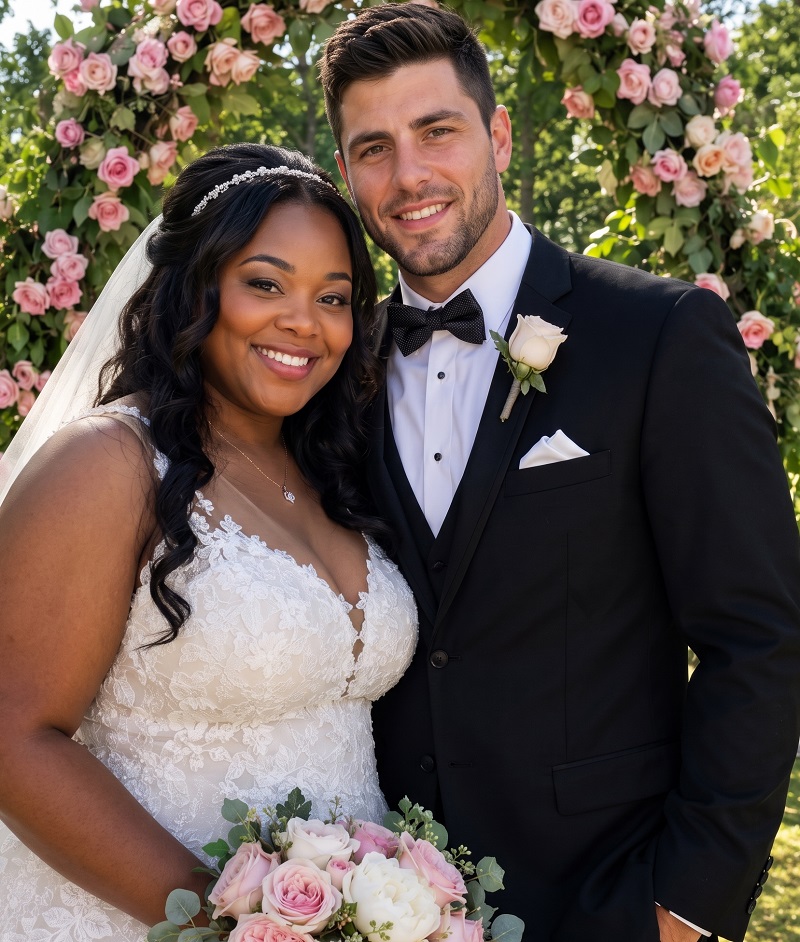
The Envelope Waiting on Our Wedding Night
On the first night of my marriage, I turned toward my new husband expecting him to kiss me.
Instead, he stood beside the bed holding an envelope with trembling hands.
The expression on his face made my happiness disappear before he even spoke.
Outside our villa, the Maldivian sunset had transformed the ocean into liquid gold. Warm wind drifted through the open balcony doors, carrying the scent of salt and tropical flowers. I was still wearing the soft white dress from our reception, my hair loose around my shoulders and grains of sand clinging to my feet.
Only a few hours earlier, Carter and I had promised to love each other for the rest of our lives.
Now he looked as though he regretted every word.
“Please sit down,” he said.
His voice was so quiet that I almost did not recognize it.
I lowered myself onto the edge of the bed. The fabric of my dress gathered around me like spilled moonlight.
“What’s wrong?”
Carter looked at the envelope, then at me.
“You deserve to know why I really married you.”
The room seemed to tilt.
And suddenly, I was no longer a bride on a beautiful island.
I was a frightened little girl standing beside a muddy puddle, watching Carter destroy the one thing I loved most.
The Boy Next Door Who Made Me Feel Small
Carter had lived next door to me for most of my childhood.
Our houses stood only a few yards apart, but our families lived in completely different worlds.
His home had stone columns, spotless windows, landscaped gardens, and a driveway wide enough to hold several luxury cars. My parents’ house was modest, warm, and slightly worn around the edges. My father repaired whatever broke himself. My mother saved wrapping paper and reused glass jars.
We never had much, but our home was filled with love.
Carter made sure I understood that love was not something his family valued as much as status.
In fifth grade, he grabbed my sketchbook from my hands, tore it down the middle, and dropped the pages into a rain puddle.
I can still remember kneeling on the wet pavement, trying to rescue drawings that dissolved beneath my fingers while he laughed with his friends.
Later, his mother, Vivienne, came outside wearing a cream-colored suit and an expression of annoyance.
She did not ask why I was crying.
She looked at my muddy shoes and said to my father, “Please keep your daughter off our lawn. The grass stains easily.”
Carter’s cruelty continued for years.
He mocked my secondhand clothes. He repeated private things I had told him when we were younger. Once, he started a rumor that left me eating lunch alone for nearly a month.
Eventually, Carter left town.
I told myself I was relieved.
Yet some part of me continued to carry that little girl’s wish that one day the people in the beautiful house next door would finally see me as someone worthy.
That weakness would cost me more than I ever imagined.

The Apology I Wanted to Believe
Two years before our wedding, Carter returned home.
I saw him at a mutual friend’s birthday party.
At first, I almost did not recognize him.
He was thinner than I remembered. Quieter too. The arrogance he had worn so naturally as a teenager was gone. Something heavier seemed to have replaced it.
He approached me near the drinks table.
“I know I’m probably the last person you want to see,” he said.
“You’re right.”
He accepted my answer without becoming defensive.
“I was cruel to you,” he continued. “There’s no excuse for it. I’ve thought about what I did for years, and I couldn’t let more time pass without apologizing.”
“You think saying sorry erases everything?”
“No.” His eyes filled with regret. “I don’t expect forgiveness. I only wanted you to hear an apology from someone who finally understands how much harm he caused.”
I should have walked away.
Instead, I listened.
Carter did not ask for a relationship immediately. He began with small gestures.
He sent me a replacement sketchbook, but included a note saying he understood if I never used it.
He remembered that I took my coffee with two sugars and a splash of oat milk. When my car broke down, he waited beside me until help arrived, though I repeatedly told him he could leave.
He never pressured me to forgive him.
Slowly, I began to believe he had changed.
When he asked me to dinner, I said yes.
When he told me he loved me, I wanted desperately to believe that too.
A Romance Moving Too Quickly
Everything happened fast after that.
Within months, Carter began talking about marriage.
He proposed before our first anniversary.
At our engagement dinner, a single white peony rested beside my plate. It had been my grandmother’s favorite flower, a detail I had mentioned only once.
I looked at that flower and thought, This is what love feels like. It remembers.
But there was always something urgent about Carter.
He planned as though time were chasing him.
He wanted to set the wedding date immediately. He became uneasy whenever I suggested waiting another year. Even the smallest delay seemed to frighten him.
My mother noticed.
“Why is everything happening so quickly?” she asked after we announced the date.
“He knows what he wants.”
She studied me carefully.
“People who truly know what they want don’t usually have to rush this much.”
I became defensive.
“You never liked his family.”
“I’m not talking about his family. I’m talking about the way you look whenever someone asks you to slow down.”
I did not speak to her for a week.
Deep down, I knew her question unsettled me because I had asked myself the same thing.
But I ignored the feeling.
Vivienne’s behavior changed too.
The woman who had once treated me like dirt suddenly welcomed me with open arms. She invited me to elegant brunches, introduced me proudly as her future daughter-in-law, and insisted on paying for the wedding.
Carter’s relatives exchanged puzzled looks whenever she embraced me.
I saw those looks.
I simply chose not to understand them.
I wanted to believe I had finally been accepted by the family who had once made me feel invisible.
So I stopped asking why.
“Two Years Ago, I Was Told I Was Dying”
On our honeymoon, Carter finally handed me the truth.
“Two years ago,” he said, “a doctor told me I had a neurological disease.”
I stared at him.
“The same illness that killed my father before he turned forty. I was told I had inherited the gene. They said I might have only a few healthy years left.”
He opened the envelope and placed several documents on the bed.
There were medical reports, appointment cards, genetic test results, and letters bearing the name of a private clinic.
“That’s why you came home?” I whispered.
He nodded.
“I made a list of people I had hurt. You were on it. I wanted to apologize before I ran out of time.”
My throat tightened.
“So I was an item on your list.”
“At first.”
The words struck harder than I expected.
He sat across from me but did not try to touch me.
“You weren’t supposed to become more than that,” he said. “But you did. Within weeks, you became the most important person in my life.”
I looked down at the papers.
A strange coldness spread through me despite the tropical heat.
“Why didn’t you tell me?”
“I was afraid you would stay because you felt sorry for me.”
Before I could respond, he reached into the envelope and removed another folder.
“Six weeks ago, I saw a second specialist.”
My heart began pounding.
“He asked for the original laboratory data. The clinic couldn’t provide it, so he ordered new tests.”
Carter placed the second report beside the first.
“The original diagnosis was wrong,” he said. “I don’t have the disease. I never did.”
The ocean continued crashing outside, but inside the room, everything became silent.
I looked at him, then at my wedding dress.
“If you found out six weeks ago, why did you still marry me?”
His face collapsed.
“I wanted to cancel the wedding.”
“But you didn’t.”
“I couldn’t.”
“You couldn’t—or you chose not to?”
He did not answer.
That silence gave me my first glimpse of the nightmare beneath our marriage.

The Debt Vivienne Used Against Him
“Was this your mother’s decision?” I asked.
Carter lowered his eyes.
“My mother threatened your parents.”
I stood so quickly that the papers slid from my lap.
“What did you just say?”
“She owns their mortgage.”
I stared at him, certain I had misunderstood.
“My parents have a bank loan.”
“Not anymore. Years ago, one of my mother’s companies quietly purchased the debt.”
My stomach twisted.
“Vivienne owns my parents’ house?”
“Technically, she controls the loan.”
“And she threatened to take their home if you canceled our wedding?”
He nodded.
“When I told her about the second report, she said she would demand immediate payment. Your parents could never have covered it.”
I could barely breathe.
“So you said nothing to me.”
“I spent the last six weeks trying to get the loan away from her. A family friend finally bought it this morning.”
“This morning?”
“While we were getting married.”
The words felt unreal.
Carter stepped toward me, but I moved back.
“I couldn’t tell you while she still had power over your family,” he said. “But I also couldn’t let you spend tonight believing I had been honest with you.”
“You let me walk down the aisle.”
“I know.”
“You looked my father in the eye.”
“I know.”
“You listened while I promised you my entire future.”
His voice broke.
“I know.”
I looked at the documents again.
The rushed proposal.
The deadline surrounding his twenty-seventh birthday.
Vivienne paying for everything.
Her sudden affection.
Every romantic gesture now seemed connected to something hidden.
“There’s more,” I said.
Carter’s face told me I was right.
“I can’t tell you everything tonight.”
That was the moment something inside me finally snapped.
I gathered the papers, crushed them against my chest, and walked toward the door.
“Where are you going?” he called.
I did not answer.
I had no idea whether I was escaping my husband or searching for the rest of the truth.
The Paper Trail Vivienne Tried to Hide
I moved to a small room on the opposite side of the resort.
For two days, I barely slept.
I spread every document across the bed and studied dates, signatures, medical terms, and corporate names. The more I read, the less sense the story made.
On the second morning, I called my best friend, Danielle.
“I need you,” I said.
“I’m already heading to the airport,” she replied. “Do not confront anyone else until I get there.”
Months earlier, Vivienne had mailed me a program from one of her charity galas. I had photographed it because Carter’s name appeared in the list of donors.
The program included members of the charity board.
One name matched the doctor who had diagnosed Carter.
Danielle began searching corporate filings during her layover. By the time she arrived, she had uncovered connections I never would have found alone.
She sat cross-legged on the hotel bed, surrounded by papers.
“Look at the doctor’s name,” she said. “Now look at Vivienne’s charity board.”
“They’re the same.”
She nodded.
“Now look at the company that renovated the clinic.”
The company was connected to one of Vivienne’s family trusts.
The clinic’s attorney had also worked for several businesses controlled by Vivienne.
Danielle tapped Carter’s original diagnosis.
“There are no actual laboratory results attached to this report. Only the doctor’s written interpretation.”
The truth was becoming impossible to deny.
“Vivienne created the entire trail,” I whispered.
“Maybe,” Danielle said carefully. “But you’re still trying to separate Carter from what happened.”
“He believed he was sick.”
“At first,” she replied. “But six weeks ago, he learned he wasn’t. After that, every day he stayed silent was a decision.”
“He was trying to protect my parents.”
“He may have believed that. But he also let you choose flowers, write vows, and build a future around information he knew was false.”
I searched for another excuse.
For the first time, I could not find one.
The Truth on the Beach
I asked Carter to meet me on the beach at sunrise.
I arrived barefoot, wearing a simple dress that did not feel like bridal clothing anymore.
He was already waiting.
I handed him the evidence Danielle and I had found.
He looked at the documents and went pale.
“There was never any disease,” I said.
“I didn’t know that at the beginning.”
“But your mother did.”
He remained silent for a long time.
Then he finally told me everything.
“My father left a trust,” he said. “I can only inherit it if I’m legally married before I turn twenty-seven.”
His birthday was less than three weeks away.
“My mother wanted control of the money,” he continued. “She planned to choose a bride who would cooperate with her. But I kept resisting every woman she introduced.”
“So she convinced you that you were dying.”
“She paid the doctor to hide my actual results and tell me I had inherited my father’s condition. A man who believes he has only a few years left is easier to control.”
“And once you proposed to me, she stopped caring who the bride was.”
“She only needed the marriage completed before the deadline.”
Cold water washed across my feet.
I barely felt it.
“You believed you were dying for two years.”
“Yes.”
“And when the second doctor discovered the truth?”
“I panicked. I wanted to stop everything, but my mother threatened your parents. I thought if I could free them from her first, I could tell you afterward.”
“After we were married.”
“I kept telling myself I needed one more week. Then three more days. Then one more day.”
He looked toward the ocean.
“I convinced myself that protecting your parents first was the least terrible choice available.”
“Do you hear what you’re saying?”
His shoulders dropped.
“I was a coward.”
“You were more than a coward. You made a decision about my life without giving me the truth.”
He closed his eyes.
“I know.”
“No, Carter. You know now because there are consequences.”
Tears gathered in his eyes, but I did not reach for him.
“A man who truly loved me would have told me the moment that second report arrived,” I said. “He would have risked the trust, the wedding, and his mother’s anger. He would have trusted me enough to face the danger beside him.”
“I’m sorry.”
“You let me marry a version of you that didn’t exist.”
I removed my wedding ring.
“I’m filing for an annulment.”
His face tightened, but he nodded.
“Fraud means the marriage can be treated as though it never happened,” I continued. “And when your birthday arrives, there will be no valid marriage. Your mother will lose the trust she manipulated us to obtain.”
“What are you going to do about her?” he asked.
I looked at the endless blue water.
“She paid for a performance,” I said. “I think she deserves to see the final scene.”

The Brunch Where Everything Fell Apart
I did not file the paperwork immediately.
Instead, I waited.
Two weeks later, Vivienne invited us to a celebratory brunch at her home. She planned to present Carter and me to her friends as the perfect newlywed couple.
I accepted.
Then I sent Carter a message.
Be there. Say nothing.
His reply came moments later.
Okay.
On the morning of the brunch, I wore my wedding dress.
Vivienne’s house was filled with flowers, crystal glasses, and guests wearing expensive clothes. She greeted me with a proud smile, apparently unaware that her carefully constructed world was about to collapse.
Carter stood beside her.
He looked exhausted.
Inside my handbag was a message from Carter’s estranged aunt, Marlene. She had contacted me after hearing pieces of what had happened.
Call me if you ever need the truth, she had written.
I called.
Marlene had spent years watching Vivienne control the family through secrets, money, and fear. She agreed to attend the brunch and bring documents of her own.
When Vivienne lifted her glass to offer a toast, I stepped toward the microphone.
“Thank you for gathering everyone,” I said. “Before we celebrate, I would like to share a few dates.”
Vivienne’s smile remained in place, but her fingers tightened around her glass.
I read the date Carter received his diagnosis.
Then I read the date Vivienne’s company funded the clinic renovation.
I read the date connected to the family trust.
I read the date the second specialist confirmed Carter had never carried the dangerous gene.
Finally, I read our wedding date.
I never directly accused Vivienne.
I did not need to.
The timeline accused her for me.
Guests began exchanging troubled glances.
“Vivienne,” I said, turning toward her, “thank you for paying for the most educational year of my life.”
I handed the folder to Marlene.
She opened it calmly.
“There will be an annulment,” I announced.
Vivienne placed her glass on the table.
“Darling, this is not the place for a private family disagreement.”
But the room had already changed.
People picked up their coats. Conversations stopped. Groups moved toward the door, avoiding Vivienne’s eyes.
For the first time, she could not control what people believed.
Carter did not defend her.
He did not defend himself either.
As I walked past him, he spoke quietly.
“I’m sorry for everything. From the sketchbook onward.”
I stopped.
His first apology had cost him nothing.
This one had cost him his marriage, his inheritance, his mother, and the illusion that he could protect someone through deception.
I nodded once.
Then I walked out.
The First Blank Page
Months later, I sat at my parents’ kitchen table drinking Sunday coffee.
The annulment had been granted.
The trust deadline had passed.
Vivienne’s influence had not disappeared overnight, but her social circle had quietly abandoned her. Once people began examining her business dealings, more questions followed.
Carter cut ties with her.
He sent me one letter.
I never opened it.
Perhaps some of his love had been real. Maybe the coffee, the white peony, and the way he listened when I spoke had all come from something genuine.
But I had finally learned that love was not measured only by emotion.
Love was measured by choices.
Carter may have loved me in the only way he knew how, but when honesty became dangerous, he chose control. He decided what I should know, what I could handle, and what risks I was allowed to take.
That was not the kind of love I wanted anymore.
My old sketchbook rested on the kitchen table.
Its cover was faded and soft with age. My mother poured me another cup of coffee, then quietly left the room, sensing that I needed space.
I opened the book to the first blank page.
For several minutes, I simply stared at it.
I remembered the little girl kneeling beside a puddle, trying to save ruined drawings while a boy laughed.
Back then, I believed people like Carter and Vivienne had the power to decide whether I belonged.
I picked up a pencil.
Slowly, I drew one line.
It was imperfect, but it was mine.
Then I drew another.
The lines became the outline of a window opening toward a wide horizon—a view that did not include the mansion next door, the lawn I had once been forbidden to touch, or the family whose approval I had confused with love.
For the first time since fifth grade, the page no longer felt like something another person could destroy.
I had spent years waiting to be chosen.
Now I understood that the most important choice had always belonged to me.
I turned the page.
And I began again.
Note: This story is a work of fiction inspired by real events. Names, characters, and details have been altered. Any resemblance is coincidental. The author and publisher disclaim accuracy, liability, and responsibility for interpretations or reliance. All images are for illustration purposes only.