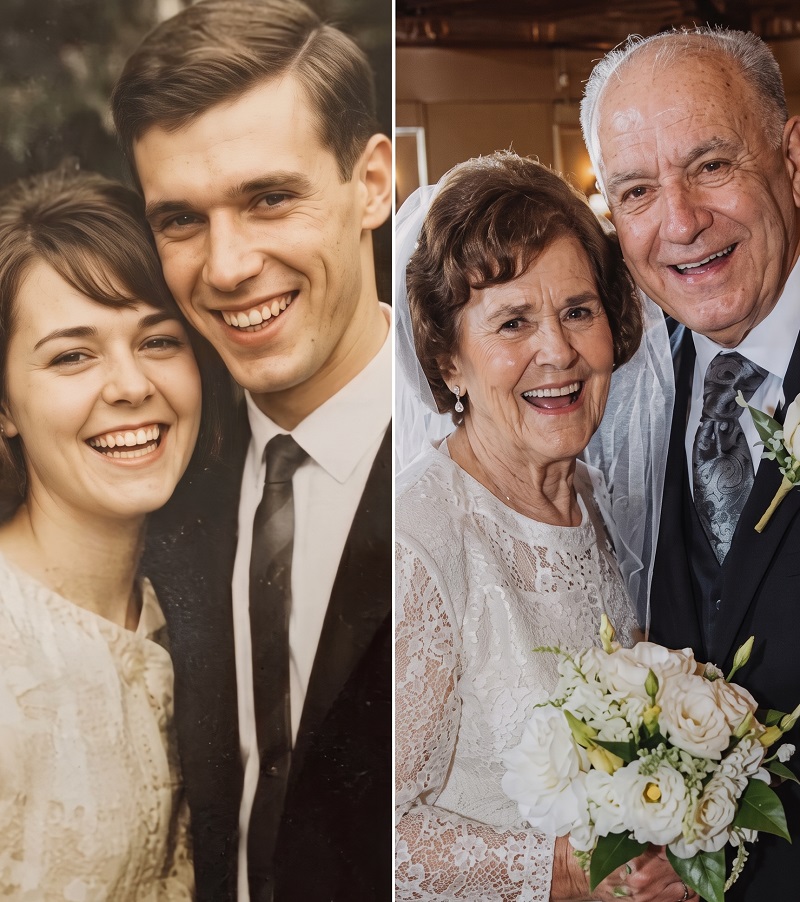
My children believed I was being manipulated. His relatives accused me of chasing an inheritance. And everyone wondered why a seventy-three-year-old widow would agree to marry the man who had abandoned her fifty-five years earlier.
But I did not marry Thomas for money.
I married him because I had spent nearly my entire life carrying a question he had never answered.
The truth finally reached me after his funeral, hidden inside a bank vault and protected by a small brass key.
What I discovered changed everything I believed about the boy who had once promised to grow old beside me.
The Voice I Never Expected to Hear Again
Thomas called me on a quiet Tuesday afternoon.
I was sitting at my kitchen table with a cup of tea when the telephone rang. I answered without looking at the number.
For several seconds, no one spoke.
Then I heard a faint breath.
“Eleanor.”
My hand tightened around the receiver.
Fifty-five years had passed since I had last heard that voice, yet I recognized it immediately.
Some voices live too deeply inside us to be forgotten.
“Thomas?”
A weak laugh came through the line.
“So you remember me.”
I lowered myself into the nearest chair so quickly that tea spilled across the saucer.
Remember him?
I had spent decades trying not to.
My eyes drifted toward the framed photograph of my late husband, George, resting on the shelf.
George had been gone for four years.
We had shared forty-six years of marriage, three children, five grandchildren, difficult seasons, joyful holidays, illnesses, arguments, reconciliations, and countless ordinary mornings that had built a beautiful life.
I had loved him completely.
My life with George had never been a replacement for anything.
But long before George, there had been Thomas.
And at eighteen, I had believed Thomas would be the only man I would ever love.
The Letter That Destroyed Our Future
Thomas and I had once planned everything.
We had chosen names for children who were never born.
We had walked through neighborhoods pointing at houses, pretending one of them would someday belong to us.
Under an old oak tree behind my parents’ church, he had placed a thin gold ring on my finger and asked me to become his wife.
I said yes before he had even finished speaking.
Our wedding was scheduled for the following spring.
Then, one month before the ceremony, a letter arrived.
It contained only four sentences.
“Eleanor,
I have made my choice. I cannot marry you. Do not wait for me, and do not try to contact me.
Thomas.”
That was all.
No explanation.
No apology.
No final meeting beneath the oak tree where he had promised me forever.
Within weeks, he had left town.
For years, I tortured myself by searching for something I might have missed.
Had there been another woman?
Had he grown tired of me?
Had he looked at our future and realized I was not the person he wanted beside him?
I replayed every conversation, every disagreement, every promise and every goodbye.
Eventually, survival demanded that I stop asking.
I married George.
I became a mother, a schoolteacher, a grandmother, and finally a widow.
Thomas became a room in my memory that I kept locked.
Until the afternoon he called my name.

“I Am Dying”
“What do you want?” I asked.
The warmth had left my voice.
There was a long silence before he answered.
“I’m dying.”
I closed my eyes.
However much pain he had caused me, I could not hear those words without feeling something break.
“I’m sorry,” I whispered.
“Pancreatic cancer,” he said. “The doctors have given me weeks. Maybe less.”
I held the phone more tightly.
“Why are you telling me?”
“Because I need to ask you for one final favor.”
He wanted me to visit him the next afternoon.
My daughter Rachel reacted exactly as I expected.
“He abandoned you,” she said. “He disappeared for more than half a century, and now that he’s dying, he expects you to go running back to him?”
“He didn’t ask me to run.”
“You don’t even know what he wants.”
She was right.
But I had spent fifty-five years wondering what Thomas might have said if he had ever found the courage to face me.
I could not ignore the possibility that I was finally about to learn the answer.
The Old Man Beside the Window
Thomas lived in a private care residence nearly two hours away.
I almost turned back three times during the drive.
When I reached his room, I found an old man seated beside the window.
For one disorienting second, I saw nothing of the boy I remembered.
He was painfully thin. His gray skin seemed stretched over fragile bones, and an oxygen tube rested beneath his nose. His hands trembled in his lap.
Then he looked at me.
His eyes had not changed.
“Eleanor.”
I remained near the doorway.
“You look well,” he said.
“You look terrible.”
His laugh was brief, but genuine.
“Still honest.”
On the table beside him stood a photograph of me at eighteen.
I stared at it.
“Why do you have that?”
His gaze followed mine.
“I kept more than I had any right to keep.”
He motioned toward a chair.
I sat down, though I left my coat buttoned.
“What is this favor?”
Thomas turned toward the window, as though the words might be easier to say if he did not have to see my face.
“Marry me.”
I thought the illness had confused him.
“What did you say?”
“I’m asking you to become my wife.”
“You’re dying.”
“I know.”
“We haven’t spoken in fifty-five years.”
“I know that too.”
I stood so quickly that the chair scraped across the floor.
“This is cruel.”
“No, Eleanor.”
“You shattered my heart, vanished without an explanation, and now you want me to marry you because you’re afraid to die alone?”
“It isn’t about loneliness.”
“Then what is it about?”
His eyes filled with tears.
“I can’t explain everything yet.”
A bitter laugh escaped me.
“Of course you can’t. You couldn’t explain yourself then either.”
“I need you to trust me one more time.”
“You’re asking that from the one person who has every reason not to.”
Thomas lowered his head.
“I know.”
I left without saying goodbye.
A Proposal No One Could Understand
That evening, I told my children.
Rachel was furious.
My son, Andrew, immediately suspected money.
“Is he trying to leave you an inheritance?”
“I don’t know.”
“Then maybe that’s what this is. Maybe his family is fighting over his estate, and he wants to use you.”
“I don’t want his money.”
My youngest daughter, Claire, had remained quiet.
Finally, she asked, “Do you still love him?”
I looked toward George’s photograph.
My love for George had been real, loyal, and complete. Nothing Thomas said could erase the life we had shared.
But the heart does not always close one door simply because another life begins.
“Love doesn’t always disappear,” I said softly. “Sometimes it changes shape. Sometimes it becomes something you learn to live around.”
Rachel shook her head.
“That isn’t an answer.”
“It’s the only honest answer I have.”
Thomas called the next morning.
“I’m sorry,” he said. “I had no right to place this burden on you.”
“No, you didn’t.”
“I have letters, records, and documents that you deserve to see. But if I die before you can legally access them, my family will take control.”
“What documents?”
“The truth about why I left you.”
My heart seemed to stop.
“What truth?”
“I need you to become the person with unquestioned legal authority to carry out my final instructions.”
“You have an attorney.”
“My relatives are already preparing to challenge my estate plan. If they gain control, they’ll destroy everything.”
“Why would your family care about two old people and an engagement that ended fifty-five years ago?”
Thomas became silent.
When he finally spoke, his voice was barely above a whisper.
“Because my father was not the man the world believed him to be.”
Three weeks later, I married Thomas.
Seventeen Days of Marriage
The ceremony took place in the care residence library.
Only six people attended: my three children, Thomas’s attorney, Mr. Bell, a nurse, and a retired judge who had known Thomas for years.
Thomas’s relatives refused to come.
One of his nephews, Stephen, sent me a message accusing me of taking advantage of a wealthy, dying man.
Rachel remained unconvinced.
Before the ceremony, she pulled me aside.
“You don’t owe him this, Mom.”
“I know.”
“Then why are you doing it?”
“Because I’ve spent fifty-five years wondering why he left. I don’t want to spend whatever time I have remaining wondering what he was trying to tell me.”
Thomas wore a dark suit that hung loosely from his shoulders.
When he reached for my hand, his fingers felt cold and weightless.
“I’m sorry,” he whispered.
“For which part?”
His eyes met mine.
“All of it.”
We were married for seventeen days.
There were no romantic trips, candlelit dinners, or attempts to recreate the dreams we had shared at eighteen.
Our marriage consisted mostly of nurses entering the room, medication schedules, short conversations, and long periods when Thomas slept.
He never pretended we were young again.
He asked about George.
He wanted to know whether I had been happy.
“Yes,” I told him. “I loved him very much.”
Thomas nodded slowly.
“I’m glad.”
There was no jealousy in his voice.
Strangely, that hurt more than jealousy would have.
It reminded me that whatever he was about to reveal could not return the years we had lost. Nothing could undo the lives we had lived apart.
The Brass Key
On our final night together, Thomas struggled to remain awake.
“There’s a brass key,” he said.
“What key?”
“Bell will give it to you after my funeral.”
I leaned closer.
“What does it open?”
“A safe-deposit box.”
“What’s inside?”
“Everything I should have told you before I left.”
“Then tell me now.”
His breathing had grown shallow.
“I’m ashamed.”
“Thomas, please.”
He opened his eyes.
“My father lied to me. I only discovered how much a few months ago.”
“What did he lie about?”
Thomas tried to answer, but pain tightened his face.
A nurse entered and increased his medication.
I sat beside him through the night.
Shortly before dawn, his fingers moved weakly against mine.
Then his hand became still.
Thomas died with my hand wrapped around his.

The Funeral and the Accusation
At the funeral, I stood near the back.
Thomas’s relatives filled the front rows. They looked at me as though I had wandered in uninvited.
Before the service, Stephen approached me.
“I hope you enjoyed your little performance,” he said.
I faced him calmly.
“I have already buried one husband. I will not stand here and allow you to insult another.”
“You were married to him for seventeen days.”
“And yet I was still his wife.”
His expression hardened.
In that moment, I understood why Thomas had been so afraid of what his family might do.
After the burial, Mr. Bell found me near the cemetery gates.
“Eleanor?”
I nodded.
He placed a small brass key in my palm.
“Thomas instructed me to give you this only after the funeral.”
The following morning, Bell accompanied me to the bank.
The key opened a safe-deposit box registered in Thomas’s name. His estate documents clearly authorized me to access it after his death.
There was no money inside.
Instead, I found dozens of letters tied with faded ribbon, photographs, newspaper clippings, a worn leather journal, and a sealed envelope with my name written across the front.
My hands trembled as I opened it.
The Lie That Separated Us
“Eleanor,” the letter began.
“When I left you, I believed something that was not true.”
Thomas explained that his father had claimed to have hired a private investigator.
According to him, the investigator had gained access to my medical records and discovered that I carried a rare inherited illness.
Thomas’s father told him I would likely die young.
Worse, he said any children Thomas and I had would almost certainly inherit the condition.
He warned Thomas that if he refused to end the engagement, he would visit me and my parents and show us the reports.
Thomas believed he knew what I would do.
I would have ended the engagement myself to protect him.
I would have spent the rest of my life believing that loving me meant sacrificing his chance to have healthy children.
So Thomas chose to make me hate him instead.
He left abruptly, believing hatred would be easier for me to carry than guilt.
Only months before his death, after inheriting his father’s private papers, had Thomas discovered the truth.
There had never been an investigator.
There had never been a diagnosis.
The medical reports had been fabricated.
His father wanted him to marry a woman from a family he considered more respectable. He knew Thomas would resist money, threats, and social pressure.
So he created the one lie powerful enough to make Thomas walk away from me.
“I wish I had asked you,” Thomas wrote.
“I wish I had trusted you. I wish I had tried to prove him wrong.
Instead, I believed him.
That is the shame I have carried for fifty-five years.”
I read the letter twice.
Then I opened the leather journal.
Fifty-Five Years of Unsent Words
Thomas had recorded everything.
He described the day his father confronted him and placed the forged medical reports in his hands.
His father had given him twenty-four hours to end our engagement.
In one entry, Thomas wrote:
“Eleanor would sacrifice herself without hesitation. She would leave me and spend her life believing she had ruined my future. I cannot allow my father to place that burden on her. If one of us must be hated, let it be me.”
I pressed my fist against my mouth.
The bank room blurred through my tears.
Bell quietly moved a box of tissues toward me.
Beneath the journal were letters Thomas had written but never sent.
He had written on my birthdays.
He had written after seeing my wedding announcement in the newspaper.
“I saw that you married a good man,” one letter read. “I hope he gives you the gentleness I lacked the courage to fight for.”
He had kept newspaper clippings about my teaching awards.
He had saved photographs from community events.
He had even preserved the announcement of Rachel’s birth.
One unopened letter had been written after George died.
“I was sorry to learn of your loss. I will not intrude on your grief. Loving you does not give me the right to enter your life simply because mine feels empty.”
At the bottom of the box were the false medical records.
Even without legal or medical training, I could see the problems.
The typefaces were inconsistent.
Several dates did not match.
One doctor’s signature was linked to a clinic that had not yet existed when the supposed examination took place.
Thomas had also preserved his father’s private correspondence.
In one memorandum, I was described as “socially unsuitable.”
The lie had not been an emotional outburst or a desperate mistake.
It had been carefully planned.
The Family Tried to Bury the Truth
By that evening, Thomas’s relatives knew I had opened the box.
Stephen called me.
“Those papers are private family property.”
“They were left to me.”
“My uncle was heavily medicated. He was confused.”
“He knew exactly what he was doing.”
“You were married for seventeen days.”
“And during those seventeen days, I was his legal wife.”
“We’re challenging the marriage.”
The lawsuit arrived four days later.
Thomas’s relatives claimed he lacked the mental capacity to marry me or revise the instructions controlling his estate.
They accused me of manipulating a dying man.
They demanded that I surrender the box until the court decided who had authority over it.
They also requested an order preventing me from sharing the documents with anyone.
I could have walked away.
I already had the answer I had wanted for fifty-five years.
Thomas had not stopped loving me.
He had not left because he had found someone else.
But the truth was no longer only about the two of us.
Thomas’s father had been a celebrated businessman. His name appeared on hospitals, scholarships, foundations, and public buildings.
The family wanted to preserve his spotless image by hiding what he had done.
I hired an attorney.
Seven Months in Court
The case lasted seven months.
Thomas’s doctors testified that he had remained mentally competent.
The judge who performed our wedding confirmed that Thomas understood both the legal and emotional consequences of the marriage.
Mr. Bell produced recordings Thomas had made months before contacting me.
In one recording, Thomas explained his decision clearly.
“I am not marrying Eleanor to transfer my wealth. Most of my estate has already been committed elsewhere. I am marrying her because she is the person harmed by these documents. She is also the only person I trust not to destroy them.”
The court ruled in my favor.
Our marriage was valid.
Thomas had acted knowingly and deliberately.
The safe-deposit box and everything inside it belonged to me under his written instructions.
Stephen left the courtroom without looking in my direction.
I did not celebrate.
There was nothing joyful about proving that a dying man had been sane enough to understand the regret he had carried for most of his life.
The Truth Finally Became Public
With guidance from my attorney, I gave copies of the documents to an investigative journalist.
The story became public.
The revelations did not erase Thomas’s father from history. Powerful men are rarely undone by a single truth.
But the truth changed how people remembered him.
Organizations bearing his name were forced to answer difficult questions.
Former employees came forward with their own stories of intimidation, manipulation, and control.
For the first time, Thomas’s family could no longer decide which version of the man would survive.
The polished public image remained, but it was no longer the whole story.
And the lie that had separated two eighteen-year-olds could no longer be hidden inside a locked box.
The Life I Lived and the One We Lost
One year after Thomas died, I visited his grave alone.
I carried the first letter he had written but never mailed.
The cemetery was quiet. I sat on the grass beside his headstone and traced his name with my fingers.
“I was angry with you for most of my life,” I said. “Then I learned the truth, and I became angry because you wasted yours.”
The wind moved gently through the trees.
“You should have trusted me,” I continued. “You should have told me what your father said. You should have allowed me to make my own choice.”
Love did not erase Thomas’s mistake.
His father had manipulated him, but Thomas had still chosen silence.
He had decided what was best for me without asking me, just as his father had decided what was best for him.
I could forgive Thomas without pretending his sacrifice had been noble or necessary.
He had been wrong.
But he had not been heartless.
“I loved George,” I told him. “I loved our children. I had a good life—a beautiful life.”
My voice broke.
“But a part of me never stopped loving the boy beneath the oak tree.”
For fifty-five years, I believed Thomas had abandoned me because he had chosen another future.
Only after his death did I understand the choice he had actually made.
He did not leave because he wanted a life without me.
He left because he believed losing our life together would save me from carrying a terrible burden.
He was wrong.
His silence cost us both more than the truth ever could have.
But during the final weeks of his life, he did the only thing still within his power.
He gave me the truth.
I rested my hand against the cold stone and smiled through my tears.
Then I whispered the words I had forbidden myself to say since I was eighteen.
“I never stopped loving you, Thomas.”
I stood slowly and began walking home.
I carried the memory of the man I had married for seventeen days, the boy I had loved beneath the oak tree, the husband who had given me forty-six wonderful years, and the family that had become my greatest joy.
I could not recover the life Thomas and I had lost.
But at last, I understood it.
And sometimes, the truth does not return what was taken from us.
It simply allows us to stop carrying the wrong story.
Note: This story is a work of fiction inspired by real events. Names, characters, and details have been altered. Any resemblance is coincidental. The author and publisher disclaim accuracy, liability, and responsibility for interpretations or reliance. All images are for illustration purposes only.