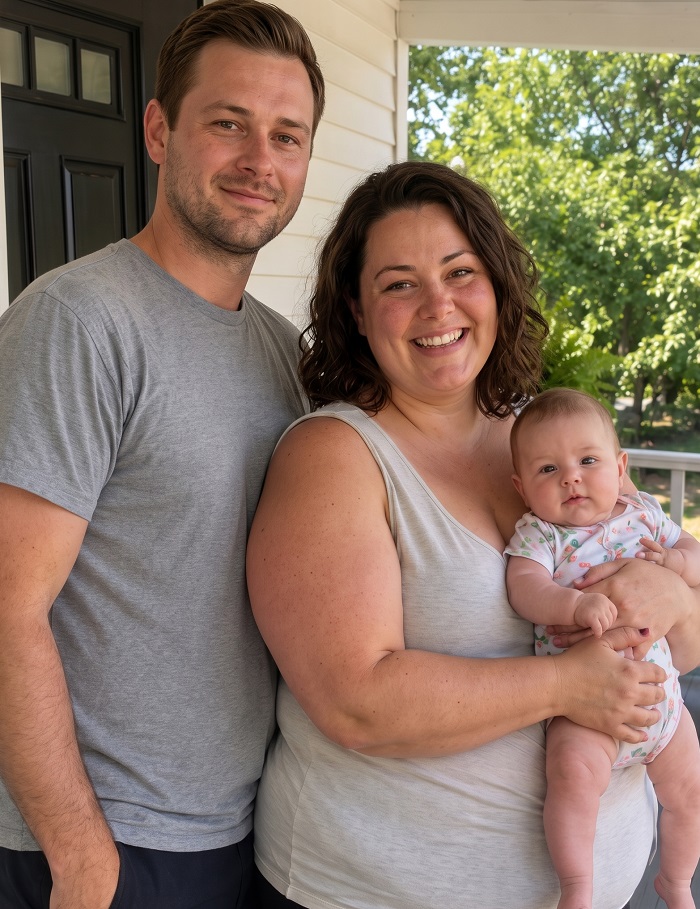
Nine weeks after I gave birth to our daughter, my husband stood in the hallway with a suitcase in his hand and looked at me as though motherhood had turned me into someone unworthy of love.
Three years later, he saw me at one of the city’s most prestigious charity galas.
I was wearing an emerald-green gown, holding the hand of a man my ex had once begged to impress.
The moment he recognized us, the glass slipped from his fingers.
Then, loud enough for half the ballroom to hear, he shouted:
“How could you do this to me?”
For a second, I almost laughed.
Because even after everything he had done, Liam still believed the story was about him.
The Marriage I Mistook for Love
Before our daughter was born, Liam appeared to be a devoted husband.
At least, that was what everyone else saw.
He loved taking me to corporate dinners, charity events, and business receptions. He would place his hand against the small of my back, introduce me with a proud smile, and tell people how fortunate he was to have me.
But Liam did not love me most when we were alone.
He loved me most when other people were watching.
In public, I was part of the image he had carefully built—a successful man with a polished wife, an impressive career, and a flawless future.
Behind closed doors, his compliments always seemed to contain instructions.
At restaurants, he would glance at what I ordered and quietly redirect me.
“Maybe choose the fish,” he would suggest, pushing the menu toward me. “It’s a better option.”
Before events, he inspected my clothes as though he were approving a presentation.
“The darker dress is more flattering,” he would say. “Wear that one.”
Sometimes he adjusted my hair, corrected the way I stood, or told me which stories not to share because they were “too personal.”
His criticism was rarely loud.
That was what made it so difficult to recognize.
He wrapped control in concern and delivered insults with a gentle voice.
When I became pregnant, Liam treated the announcement like another achievement.
He proudly showed everyone the ultrasound photographs. He posted pictures with his hand resting on my stomach. He told colleagues that becoming a father would be his greatest accomplishment.
At home, however, he monitored every visible change.
He asked about my weight after appointments.
He commented on what I ate.
He reminded me that some women “recovered quickly” after giving birth.
I told myself he was anxious.
I told myself he wanted us both to be healthy.
I told myself many things because the truth was more frightening: my husband did not see my body as mine.
He saw it as something that reflected on him.

Nine Weeks After Our Daughter Arrived
Labor left me exhausted, emotional, and overwhelmed.
Our daughter cried at unpredictable hours. I slept in fragments. Some mornings, I could barely remember when I had last eaten a proper meal.
My body no longer resembled the one Liam had displayed so proudly at his company events.
It was healing.
It was feeding and comforting our child.
It was carrying me through sleepless nights.
But Liam looked at those changes and saw failure.
He began staying at work later. When he came home, he complained about the noise, the clutter, and my appearance.
He rarely picked up the baby unless someone was visiting.
Then, one evening, I found him packing a suitcase.
Our daughter was resting against my shoulder as I stood in the hallway watching him fold his shirts.
“Where are you going?” I asked.
“I need space.”
“For how long?”
He zipped the suitcase and finally looked at me.
His eyes moved slowly over my tired face, loose shirt, and postpartum body.
There was no kindness in them.
“I can’t keep living with someone who has completely given up on herself.”
For several seconds, I could not speak.
I had not given up.
I was caring for our newborn nearly every hour of the day while trying to keep our home together.
But Liam had already decided what version of the story he wanted to believe.
“You’re leaving because I just had your child?” I whispered.
He exhaled impatiently.
“Don’t turn this into something dramatic. I’m simply being honest. I’m no longer attracted to you.”
Then he walked out.
I stood there holding our daughter while the front door closed behind him.
She stirred against my chest, and I tightened my arms around her.
That night, I cried quietly because I did not want to wake her.
I thought Liam’s departure was the cruelest thing he could ever do to me.
Years later, I would discover that I was not the first woman he had judged, diminished, and discarded when she was no longer useful to him.
Rebuilding Was Not Beautiful
People often describe rebuilding your life as though it is a graceful transformation.
Mine was not.
There was no inspiring music playing while I discovered my strength.
There were overdue invoices, daycare applications, piles of laundry, and nights when I studied with my laptop balanced beside a sleeping baby.
There were mornings when I cried in the bathroom for three minutes, washed my face, and went back to work because my daughter needed breakfast.
My sister Jenna became the person who kept both of us standing.
She changed her work schedule to help with childcare. She memorized feeding times, nap routines, and pediatric appointments. When I forgot to buy groceries, she appeared with bags of food and never made me feel ashamed.
Her help was not dramatic.
It was practical, steady, and lifesaving.
Liam rarely acknowledged what she did.
During one custody exchange, he referred to Jenna as my “permanent babysitter.”
She smiled sweetly at him.
“If I’m the babysitter,” she replied, “that makes you the occasional donor. I’m comfortable comparing attendance records.”
He did not call her that again in front of her.
With Jenna’s support, I returned to school part-time.
Progress came slowly.
I completed assignments after midnight. I took phone calls during nap time. I learned to stretch every dollar and every hour.
Eventually, I began noticing how many people were struggling with the same problem I faced.
They were talented parents—mostly women—who had taken time away from work to raise children, care for relatives, or survive difficult circumstances.
Their skills had not disappeared.
Their intelligence had not diminished.
Yet employers treated a gap on a résumé like proof that they lacked ambition.
I knew what it felt like to have someone decide your value based on a difficult season of your life.
So I decided to build something different.
The Agency That Began at My Kitchen Table
My employment agency started with a secondhand laptop and a folding table in the corner of my apartment.
At first, I helped parents update their résumés and prepare for interviews. Then I began arranging temporary placements and flexible contracts.
The goal was simple: connect skilled people with employers willing to judge them by their ability rather than by the gaps in their work history.
Jenna helped from the beginning.
She created our schedules, tracked applicants, handled follow-ups, and organized the countless details I overlooked.
Liam continued calling the business my “little project.”
He assumed Jenna had been given a role because she was my sister.
In reality, she earned every bit of authority she received.
Six months after we opened, Jenna noticed that several qualified applicants were withdrawing during the onboarding process. She studied the data, interviewed former candidates, and rebuilt the entire system.
Our completion rate improved almost immediately.
Later, when a hospital network threatened to cancel a major contract because of a reporting error, Jenna stayed up all night reconstructing every figure.
The next morning, she entered the meeting carrying neatly organized documents and walked out with a two-year partnership.
She was not successful because she was my sister.
She was successful because she was exceptional.

The First Man Who Listened
Marcus became one of our earliest major clients.
At the time, he directed a charitable foundation that funded employment programs across the city.
I arrived at our first meeting expecting him to behave like many of the executives I had encountered—glance at the presentation, interrupt halfway through, and search for flaws in my appearance instead of listening to my ideas.
He surprised me.
He read every page.
After I finished, he tapped the final section of my proposal.
“You designed this program around keeping people employed,” he said, “not around producing impressive launch numbers.”
“Launch numbers don’t pay anyone’s rent,” I answered.
A smile appeared at the corner of his mouth.
“No, they don’t. But a surprising number of people build careers by pretending appearances matter more than results.”
At the time, I thought he was simply making an intelligent observation.
Later, I understood that he had known someone exactly like that.
Marcus respected Jenna from the beginning. He asked her questions directly and listened carefully to her answers.
He never treated me as fragile after learning about my divorce. He did not try to rescue me or speak for me.
He trusted my decisions.
Over time, he became my mentor.
Then he became my friend.
Eventually, he became someone whose presence mattered enough to frighten me.
I had spent so long being corrected, evaluated, and controlled that genuine respect felt unfamiliar.
Marcus never asked me to make myself smaller so he could feel larger.
He simply stood beside me.
The Name From Marcus’s Past
I discovered Marcus’s connection to Liam by accident.
We were reviewing candidates for a new employment program when Marcus paused over a document.
“I haven’t heard Liam’s name in a long time,” he said.
My attention sharpened instantly.
“You know my ex-husband?”
Marcus leaned back in his chair.
“He worked under me years ago.”
I waited, but he did not continue.
“What happened?”
His expression became guarded.
“Liam wanted a promotion. I refused to recommend him.”
“Why?”
Marcus looked down at his coffee.
“He was talented at presenting results. Unfortunately, some of those results belonged to other people.”
He would not tell me more at first.
He did not reveal names or private company details. He simply said that Liam had enjoyed receiving recognition far more than earning it.
The information stayed with me.
By then, Liam had already begun telling former friends that I had become unstable after our separation.
He regularly missed visits with our daughter, then posted affectionate photographs during the few hours he did appear.
Online, he looked like a devoted father.
In reality, Jenna attended more school events than he did.
He publicly mocked my agency, yet I later learned he had privately asked whether his company could participate in one of our return-to-work programs.
He wanted access to what I had built.
He simply did not want anyone to know that it had value.
The Night Everything Collided
Three years after Liam left, our agency was invited to a major charity gala.
The event brought together business leaders, nonprofit directors, city officials, and corporate board members.
For the first time in years, I prepared for a formal event without hearing Liam’s voice in my head.
I chose an emerald-green gown because I loved it.
No one inspected how it fit.
No one suggested that another color might make me appear smaller.
At dinner, I ordered what I wanted and finished every bite.
Before we left, Jenna helped fasten one of my earrings.
She stepped back and smiled.
“You look like a woman who finally understands that she never needed anyone’s permission.”
Marcus arrived a few minutes later.
When he saw me, his expression softened.
“You look incredible,” he said.
There was no hidden criticism.
No instruction attached.
Just admiration.
At the gala, the printed program listed me as the founder of our agency.
Beside my name was Jenna’s title: Operations Director.
For nearly an hour, Liam remained on the opposite side of the ballroom.
He moved from one important guest to another, laughing at the correct moments and offering handshakes with carefully measured warmth.
Then he noticed me.
Shock crossed his face.
It disappeared quickly, replaced by the smug expression I remembered too well.
He walked toward us with the confidence of a man who still believed he could make me feel small.
“Well,” he said, looking me up and down. “This is a surprise.”
“Not to me,” I replied.
His gaze dropped to the program in his hand.
When he saw Jenna’s title, he laughed.
“Operations Director? That’s quite an upgrade from babysitting.”
Jenna tapped the printed words with one finger.
“It is longer,” she said calmly, “but it’s also accurate.”
Liam ignored her.
He turned to me.
“Is this how your company operates? You invent impressive titles for family members and expect people to take you seriously?”
Before I could answer, Marcus returned from the bar.
He stepped beside me, rested one hand gently at my waist, and kissed my temple.
The change in Liam was immediate.
His face lost its color.
The drink in his hand tilted dangerously before he set it down.
His eyes moved from Marcus to me and back again.
Then his voice erupted across the room.
“How dare you?”
Several nearby conversations stopped.
Marcus remained calm.
“Good evening, Liam.”
“You ruined my career,” Liam snapped, pointing at him. “Now you’re standing here with my ex-wife as though this is some kind of victory?”
“I didn’t ruin your career,” Marcus answered. “I declined to recommend you for a position you had not earned.”
Two board members from Liam’s current company turned toward us.
For the first time that evening, uncertainty flashed across his face.
But Liam had always been skilled at redirecting attention.
His panic quickly became calculation.
Liam’s Final Attempt to Control the Story
Liam raised his voice so more people could hear him.
“This explains everything,” he announced. “She’s my former wife. Marcus is both her client and her partner. Now her agency is involved in evaluating companies like mine. Does no one see the conflict?”
A murmur passed through the people around us.
One board member frowned.
For half a second, Liam looked relieved.
He thought he had regained control.
Before Marcus could respond, I stepped forward.
“You’re correct about one thing,” I said. “That situation could create a conflict.”
Liam’s mouth curled into a satisfied smile.
“That is why I disclosed our history months ago and formally removed myself from every review connected to your division. An independent panel handles those decisions. The documentation has already been submitted to the board.”
The smile vanished.
Silence settled over the group.
Liam searched for another opening.
“Marcus always made excuses for women whose family responsibilities affected their performance.”
The words hit an old wound.
For a moment, I was back in the hallway, holding my newborn while Liam told me I had stopped trying.
But I was not that frightened woman anymore.
“You said something similar to me nine weeks after I gave birth,” I replied. “And apparently, you have been saying versions of it to women throughout your career.”
His expression hardened.
I continued.
“There was a strategist at your former company named Rosa. She took two days away from work to care for her mother. While she was gone, you presented her proposal as your own.”
“That is not what happened,” Liam said quickly.
“It is exactly what happened.”
I held his gaze.
“And I know because Rosa works for my agency now.”

The Woman Whose Work Finally Carried Her Name
Before Liam could respond, the emcee stepped onto the stage and announced the recipient of the foundation’s Career Reentry Award.
Rosa’s name echoed through the ballroom.
She walked toward the stage wearing a navy-blue dress, her shoulders straight and her expression composed.
Liam stared at her as though the past had stepped out of hiding and taken human form.
At the microphone, Rosa thanked the foundation and our agency.
She spoke about returning to work after years of doubting herself. She talked about how difficult it was to rebuild confidence after someone else had taken credit for her ideas.
Then she thanked Marcus.
“He was the first executive who asked what had truly happened,” she said, “instead of automatically believing the most confident person in the room.”
She never mentioned Liam.
She did not need to.
Everyone understood.
Rosa’s applause filled the ballroom.
As she walked off the stage, the emcee made a second announcement.
Our agency had been selected to lead a citywide employment partnership involving several major companies—including Liam’s.
We would also coordinate independent reviews of hiring and promotion systems to ensure employees received fair credit and consideration.
I would not oversee Liam’s division.
The independent panel would.
Liam looked as though the room had tilted beneath his feet.
What the Investigation Revealed
In the months that followed, the panel interviewed employees from several departments.
A pattern quickly emerged.
Women described receiving public praise when their work benefited Liam. But when they requested flexibility, recognition, or promotion, he questioned their commitment.
Several said their ideas had been presented without their names attached.
Others described being labeled difficult after asking for proper credit.
Rosa’s original authorship of the major client proposal was officially restored in the company’s records. She also received the compensation she should have been awarded years earlier.
Liam was removed from all promotion and performance-review responsibilities. He was required to participate in corrective training and formal review sessions.
People expected me to celebrate his humiliation.
I did not.
Accountability mattered, but revenge was never the purpose.
The most important outcome was not that Liam lost authority.
It was that Rosa regained something that had been taken from her.
Truth should repair damage whenever possible.
Otherwise, it risks becoming nothing more than public entertainment.
The People Who Had Believed Him
After clips from the gala circulated online, Liam’s mother contacted me.
She said Liam had told her I wanted nothing to do with his family.
For years, she had stayed away from both me and her granddaughter because she believed approaching us would create conflict.
I agreed to meet her for coffee, but I brought Jenna with me.
Liam’s mother cried when she admitted how easily she had accepted his story.
“I thought supporting my son meant believing him,” she said.
Jenna’s expression was firm but not cruel.
“Loyalty without honesty often protects the person causing the harm.”
The words stayed with all of us.
Liam’s mother began visiting her granddaughter carefully and consistently. She did not demand forgiveness. She simply started showing up.
Liam’s progress was slower.
At first, he treated every review session as another obstacle to overcome.
Then Rosa attended one of them.
She sat across from him and explained what his actions had cost her—not only professionally, but emotionally and financially.
She told him how long she had doubted her own ability after watching him receive praise for her work.
She did not forgive him.
She was not required to.
But she forced him to hear the consequences without allowing him to rewrite them.
One Year Later
A year after the gala, our agency held its first graduation dinner for participants who had completed our return-to-work program.
Jenna introduced me as the founder.
Marcus stood near the stage, but never in front of me.
He did not speak on my behalf or take credit for what I had built.
He simply watched with quiet pride.
Halfway through the event, my daughter escaped from Jenna’s side and ran onto the stage carrying a handmade card.
Before anyone could stop her, she reached the microphone.
“My mommy helps people feel brave at work,” she announced.
The room filled with laughter and applause.
I bent down and hugged her, blinking back tears.
From the back of the room, I noticed Liam clapping.
After dinner, he approached me alone.
For once, there was no performance in his expression.
“I finally understand why Marcus wouldn’t recommend me,” he said.
I studied him carefully.
“What changed?”
His eyes moved across the room toward Rosa, who was laughing with members of her new team.
“I stopped concentrating on what I believed people had taken from me,” he said. “I started looking at what other people lost because of what I did.”
I believed he meant it.
But understanding his regret did not erase the past.
Healing did not require me to welcome him back into my life.
Forgiveness, if it ever came, would belong to me and happen on my timeline.
He Was No Longer My Responsibility
When the evening ended, my daughter slipped her small hand into mine.
Jenna carried the award we had received.
Marcus walked beside us—not leading, not rescuing, simply sharing the road.
Behind us, Liam remained in the ballroom with the truth he had spent years avoiding.
For most of our marriage, he had controlled the story.
He had decided what I should wear, what I should eat, how I should look, and how much space I was permitted to occupy.
After he left, he tried to decide what other people believed about me.
But that night, I finally understood something important.
I had not rebuilt my life to prove Liam wrong.
I had rebuilt it because my daughter deserved to see a woman who did not confuse cruelty with honesty or control with love.
What Liam chose to do with the truth was no longer mine to manage.
My life was waiting beyond those ballroom doors.
So I held my daughter’s hand, stepped into the night, and never looked back.
Note: This story is a work of fiction inspired by real events. Names, characters, and details have been altered. Any resemblance is coincidental. The author and publisher disclaim accuracy, liability, and responsibility for interpretations or reliance. All images are for illustration purposes only.