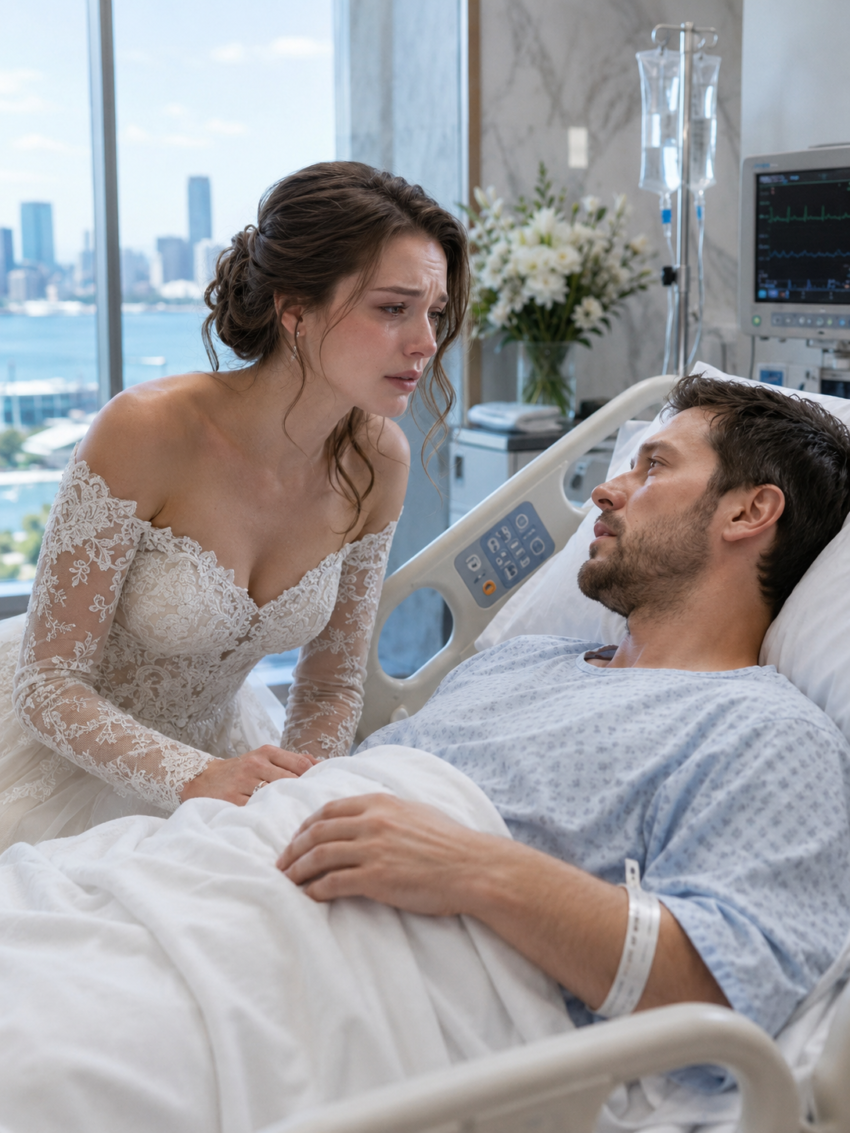
Chapter 1: The Golden Cage
The afternoon I was legally traded into a corporate dynasty, I stood beside a man who hadn’t spoken a word or opened his eyes in nine months. The chapel smelled like orchids and expensive perfume, and the whole ceremony felt more like an upscale wake than a wedding.
Everyone in high society swore Christopher Harrington couldn’t hear a thing. The doctors whispered that he’d stay trapped in his silent world forever. But that night, when the mansion finally went quiet, I bent over his bed and whispered the truth of how I’d ended up there.
His index finger twitched against the sheets.
That morning, I’d walked down the aisle in a rented lace dress that didn’t quite fit. Christopher sat motionless in a motorized wheelchair beside the altar, hair combed neatly back by a handler, hands resting in his lap like stone. A private nurse hovered behind him, monitoring his vitals like his own breathing needed her permission. He never blinked. Never acknowledged the vows read over our heads.
The whole thing was absurd, because Christopher Harrington — sole heir to a global shipping empire — was drifting through a coma.
“Say the words, Madeline,” my father muttered, gripping my elbow hard enough to bruise.
“I do,” I said. It felt less like a vow and more like a life sentence in a glamorous prison.
The minister wrapped things up quickly. A handful of executives clapped politely. And just like that, with a few strokes of a fountain pen, I became Mrs. Harrington. Nobody suggested the bride kiss the groom — the groom wasn’t exactly available for that.
Two orderlies wheeled Christopher toward a medical van while I stood frozen on the church steps. My father caught up to me, relief washing over his tired face.
“You did the right thing for our future, Madeline,” he said, not quite meeting my eyes.
I laughed, bitter and joyless. “Are you referring to the fact that I just married a man who’s physically incapable of consenting to anything?”
His jaw tightened. “This arrangement saves us from ruin, and you know it.”
Three weeks earlier, he’d cornered me in our cramped kitchen in Bridgeport, Connecticut, to lay out the deal. The Harrington family trust required Christopher to be legally married before his thirtieth birthday, or control of the empire would slide to his cousin. If I played the convenient bride, our mountain of debt — every loan, every unpaid medical bill from my mother’s illness — would vanish.
“You’re asking me to bind my life to a stranger on life support?” I’d demanded.
“I’m asking you to let me fix my mistakes,” he’d pleaded, “so I can stop watching you work three jobs just to keep a roof over our heads.”
I’d wanted so badly to believe that was selfless.
The Estate
The car pulled up to the Harrington estate on the Delaware River, a limestone fortress with iron gates and vaulted marble corridors — every surface a reminder that I now belonged to a different world.
The first person to greet me was Christopher’s cousin, Bradley Harrington, leaning against a column like he already owned the place.
“So you’re the desperate little bride they brought in to save the day,” he said, eyes crawling over me.
“If you’re quite finished staring at your cousin’s wife, Bradley, clear the path,” cut in a sharp voice from the staircase.
Abigail Harrington descended — elegant, cold, radiating absolute authority. Christopher’s grandmother. She studied my face with calculating eyes. “You will suffice,” she said dryly, then turned and led me upstairs without waiting for a response.
Christopher’s quarters caught me off guard — sunlight, fresh flowers, soft classical music. Vibrant, in a way that only made the stillness of the man at its center more tragic.
“You officially have a legal wife now, Christopher,” Abigail said, briefly softening as she brushed his shoulder. “Try not to embarrass the family name any further.”
No response. Of course.
Once she left, I sat by his bed, feeling foolish, and started talking anyway. About my mother, dead two years. About how ashamed she’d be of this whole circus. About how I hadn’t wanted any of it — just been terrified of losing everything my father owed to the wrong people.
I was crying into my hands when I felt it: his index finger, moving against the mattress. A fraction of an inch. I froze.
Then his eyelashes twitched. His eyes opened — gray, disoriented, struggling to focus.
Before I could scream for the nurses, his lips parted. A raspy whisper, like broken glass on concrete.
“Do not trust Bradley.”
The Camera
I stared into his eyes, sure I’d imagined it. But his gaze held mine with a terrifying, deliberate intensity.
“Christopher?” I whispered.
My hand shook toward the call button. His fingers curled weakly around my sleeve — stopping me.
“You don’t want me to call the doctors?”
He closed his eyes once. A yes.
“Why?”
“Camera,” he breathed.
A chill ran down my spine. I scanned the room slowly and found it — a tiny lens tucked into the gold carvings of an antique clock on the wall. Someone was watching everything.
I forced myself calm, playing the grieving bride, bowing my head as if simply weeping. Christopher’s eyes fluttered shut, exhausted.
Five seconds later, the door opened without a knock. Bradley.
“Well, well. Already settling into your glamorous new role, Madeline?”
“I was introducing myself to him,” I said, hiding my shaking hands.
He circled the bed, glancing at Christopher, then back at me. “I suppose it makes the living feel less uncomfortable, staring at a vegetable.”
“He is not a vegetable.”
His smile sharpened. “No. Not entirely dead yet, I suppose.” He leaned in close. “You were purchased for a specific financial purpose, Madeline. Smile for the cameras. Sign whatever’s put in front of you. Stay out of the west wing.”
“And if I don’t?”
His gaze dropped to the bruise my father had left on my arm. “Sentimental girls from poor towns tend to make very permanent, very fatal mistakes in this house.”
Abigail’s voice sliced through the room before I could respond. “Bradley. I don’t recall granting you permission to be in this wing.”
He recovered his smirk, gave a mocking bow, and left.
Once his footsteps faded, Abigail turned to me. “Did that fool threaten you?”
Instead of denying it, I pointed at the clock. At the camera.
Real fury flickered across her face for the first time. “Come with me.”

What Abigail Knew
She led me to a sealed room in the west wing — swept for surveillance, she assured me — and poured tea with steady hands.
“I did not select you,” she said, “because you were beautiful or convenient. I chose you because your file said you sat by your mother’s bedside and sang to her every night in hospice, even after the doctors said she couldn’t hear you anymore.”
The mention of my mother hit like a blow.
“Christopher had a neural reaction to audio stimuli exactly twice during treatment,” Abigail continued. “Not to the doctors’ voices. Not to mine. His brain activity spiked once — during a recording. A video of a hospital fundraising gala. A young woman singing.”
“That was me,” I whispered. I remembered that gala — a secondhand dress, singing in exchange for a reduction on my mother’s medical debt. I’d had no idea who was in that audience.
“That was the moment I told my attorneys to find you,” Abigail said.
The truth landed like a trap closing. “You never needed a bride to secure the trust. You needed bait.”
“I needed a catalyst,” she corrected, without remorse. “And your father needed capital. I had more than enough to buy his cooperation.”
I laughed, hollow. “You people are monsters.”
“Perhaps,” she said. “But Bradley is infinitely worse.”
I told her what Christopher had said — do not trust Bradley. Her whole body went rigid.
“Nine months ago,” she said quietly, staring out at the river, “Christopher’s car went through a guardrail on Riverview Pass during a storm. Police blamed the weather. I have never believed in convenient family tragedies.”
“You think Bradley sabotaged it?”
“I’m certain of it. I simply lack proof.”
“Then why does he still live in this house?”
“Because an enemy under your own roof is far easier to watch than one plotting in the shadows.”
That night, I crept back to Christopher’s room after the nurse — Cynthia, sweet-voiced but cold-eyed — left for the night. I waited until midnight, then leaned close.
“I told Abigail you spoke to me. I’m sorry.”
His eyes opened. I grabbed his hand.
“Squeeze once for yes, twice for no,” I whispered. “Did Bradley do something to your car?”
One squeeze.
“Do you have proof?”
One squeeze.
“Where?”
His fingers twitched, and his voice came out in fragments before exhaustion pulled him back under.
“Study,” he breathed. “Mother.”
The portrait of his mother, in the locked west study Bradley had warned me away from.
Chapter 2: What the Portrait Hid
At breakfast the next morning, my father was seated at the Harrington table — looking small in his worn suit, next to Bradley reading the financial paper like nothing had happened.
“What are you still doing here, Dad?” I asked.
Bradley answered for him, tapping a leather folder. “Just some routine estate paperwork. Nothing dramatic.”
I flipped it open. Buried on page three: language authorizing the transfer of all corporate voting rights to “the designated family representative” if Christopher remained incapacitated. The representative was Bradley.
I turned to Abigail. “Did you know about this clause?”
Genuine surprise flickered across her face. “No.”
Bradley smiled. “Sign the final page, Madeline, and your father gets the second half of his payment.”
The second half.
I turned on my father. “You were going to hide this from me?”
“I owe dangerous people, Madeline. I had no choice.”
“I understand the situation perfectly now,” I said, and threw the folder into his coffee. “I am never signing your garbage paperwork.”
Bradley’s face went dark. “Your husband is a vegetable, and you’re a purchased signature in a cheap dress. Don’t mistake yourself for a Harrington.”
Abigail cut him off before I had to. He stormed out. I turned to my father one last time.
“Get out of my sight.”

The Wall Safe
That afternoon, Abigail pressed a brass key into my hand without explanation — the key to the west study.
“Christopher’s mother died when he was eighteen,” she said. “Official cause: sleeping pill overdose. Unofficial cause: she found out entirely too much about this family’s finances.”
Inside the dusty study, a massive portrait of Christopher’s mother hung over the fireplace — same dark hair, same gray eyes, one painted finger pointing subtly toward a carved notch on the bottom of the frame.
I pressed it. The whole portrait swung forward on hidden hinges, revealing a wall safe.
I tried Christopher’s birthday. Wrong. His mother’s death date. Wrong. Then I remembered — the charity gala, the date printed on the program my mother had taped to her hospital wall until she died.
The safe clicked open.
Inside: a flash drive, medical files, and a worn leather notebook in Christopher’s handwriting.
If I do not wake up from this state, Bradley wins everything.
Page after page — names, offshore accounts, security reports. A mechanic who vanished after servicing Christopher’s car. A toxicologist bribed to alter his blood work. A board member who died of a “heart attack” two weeks before a critical vote.
Then, near the bottom of the last page: my father’s name.
Thomas Foster — $750,000.
My knees gave out. This was never about clearing an honest debt. My father had sold me into a house of murderers — for money.
The study door creaked open. Cynthia stood there, all warmth gone from her face.
“You’re not supposed to be in here, Mrs. Harrington.”
“Abigail gave me the key.”
“Her permission won’t save you now.” She pulled a syringe from her pocket.
I ran. Threw a chair in her path, bolted through a hidden servants’ corridor, and burst out into the conservatory just as a storm hammered the glass dome overhead. I nearly collided with Abigail.
“Cynthia’s working for Bradley,” I gasped. “She has a syringe.”
Abigail pulled me behind her just as Cynthia and Bradley burst in.
“You were dismissed from the city hospital for tampering with narcotics, Cynthia,” Abigail said icily. “I wondered when Bradley would find a use for you.”
Bradley’s eyes locked onto the notebook peeking out of my cardigan. “Digging up things that don’t belong to you.”
“You will not touch this girl,” Abigail warned.
“You’re getting old, Abigail,” Bradley said. “And Christopher’s already halfway in the grave.”
Abigail smiled — slow, unsettling. “Then why are you so terrified of the sound of her voice?”
Before Bradley could answer, an alarm screamed through the mansion’s speakers.
Christopher.
The Seizure
I ran. Burst into his room to find doctors and nurses in a frenzy of red lights and shrieking monitors, his body locked in a seizure.
“Get this girl out!” the doctor barked.
“No!” I fought past a nurse.
Christopher’s eyes found mine through the chaos. His hand jerked, clamping onto my sleeve. One squeeze. Stay.
“I found it,” I whispered, tears hitting his forehead. “The notebook, the drive, all of it.”
Bradley stepped in behind me, dangerously calm. “Hand it over, Madeline.”
I ignored him. Christopher’s lips moved, straining against nine months of paralysis.
“Sing,” he breathed.
“What?”
“Sing.”
Abigail’s voice cracked through the chaos like thunder. “Everyone out — except my grandson’s wife.”
“Absolutely not,” Bradley snapped.
“The state police are already at the gates,” Abigail said calmly.
I didn’t wait to see how that landed. I took Christopher’s shaking hand and sang — the same melody from the gala, years ago. My voice cracked at first, then steadied, rising over the alarms, over the storm outside.
The monitor’s frantic beeping slowed. The doctor went pale. Cynthia backed toward the door, defeated. Bradley stared like he’d watched a corpse rise to accuse him.
Christopher turned his head, gray eyes locking on his cousin.
“You should have made certain I was dead the first time, Bradley,” he rasped.
Every light in the mansion went out at once.
In the pitch black, Abigail screamed. A crash. Scuffling boots. Rough hands seized me from behind, a cloth pressed over my mouth — chloroform, sickly sweet. Christopher’s grip slipped from my fingers as the dark swallowed me.
The last thing I saw, in a flash of lightning through the open door, was Bradley’s triumphant, terrifying smile.
Chapter Three: Riverview Pass
I woke bound in the backseat of a moving car, rain hammering the windows, my father beside me, gray-faced and weeping.
“Madeline. I am so sorry for what I’ve done.”
Bradley turned from the front seat, waving the leather notebook. “You really should’ve just signed the paperwork.”
“You helped him kidnap me?” I whispered to my father.
“I owed dangerous people money. Bradley offered a way out.”
“You sold your own child twice in a month,” I said, and he had nothing to say back.
The car turned onto a narrow, cliffside road. I recognized it instantly — the guardrail, the drop to the river below.
Riverview Pass. The exact place Christopher’s car had gone over nine months ago.
Bradley chuckled in the rearview mirror. “Rather poetic, don’t you think?”
Then his phone rang. He answered, irritated — and his face went white.
“What do you mean he’s gone from his bed?” he shouted. The line went dead.
A pair of blinding headlights exploded out of the storm behind us. A massive SUV, gaining fast, slammed into our rear bumper hard enough to send us skidding across the wet asphalt.
Through the shattered rear window, the high beams lit up the driver behind us — pale, bleeding from a head wound, hospital gown under a heavy coat, soaked with rain.
Christopher Harrington. Wide awake. Smiling like a man who’d crawled out of hell for vengeance.
The Crash
The SUV rammed us again, sending our car spinning into the rocky cliffside. Airbags deployed, trapping Bradley and the driver. Before Bradley could untangle himself, the door was ripped open from outside.
Christopher stood in the storm, tire iron in hand, and cut my bindings with a pocketknife.
“Are you harmed, Madeline?”
“I’m fine. Bradley has the notebook and the drive.”
Bradley crawled from the wreck, blood on his face, fury in his eyes. “You’re supposed to be a corpse, Christopher!”
“You should’ve checked my pulse yourself, cousin,” Christopher said, leveling the iron bar.
Before it went further, the road flooded with police lights. Abigail stepped out of the lead cruiser, flanked by armed troopers.
“It’s officially over, Bradley.”
The Boardroom
Three days later, the Harrington empire’s emergency board meeting convened in Richmond — Bradley absent, in a cell awaiting charges of attempted murder, fraud, and conspiracy.
The lead attorney began reading succession documents when the projection screen flickered to life — a video of Christopher, recorded days before his “accident.”
“If I am incapacitated or presumed deceased under suspicious circumstances, all corporate voting rights transfer immediately to my legal spouse, Madeline Harrington.”
The room erupted. I stood.
“The era of Bradley’s corruption is over,” I said.
The doors opened. Christopher walked in on a cane, thin and pale but alive, and stopped beside my chair.
“My wife speaks for the Harrington empire now,” he told the room.
The Silver Band
The scandal dominated headlines for weeks. Cynthia was caught at the border, her confession sealing Bradley’s fate. My father avoided prison by testifying against the corrupt doctors, then left the state in shame. The Harrington Foundation was rebuilt and renamed for my mother, Rosemary Foster, to help families drowning in medical debt.
Christopher’s recovery was slow — some days twenty steps down the garden path, some days barely enough strength to lift a spoon. I sat with him every afternoon anyway, reading the paper, arguing over crosswords.
One evening, he pulled a signed annulment from the nightstand.
“You were forced into this marriage,” he said. “You’re free to leave. No conditions.”
Freedom. It should have felt like relief. Instead, it felt hollow.
“Did you choose me before the crash?” I asked.
“I left instructions with Abigail to find you and protect you — because your mother died protecting the truth about this family,” he said. “Abigail forced the marriage when she realized Bradley was moving on the trust.”
“I heard a lot of voices while I was trapped in that silence,” he said quietly. “Greedy lawyers. Corrupt doctors. My cousin, discussing my body like furniture. But yours was the first one that didn’t demand anything from me.”
I tore the annulment papers in half.
“I don’t want to be the girl your grandmother picked from a file,” I said, “or the daughter my father sold for a debt. I want to be properly asked, Christopher.”
With visible effort, he lowered himself to one knee on the rug, pulling a small velvet box from his pocket. Inside: a simple silver band engraved with two words.
I heard.
“Madeline Foster,” he said. “Will you marry me a second time? This time, with my eyes wide open?”
“Yes,” I laughed, crying, pulling him into an unsteady hug. “A thousand times yes.”
Months later, we stood at the altar of that same stone chapel — no hidden contracts this time, no cameras in the clocks, no nurse standing guard. Christopher stood on his own two feet, cane discarded, waiting as I walked toward him in a simple ivory gown.
Abigail sat in the front row, wiping away a single tear and threatening to fire any photographer who dared capture it.
“I do,” Christopher said, voice ringing through the chapel.
As he slid the silver band onto my finger, he leaned close. “My world woke up the second I heard your voice, Madeline.”
“And I stayed,” I said, “because you finally found the strength to use yours.”
Outside, sunlight turned the mansion’s windows to gold. The limestone fortress that had once been a kingdom of secrets had become, finally, something else entirely.
A home.
THE END
Note: This story is a work of fiction inspired by real events. Names, characters, and details have been altered. Any resemblance is coincidental. The author and publisher disclaim accuracy, liability, and responsibility for interpretations or reliance. All images are for illustration purposes only.