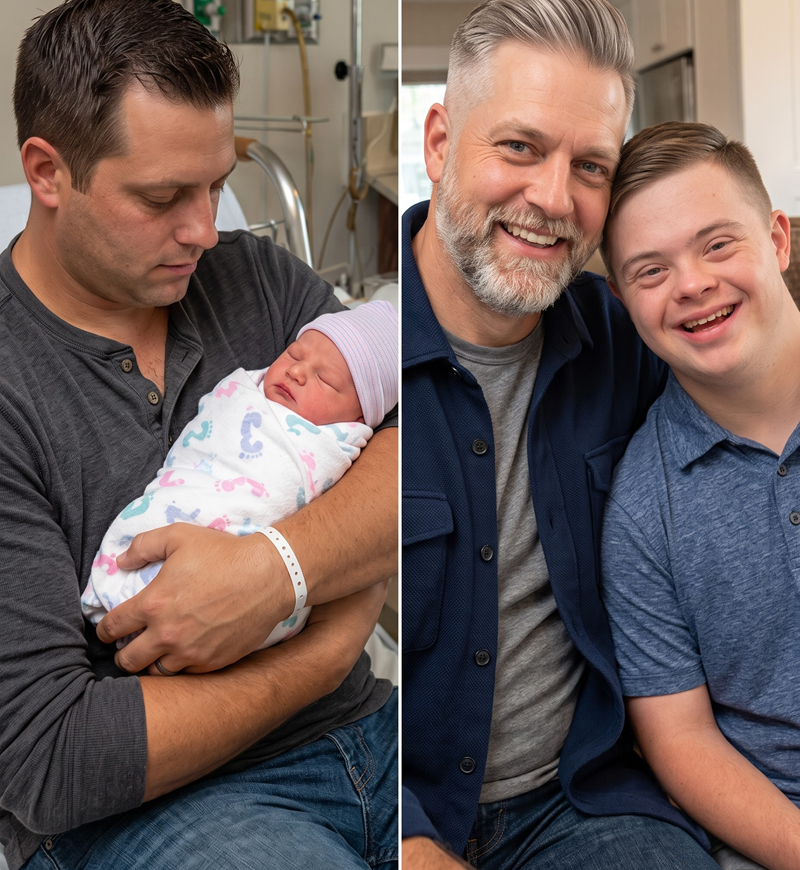
For eighteen years, I believed my wife had abandoned our newborn son because he had Down syndrome.
I called her heartless.
I called her selfish.
Most of all, I called her a coward.
Then, on our son’s eighteenth birthday, I opened a letter she had written before disappearing from our lives.
By the time I reached the final sentence, the story I had repeated to myself for nearly two decades no longer made sense.
The truth was far more painful than the lie.
Part 1: The Day Everything Changed
It began in a quiet hospital room eighteen years earlier.
My wife, Goldi, lay pale and exhausted against a stack of pillows. Our newborn son rested in a clear bassinet beside her bed. A doctor pulled a chair closer and spoke in the careful, gentle voice people use when they know their words will change a family forever.
Testing indicated that our baby had Down syndrome.
The doctor explained that our son might need additional medical examinations. There could be concerns involving his heart, hearing, muscle development, or other areas. Early support and regular therapy would likely become part of our lives.
I heard the words, but they seemed distant.
All I could see was my son.
We had named him Leo.
He had soft dark hair, a round face, and tiny fingers that curled around the tip of mine. His grip was surprisingly strong. The moment he held on to me, I felt something inside my chest settle.
Whatever the future brought, he was mine.
And he was perfect.
Then I looked at Goldi.
She was staring at the floor.
She had barely looked at Leo since the doctor entered. Her hands were folded tightly over the blanket, her knuckles almost white.
After the doctor left, silence filled the room.
Finally, Goldi whispered, “I can’t do this.”
I assumed she was overwhelmed. I was frightened too, though I did not want her to see it.
I moved my chair beside her bed.
“We don’t have to understand everything today,” I said softly. “We’ll learn. We’ll ask for help. We’ll take it one day at a time.”
Goldi slowly shook her head.
“No, Arthur.”
I reached for her hand, but she pulled it beneath the blanket.
“You’re scared,” I said. “That’s all. I’m scared too.”
She turned toward the window.
“You’re not hearing me. I can’t do this.”
For the remainder of the afternoon, she would not hold Leo.
I fed him. I changed him. I carried him around the room while Goldi remained silent.
I tried not to judge her. She had just endured labor. Her body was exhausted, and our expectations for the future had been overturned within minutes.
I told myself that she needed time.
That night, I fell asleep in the chair beside her bed.
Sometime after midnight, I opened my eyes and saw Goldi standing beside Leo’s bassinet.
The room was dark except for the light above the sink.
Her back was turned to me. One trembling hand hovered above Leo’s blanket. She looked as though she desperately wanted to touch him but was fighting against herself.
For one brief moment, I thought she might lift him into her arms.
Instead, her hand fell to her side.
I closed my eyes before she realized I was awake.
The next morning, she asked me a question I would remember for the rest of my life.
“Arthur, could you raise him without me?”
I thought she was asking what would happen if one of us became sick or died years in the future.
“You don’t have to worry about that,” I replied. “Leo has both of us.”
Tears appeared in her eyes.
I leaned closer, but she turned her face away.
Two days later, Goldi told me she wanted a divorce.
At first, I laughed.
Not because it was funny, but because the idea was so impossible that my mind refused to accept it.
We had been married for four years. Only weeks earlier, she had stood in Leo’s nursery folding tiny clothes. We had argued playfully about lamps, curtains, and whether we had bought too many blankets.
Now she would not touch our child.
She would not even look at me.
“You don’t mean that,” I said.
“I do.”
“Is this because Leo has Down syndrome?”
Goldi said nothing.
Her silence became the answer I carried for the next eighteen years.

Part 2: The Woman Who Walked Away
Within a week, Goldi signed papers giving me sole custody of Leo.
She did not request visitation.
She packed a single suitcase and prepared to leave the apartment where we had planned to raise our family.
Before walking out, she stopped beside Leo’s crib.
I stood in the doorway with my arms crossed, too angry to speak.
She looked down at him for a long time.
For one hopeful second, I believed she might pick him up. I thought she might suddenly understand what she was throwing away.
Instead, she bent closer and whispered something I could not hear.
Then she pressed her fingertips to her lips, touched them lightly to the edge of his blanket, and walked toward the door.
“Goldi,” I said.
She stopped but did not turn around.
“You’re really leaving?”
Her shoulders shook once.
Then she opened the door and disappeared.
I was thirty years old, alone in an apartment with a newborn child in my arms.
I remember standing in the silence after the door closed, unable to move.
Leo began crying.
That sound pulled me back into the room.
I held him against my chest and promised him that I would never leave.
From that day forward, anger became the fuel that kept me moving.
I hated Goldi at every medical appointment.
I hated her while sitting beneath the harsh lights of hospital waiting rooms.
I hated her when doctors discussed treatments and procedures I barely understood.
I hated her when therapists handed me exercises to practice at home and reminded me that repetition and patience were essential.
I hated her whenever money became tight.
There were days when I had to choose between missing work and leaving Leo with someone else. There were nights when I stared at unpaid bills after he fell asleep, wondering how long I could keep everything together.
Sometimes I cried quietly in the bathroom so he would not hear me.
I was terrified of failing him.
I worried that every mistake I made would cost him an opportunity. I worried that I was not patient enough, informed enough, wealthy enough, or strong enough.
And whenever those fears became unbearable, I blamed Goldi.
It was easier to hate her than to admit how frightened I was.
I hated her most on Leo’s birthdays.
On Mother’s Day, he sometimes returned from school carrying handmade cards created during class. His teachers meant well, but every paper flower and carefully written message reminded me that there was an empty place in his life.
When Leo was six, he finally asked about her.
I was washing dishes when he came into the kitchen.
“Dad, where is my mother?”
The plate in my hands nearly slipped into the sink.
I kept my back toward him.
“Some families have two parents,” I said. “Some have one.”
“I know.”
I turned off the water.
Leo stood behind me with the serious expression he always wore when he was trying to understand something important.
“But having one parent doesn’t mean I don’t have a mother,” he continued.
I dried my hands slowly.
“You have me,” I said. “And I have you. That’s what matters.”
It was not an answer.
Even at six years old, Leo understood that.
But he also recognized that I would not say more.
I never told him that I believed his mother had rejected him after learning about his disability. I could not place that kind of wound inside my son.
I wanted Leo to grow up knowing that he was not a disappointment.
He was the greatest gift I had ever received.
Raising him was demanding, but the difficult days were only part of our story.
There were also victories.
There was the morning he spoke his first clear sentence and repeated it ten times because I kept asking him to say it again.
There was his first day of school, when he walked through the entrance proudly and then ran back to hug me one more time.
There was the afternoon he tied his shoes by himself after months of practice.
And there was the school play when he forgot his line, paused in front of the audience, and invented something so funny that the entire room burst into applause.
Leo bowed as though the laughter had been part of the script.
He filled our home with music, questions, jokes, and more joy than I had ever imagined.
I may have raised him alone, but we were not entirely without help.
Our elderly neighbor, Mrs. Johnson, lived across the hall.
The morning after Goldi left, she appeared at my door carrying a pot of soup.
She took one look at my face and pushed past me.
“That baby has been crying,” she said. “And from the look of you, neither one of you has slept.”
Before I could object, she lifted Leo from my arms with the calm confidence of a woman who had raised four children.
From that day forward, she became part of our family.
She watched Leo when I worked late. She brought meals when I was too tired to cook. She sat beside me during his medical procedures and squeezed my hand whenever a doctor entered the waiting room.
She came to birthdays, school performances, graduations, and holiday dinners.
Leo began calling her Grandma Johnson long before he understood that we were not related by blood.
For eighteen years, I believed she had saved us simply because she was kind.
I did not know she was also keeping a secret.
Part 3: The Eighteenth Birthday
Yesterday, we celebrated Leo’s eighteenth birthday.
There was nothing extravagant about the party.
Mrs. Johnson prepared her homemade lasagna. I baked a chocolate cake that leaned slightly to one side. Eighteen candles produced so much smoke that the alarm nearly went off.
Leo wore a paper crown Mrs. Johnson had bought from a party store.
“Now that I’m officially an adult,” he announced, “I should be allowed two slices of cake.”
“Adults also pay rent,” I replied.
He considered this carefully.
“One slice will be enough.”
We laughed.
It should have been an ordinary family moment.
After Leo blew out the candles, however, his expression changed. He reached into his pocket and removed a small yellow envelope.
The paper was faded with age.
He slid it across the table toward me.
I smiled uncertainly.
“Buddy, it’s your birthday. I’m supposed to be giving you presents.”
“I know, Dad. Grandma Johnson gave this to me yesterday.”
I turned toward her.
She was sitting perfectly still.
“She told me not to open it,” Leo continued. “She said we had to read it together today.”
Mrs. Johnson’s hands trembled so violently that tea spilled from her cup into the saucer.
I picked up the envelope.
A date had been written in the upper corner.
Eighteen years earlier.
My stomach tightened before I even recognized the handwriting.
It belonged to Goldi.
I looked at Mrs. Johnson.
“What is this?”
Her eyes filled with tears.
“Arthur,” she said, “Goldi did not leave because she stopped loving Leo.”
The room seemed to tilt beneath me.
“What are you talking about?”
“She came to me before she left. She asked me to keep that letter until Leo turned eighteen.”
“You’ve had this all these years?”
Mrs. Johnson nodded.
I wanted to shout, but no sound came out.
Instead, I tore open the envelope with shaking fingers.
The letter inside was covered in Goldi’s handwriting.
I began reading aloud.
“Arthur,
“If you are reading this, then I never found the courage or the time to tell you the truth myself.
“A few days before Leo was born, my doctors discovered that I had an aggressive cancer. By the time they found it, it had already spread. They told me there was almost no chance that treatment would save me.
“I knew what you would do if I told you.
“You would refuse to leave my side. You would spend every dollar, every hour, and every part of yourself trying to keep me alive. You would attempt to care for me while learning how to raise our son.
“I could not bear the thought of you losing your wife while also missing the beginning of Leo’s life.
“So I made the most terrible decision I have ever made.
“I allowed you to believe I had rejected our child.
“I asked for a divorce because I believed anger would help you let me go. I thought that if you saw me as cruel, you would stop searching for me and give all your love and strength to Leo.
“I never stopped loving him.
“I never stopped loving you.
“I left this letter with Mrs. Johnson and asked her to protect our son from a distance. I also asked her not to give it to you until Leo turned eighteen. By then, I hoped he would be old enough to decide for himself what kind of person his mother had been.
“Perhaps neither of you will forgive me.
“Perhaps you should not.
“But please believe this one thing: I did not leave because I was ashamed of our son.
“I left because I loved you both so deeply that I convinced myself your lives would be better without watching me die.
“I loved you enough to let you hate me.
“Goldi.”
By the time I finished, the words had blurred behind my tears.
For eighteen years, I had imagined confronting Goldi.
I had pictured myself demanding answers. I had imagined telling her about every appointment she missed and every question Leo asked.
Now I sat at the birthday table holding the truth in my hands, and I had no idea what to do with it.
Leo stared at me.
His paper crown had slipped to one side.
“She’s my mother?” he asked quietly.
I nodded.
“Yes.”

Part 4: The Weight of the Truth
I turned to Mrs. Johnson.
“How much did you know?”
Her face crumpled.
“Goldi came to my apartment the night before she left. She showed me a letter from her doctor. The cancer had already spread.”
“And you said nothing?”
“She made me promise.”
“For eighteen years?”
Tears ran down her cheeks.
“I knew she was ill, but I did not know exactly where she went. She refused to give me an address. She said that if you discovered where she was, you would come after her.”
“You watched me hate her.”
“I did.”
“You watched Leo grow up without knowing anything about his mother.”
“I did.”
My voice rose.
“What gave either of you the right to decide what I could handle?”
“Nothing,” Mrs. Johnson whispered. “I had no right.”
The anger that had sustained me for eighteen years suddenly turned in every direction.
I was furious with Goldi for leaving.
I was furious with Mrs. Johnson for keeping the secret.
I was furious with myself for never searching.
Most of all, I was devastated that the answers had been living across the hall from me all along.
Mrs. Johnson covered her face.
“Every year, I wondered whether keeping my promise was a mistake,” she said. “I stayed close because I loved Leo. But I also stayed because I felt guilty. Helping you was the only way I knew to make up for my silence.”
Leo had not moved.
After a long time, he asked, “Did my mother know my name?”
The question silenced all of us.
“Yes,” I said. “We chose it together.”
“Did she ever hold me?”
I remembered Goldi standing beside the bassinet in the darkness. I remembered her trembling hand above his blanket.
“Yes,” I told him. “She held you after you were born.”
His chin shook.
“So she didn’t leave because I have Down syndrome?”
“No.”
The word came out broken.
“No, Leo. She did not leave because of you.”
He looked down at the letter.
“I always thought she abandoned us and you were protecting me from knowing.”
“I was.”
“But you believed she left because of me?”
I could not lie to him anymore.
“Yes.”
Leo stood abruptly and walked into the hallway.
I followed.
He pressed his back against the wall, trying to control his breathing.
“I don’t know how to feel,” he said. “I’m glad she loved me. But I’m angry too.”
“So am I.”
“Is it wrong that part of me is happy?”
“No.”
“And is it wrong that another part of me wishes she had told us?”
“No.”
His eyes met mine.
“Would you have wanted her to stay?”
I did not have to think.
“Yes. Even if we only had seven months, I would have wanted those seven months.”
“Then why didn’t she let you decide?”
I had no answer.
We stood together in the hallway, both crying.
The truth brought relief, but it also created a new kind of pain.
Goldi had not rejected Leo.
Yet she had still taken away our chance to say goodbye.
After several minutes, Leo asked, “What did she look like?”
That simple question broke something open inside me.
For eighteen years, I had told myself that silence protected him.
Goldi had decided I could not survive knowing about her illness.
I had decided Leo could not survive knowing about her abandonment.
Without realizing it, I had repeated her mistake.
I had chosen for him.
“Come with me,” I said.
Part 5: The Box in the Garage
At the back of a cabinet in the garage was a sealed plastic container.
I had not opened it since Leo and I moved out of the apartment where Goldi had left us.
Inside were the pieces of her life I had been unable to throw away.
Photographs.
University notebooks.
A green scarf she wore every winter.
A silver bracelet I had given her on our first anniversary.
Leo sat beside me on the garage floor while I removed the lid.
The first photograph showed Goldi standing on a beach, laughing as the wind blew her hair across her face.
I handed it to him.
“She hated sand,” I said. “She complained about it getting into her shoes all day. Then, when it was time to leave, she refused because she wanted to watch the sunset.”
Leo smiled through his tears.
I showed him our wedding photograph.
“Was she funny?” he asked.
“Very.”
“Did she sing?”
“Yes. Badly.”
He laughed softly.
Then he studied Goldi’s face.
“Do I look like her?”
For most of Leo’s life, I had refused to look for Goldi in him.
Now that I allowed myself to see it, she was everywhere.
He had the same curve in his smile.
The same dimple in his left cheek.
The same habit of lifting one eyebrow whenever he was confused.
“Yes,” I said. “You look very much like her.”
At the bottom of the container, beneath several old cards, I found an address book.
Goldi’s mother, Rachel, was listed inside.
Goldi and Rachel had been estranged for years. I had met Rachel only twice during our marriage, and Goldi rarely spoke about why their relationship had fallen apart.
For eighteen years, I had kept that address book without using it.
Some part of me had always known that I could try to find Goldi.
But hatred had given me an excuse not to search.
What good could come from finding a woman who had abandoned her child?
Now everything was different.
I needed to know what had happened to her.
It took nearly an hour before I found the courage to call the number.
A woman answered.
“Hello?”
“Is this Rachel?”
“Yes. Who is calling?”
“My name is Arthur.”
Silence followed.
Then the woman whispered, “Goldi’s Arthur?”
My throat tightened.
“Yes.”
Rachel began crying before I asked my next question.
“She’s gone, isn’t she?” I said.
Rachel’s sob answered me.
Goldi had died seven months after leaving us.
She had contacted her mother because she had nowhere else to go. The cancer had been discovered after doctors noticed abnormal results late in her pregnancy. Further testing revealed that the illness had already spread through her body.
By the time she left us, there was little the doctors could offer beyond comfort care.
Rachel had stayed beside her until the end.
“Why didn’t you call me?” I asked.
“Goldi made me promise not to.”
“Everyone keeps saying that.”
“She begged me, Arthur. She made me swear on Leo’s name.”
“You should have broken the promise.”
“I know.”
“I had a right to choose whether I wanted to be there.”
“I know.”
“Leo had a right to know his mother.”
“I know,” Rachel repeated, her voice collapsing. “I have regretted it every day.”
Leo spoke with his grandmother that afternoon.
Their first conversation lasted almost an hour.
He asked about Goldi as a child. He asked what foods she loved, what music she listened to, and whether she had ever spoken about him.
“Every day,” Rachel said. “You were the last person she spoke about. You and your father were never far from her thoughts.”
Leo closed his eyes.
For the first time in his life, he was not imagining a mother who had rejected him.
He was grieving a mother who had loved him from a distance and died without hearing him call her Mom.

Part 6: The Grave
A few months later, the four of us visited Goldi’s grave.
Rachel stood beside Leo on one side of the headstone.
I stood on the other.
Mrs. Johnson placed white flowers beneath Goldi’s name.
For several weeks after reading the letter, I had barely spoken to her.
My anger was not easy to release.
Yet Leo continued visiting her. He still called her Grandma Johnson. He still loved her.
Eventually, I understood that two things could be true at once.
Her silence had been wrong.
But the eighteen years of love she gave us had been real.
Leo removed Goldi’s letter from his coat pocket and placed it beside the flowers.
He rested his hand on the headstone.
“I’m glad you loved me,” he said. “I just wish you had stayed long enough to let us love you too.”
Rachel began crying.
Mrs. Johnson bowed her head.
I stared at Goldi’s name carved into the stone.
For years, I had imagined that if I ever saw her again, I would tell her how much I hated her.
Now, standing at her grave, I finally said it.
“I hated you, Goldi.”
My voice shook.
“I hated you because anger was easier than admitting that I never stopped loving you.”
Rachel reached for my hand.
I let her take it.
Goldi had not been the cruel woman I had imagined.
She had been young, terrified, sick, and convinced that disappearing was the greatest sacrifice she could make.
She had loved us.
She had also made a terrible choice.
One truth did not erase the other.
Love did not make her decision right.
But her mistake did not mean her love had been false.
Part 7: Learning to Grieve
Rachel is part of our lives now.
She comes to Sunday dinner and brings far more food than four people could possibly eat. She attended Leo’s graduation and cried louder than anyone else in the room.
She has filled our home with stories about Goldi.
Leo now knows that his mother loved strawberry ice cream, collected postcards, and could never keep houseplants alive.
He knows she was stubborn, funny, impatient, generous, and afraid of thunderstorms.
Mrs. Johnson remains family too.
Forgiving her took time.
Forgiving Rachel took time.
Understanding Goldi took even longer.
I no longer remember her only as the woman who stood beside our son’s crib and walked away.
I remember the young wife who laughed at the beach even though she hated sand.
I remember the woman who sang badly while cooking dinner.
I remember the frightened mother whose hand hovered above her baby because she knew she was about to lose everything.
Goldi believed that turning herself into a villain would be her final gift to us.
She was wrong.
We would have chosen the pain of loving her through those final months.
We would have chosen the chance to sit beside her, hold her hand, and say goodbye.
But she loved us.
After eighteen years, Leo and I finally understood that.
And once we knew the truth, we could stop grieving the woman we believed had abandoned us.
At last, we could begin grieving the mother and wife we had lost.
Note: This story is a work of fiction inspired by real events. Names, characters, and details have been altered. Any resemblance is coincidental. The author and publisher disclaim accuracy, liability, and responsibility for interpretations or reliance. All images are for illustration purposes only.