The Goodbye I Never Questioned
The morning Henry left for Seattle, the sky was still black.
Streetlights glowed through the mist as I drove toward the airport, one hand on the steering wheel and the other wrapped around a travel mug filled with coffee that was far too hot to drink.
Our five-year-old daughter, Zoe, slept in the back seat with her cheek resting against a stuffed rabbit. Every now and then, the car passed beneath a streetlight, briefly illuminating her peaceful face.
Henry sat beside me, checking his phone and reviewing the schedule for his company’s annual trade conference.
It was the same trip he took every year.
Two weeks in Seattle.
Meetings, presentations, dinners with clients, and long days inside a hotel conference center.
There was nothing unusual about it.
I had booked his flight myself. I had printed his boarding pass, helped organize his paperwork, and packed his leather travel bag the night before.
Before closing the suitcase, I carefully folded his favorite navy jacket and placed it on top.
Then I remembered the little task I had been meaning to finish.
“Hold still,” I told him as I threaded a needle at the kitchen table.
Henry looked down at the jacket in his hands and sighed dramatically.
“Sophia, I’m not going to lose another jacket.”
“You said the same thing about the last one.”
“That was different.”
“You left it in a restaurant.”
“I went back for it.”
“Three days later.”
Laughing, I stitched a small fabric label inside the collar. The letters were uneven, but the name was clear.
Henry Collins.
“There,” I said. “Now anyone who finds it will know exactly who it belongs to.”
He shook his head, leaned over, and kissed my forehead.
“What would I do without you?”
At the airport, Henry hugged Zoe while she was still half asleep. Then he kissed me beside the curb and promised to call when he landed.
I watched him disappear through the glass doors.
Later, Zoe and I stood near the terminal window and watched his plane rise into the pale morning sky.
I had no reason to doubt where he was going.
No reason to question him.
No reason to imagine that eleven days later, our little girl would point toward a stranger and quietly destroy everything I believed I knew.
Eleven Days of Sweet Messages
During Henry’s trip, the house felt strangely empty.
His shoes were no longer beside the door. His coffee cup stayed untouched in the cabinet. At night, I slept on my side of the bed and tried not to notice the wide, cold space beside me.
Still, Henry made an effort to stay connected.
Every morning, he sent a message.
Sometimes it was a photograph of the Seattle skyline beneath a gray sky. Sometimes it was a complaint about hotel coffee or a joke about sitting through another endless presentation.
At night, he called to say goodnight to Zoe.
“Daddy misses you,” he would tell her.
“I miss you more,” she always answered.
He sent photographs from his hotel room. He described the rain, the restaurants, and the crowds near the waterfront.
Everything seemed normal.
There had never been another woman, a suspicious message, or an unexplained absence in our marriage. Henry was dependable, affectionate, and predictable.
There was only one part of his life that remained closed to me.
His childhood.
Whenever I asked about his family, his expression changed.
Not dramatically. Just enough for me to notice.
He would smile tightly and say, “It’s complicated.”
Then he would redirect the conversation.
I knew his father had died years earlier. I knew his mother lived several states away and rarely called. Beyond that, Henry shared almost nothing.
I told myself he would talk when he was ready.
I thought respecting his silence was an act of love.
I did not yet understand how dangerous silence could become.

A Reward for Eating Broccoli
The Saturday before Henry was due home, I took Zoe to the public swimming pool.
She had spent the entire week proudly reminding me that she had eaten broccoli three times without complaining.
“I even ate the little tree parts,” she announced from the back seat.
“Yes, you did.”
“And I didn’t hide any under my potatoes.”
“That is exactly why you earned a trip to the pool.”
The changing room was crowded and humid. The air smelled of chlorine, sunscreen, shampoo, and wet towels.
Children laughed as their mothers tried to keep clothes from falling onto the damp floor. Locker doors slammed. Flip-flops squeaked against the tile.
Zoe skipped ahead of me in her pink sandals.
Near the far wall stood a woman who appeared to be in her mid-thirties. Her dark hair was pulled into a simple knot, and she moved with a quiet confidence.
For one strange second, I felt that I recognized her.
Perhaps I had seen her at one of Henry’s company events. Maybe she lived somewhere in our neighborhood. Her face seemed familiar, yet I could not place it.
She looked in my direction, quickly lowered her eyes, and continued arranging items inside a locker.
“Mommy, hurry,” Zoe called.
I pushed the feeling aside and followed her to an empty bench.
Zoe’s favorite swimsuit was pink with a ruffled shoulder strap. She adored it even though she frequently complained that the ruffle scratched her neck.
“You’re getting in the water too, right?” she asked.
“I might put my feet in.”
“That isn’t swimming.”
“It is a very careful form of swimming.”
She giggled.
I was tying the strap on her shoulder when her expression suddenly changed.
The laughter vanished from her face.
Her small body became completely still.
Then her fingers tightened around my arm.
“Mommy, We Have to Save Daddy”
“Mommy,” she whispered.
“What is it, sweetheart?”
“We have to save Daddy.”
I smiled, assuming she was beginning one of her imaginary adventures.
“Save him from what?”
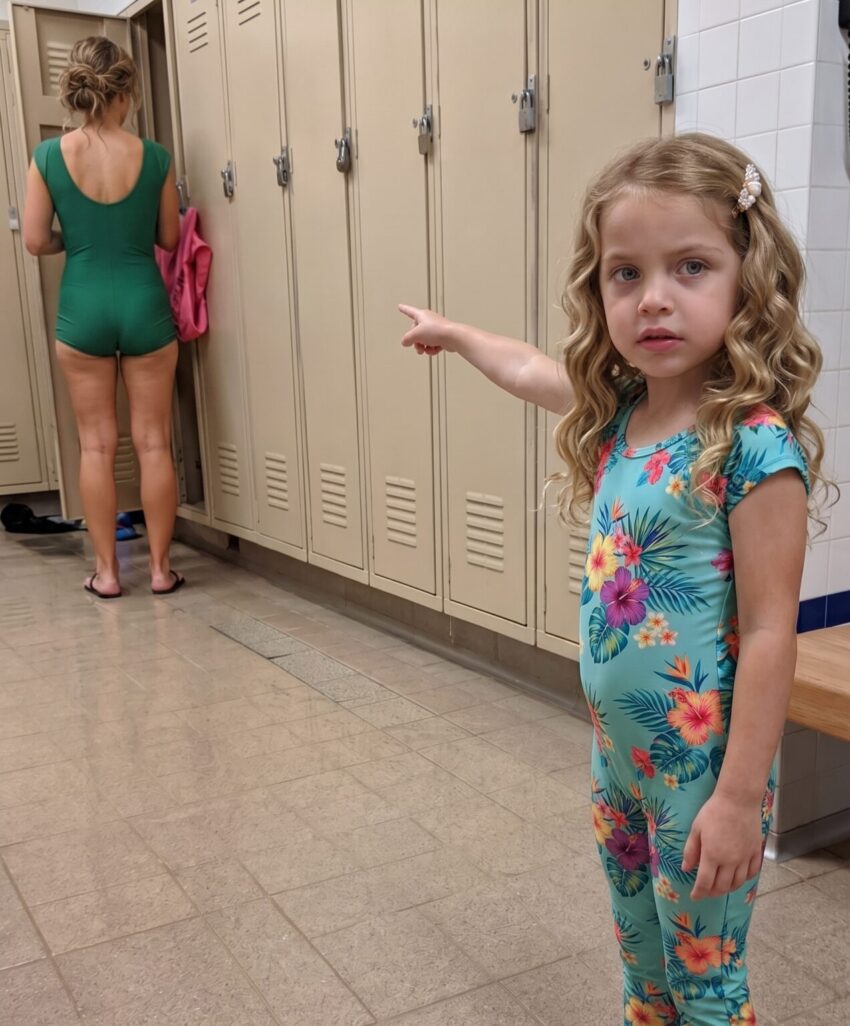
“That lady put him in her locker.”
My smile faded.
“What did you say?”
Zoe pointed toward the far corner.
“Daddy is in there. She put him away and closed the door.”
I glanced toward the woman with dark hair. She was attaching a padlock to a metal locker.
“Zoe, Daddy is in Seattle,” I reminded her gently. “Remember the airplane?”
She shook her head with complete seriousness.
“I saw Daddy.”
“You probably saw someone who looked like him.”
“No.”
“Lots of people have dark hair and glasses.”
“He had Daddy’s jacket.”
A chill traveled slowly down my spine.
“What jacket?”
“The blue one.”
I followed her gaze.
The woman walked away from the locker and headed toward the showers. The padlock hanging from the door looked as though it had not closed properly.
It rested loosely against the metal.
“Stay here,” I told Zoe.
“Are you going to get Daddy out?”
“I’m only going to check something.”
I crossed the changing room, telling myself I was behaving absurdly.
Henry was in Seattle.
I had driven him to the airport.
I had watched his plane leave.
I had spoken to him that morning.
There was no possible way that anything connected to him could be inside a stranger’s locker.
My hand still trembled when I reached for the door.
The loose lock slipped aside.
I pulled the locker open.
The Name Inside the Collar
A navy jacket sat folded on the top shelf.
For several seconds, I could not breathe.
It was not merely similar to Henry’s jacket.
It was his.
I recognized the softened cuffs and the faint mark near one pocket. I recognized the worn fabric and the small coffee stain on the inside lining that had survived countless washes.
My fingers felt numb as I lifted the collar.
There, attached with my own imperfect blue stitches, was the label I had sewn.
Henry Collins.
The noise of the changing room seemed to disappear.
I could no longer hear the locker doors, the children, or the running showers.
All I could hear was my heartbeat.
“No,” I whispered.
I touched the name again, as if the letters might rearrange themselves.
Something crackled inside the jacket pocket.
Without thinking, I reached in and removed a folded envelope.
It was a utility bill marked with a red notice.
The name printed on it was:
D. Collins.
Beneath it was an address.
418 Linden Court.
I knew the street.
There was a bakery near the corner where Zoe and I occasionally bought cinnamon rolls.
The house was less than fifteen minutes from ours.
Henry had sent me a photograph of Seattle the previous night.
He had called that morning and described the hotel breakfast.
Yet his jacket was inside a woman’s locker, beside a bill belonging to someone with his last name, at an address only minutes away.
My mind searched desperately for an innocent explanation and found none.
I took a photograph of the jacket and the stitched label. Then I returned everything exactly as I had found it.
I closed the locker and repositioned the lock.
When I returned to Zoe, she looked up at me expectantly.
“Was Daddy in there?”
I swallowed the fear rising in my throat.
“We’re going to be detectives for a little while.”
Her eyes widened.
“Real detectives?”
“Very quiet ones.”
“Do detectives get ice cream?”
“The best ones do.”
That was enough to earn her complete cooperation.

Following the Woman
We sat near the exit where I could watch the locker without drawing attention.
Several minutes later, the dark-haired woman returned. She dressed quickly, opened the locker, and placed the navy jacket inside a large canvas bag.
Then she walked out.
I grabbed our belongings and followed with Zoe’s hand firmly inside mine.
The woman climbed into a silver sedan.
I hurried Zoe into her car seat, buckled her in, and pulled onto the road after the sedan.
“Why are we following the locker lady?” Zoe asked.
“Because I need to understand something.”
“Is she a bad lady?”
“I don’t know.”
That was the truth.
I stayed several cars behind, terrified that she would notice us.
She drove away from the pool and entered a peaceful residential neighborhood lined with maple trees and carefully trimmed lawns.
Twenty minutes later, she parked outside a modest blue house with white shutters.
I stopped half a block away.
The front door opened.
A man stepped onto the porch.
The sight of him emptied every thought from my mind.
He had Henry’s height.
Henry’s dark hair.
Henry’s glasses.
Even from a distance, I recognized the slightly crooked nose I had kissed countless times—the same nose Zoe had inherited.
The woman walked up the steps.
She placed her bag on the porch and wrapped her arms around him.
Then she kissed him.
Not like a friend.
Not like a relative.
She kissed him with the comfort and familiarity of a woman greeting the man she loved.
He kissed her back.
My hands tightened around the steering wheel.
“Mommy,” Zoe said softly. “Is that Daddy?”
I could not answer.
The couple went inside and closed the door.
A Husband in Seattle—and Another One Twelve Minutes Away
I called Henry.
The call went directly to voicemail.
His cheerful recorded message said he was attending conference sessions and would respond when he could.
I called again.
Voicemail.
Then I searched for the hotel number and contacted the front desk.
The employee confirmed that Henry Collins had a reservation and was checked in until Friday.
“Would you like me to connect you to his room?” she asked.
“No,” I whispered. “Thank you.”
I ended the call.
Nothing made sense.
Either Henry had created an impossibly elaborate lie, or the man inside that blue house was not Henry.
Yet I had seen his face.
I had seen the jacket.
I had seen the name I had sewn with my own hands.
I started the car, intending to leave.
This was not a confrontation I should have with Zoe nearby. I needed to return home, gather my thoughts, and wait until Henry came back.
Then the curtains shifted.
A shadow moved behind the front window.
Someone with my husband’s face was still inside.
I turned off the engine again.
For nearly an hour, I watched the house.
My thoughts circled endlessly.
Had Henry secretly returned from Seattle?
Did he have another phone?
Was the hotel reservation only part of a carefully planned deception?
How many times had he visited this house?
How long had that woman known him?
The front door finally opened.
The man walked outside alone. He was barefoot and casually tossing a set of keys in one hand as he headed toward the garbage bins.
Something inside me broke.
The Stranger Who Wore My Husband’s Face
“Stay in the car,” I told Zoe. “Mommy will be right there.”
Her eyes grew worried.
“Are you going to save Daddy?”
“I’m going to talk to him.”
I checked her seat belt, locked the doors, and crossed the yard, keeping the car in sight.
The man looked up as I approached.
He smiled politely.
Not guiltily.
Not nervously.
Politely, as though I were a stranger asking for directions.
The calm expression on his face only increased my anger.
Before I could think clearly, I struck him across the cheek.
“How could you do this?” I demanded. “How could you lie to me and to your daughter?”
He stumbled backward, staring at me in shock.
One hand rose to his face.
“I’m sorry,” he said. “Who are you?”
“Stop pretending.”
“Ma’am, I honestly don’t know you.”
“I packed that jacket. I sewed your name inside it.”
The front door flew open.
The woman ran outside.
“Get away from him!” she shouted. “What are you doing?”
“He is my husband!”
Her face went pale with anger.
“He is my husband.”
A terrible laugh escaped me.
“No. His name is Henry Collins. We have been married for seven years. Our daughter is sitting in that car.”
The man slowly shook his head.
“My name is Daniel.”
“Don’t lie to me.”
“I’m not lying.”
“I know your face.”
“I have never seen you before today.”
The woman stepped between us and reached for her phone.
“I’m calling the police.”
I finally looked toward the car.
Zoe was watching through the window, frightened and confused.
The anger drained from me, replaced by shame and panic.
I backed away.
The man did not follow me. He only stood there with one hand against his reddened cheek, staring as though I were the most bewildering person he had ever encountered.
As I drove away, Zoe asked, “Why didn’t Daddy know us?”
I gripped the wheel and fought to keep my voice steady.
“I don’t know, baby.”
For the first time in our marriage, I was afraid of the man waiting to come home to me.
Messages From a Man I No Longer Trusted
For the next two days, Henry continued texting from Seattle.
Just survived another presentation. The coffee here should be illegal.
Did Zoe enjoy the pool? Tell her Daddy loves her.
I wish you were both here. We could walk along the waterfront tonight.
Every message felt like another insult.
I studied the photographs he sent, searching for signs that they were old or stolen.
I enlarged reflections in windows. I examined timestamps. I compared the shirts he wore to the clothes I had packed.
Everything appeared real.
Henry was either telling the truth or performing the most convincing deception imaginable.
I barely slept.
Whenever I closed my eyes, I saw the man on the blue-house porch kissing another woman.
Then I heard him asking, Who are you?
Part of me wanted Henry to be guilty because betrayal was easier to understand than what I had witnessed.
Another part feared I was losing my grip on reality.
When Henry finally returned, he walked through the front door carrying a box of chocolates for Zoe.
His face was sunburned.
A luggage tag from Seattle hung from his bag.
“Where are my girls?” he called.
Zoe ran toward him.
For one second, I watched them together and wondered whether I had imagined everything.
Then I remembered the jacket.
The kiss.
The blue house.
The stranger’s face.
“Explain This”
After Zoe carried her chocolates upstairs, I turned toward Henry.
“How can you walk in here as if everything is normal?”
He stopped smiling.
“What happened?”
I opened the photograph on my phone and pushed it toward him.
The image showed the navy jacket with the collar turned outward.
His name was visible in my handwriting.
“Explain this.”
Henry stared at the screen.
His expression changed immediately.
The color drained from his face.
“Where did you get that?”
“At the swimming pool. A woman had it inside her locker.”
He enlarged the photograph.
I continued before he could respond.
“I followed her home. A man came outside wearing your face. She kissed him. He looked exactly like you.”
Henry said nothing.
“I called you,” I said. “You didn’t answer.”
“I was in a conference session.”
“Stop lying!”
“I’m not lying.”
“I confronted him. He claimed he had never seen me before.”
Henry scrolled through the photographs again.
Then he lowered himself onto the couch.
His hand covered his mouth.
“Oh, God,” he whispered.
“What?”
He looked up at me.
“Daniel.”
The name matched the initial on the utility bill.
A new chill spread through me.
“Who is Daniel?”
Henry closed his eyes.
“My brother.”
I stared at him.
“You don’t have a brother.”
“Yes,” he said quietly. “I do.”

The Twin He Erased From His Life
Henry took a long breath.
“Daniel is my identical twin.”
The room seemed to tilt.
I sat down because my knees no longer felt steady.
“You have an identical twin brother?”
He nodded.
“And in seven years of marriage, you never thought that was worth mentioning?”
“I should have told you.”
“You think?”
“My father died twelve years ago. Daniel and I had a terrible fight afterward. It started over the house and the will, but it became about everything we had ever resented about each other.”
Henry rubbed his hands together.
“Lawyers became involved. Our relatives chose sides. My mother blamed Daniel. Daniel blamed me. Eventually, we stopped speaking.”
“That does not explain why you hid his existence.”
“I was angry. I packed away the photographs. I stopped saying his name. Whenever someone asked whether I had siblings, I said no.”
“You lied.”
“Yes.”
The word hung between us.
“When we got married, my mother refused to invite him. Daniel would not have attended anyway. By then, years had passed. No one in the family mentioned him anymore.”
“So you allowed me to believe you were an only child.”
“I kept thinking I would explain it someday.”
“But you never did.”
He lowered his head.
“No.”
I thought about every conversation we had shared about childhood, family, and the possibility of giving Zoe a sibling.
He had sat beside me and carefully avoided mentioning that another man existed with his exact face.
“You did not forget to tell me,” I said. “You deliberately removed him from your life.”
Henry’s eyes filled with tears.
“I know.”
Why Daniel Had the Jacket
“There is more,” Henry continued.
I folded my arms and waited.
“Daniel came to my office two weeks ago.”
My eyes narrowed.
“You saw him before your trip?”
“He contacted me and asked if we could talk. I almost refused. But after twelve years, I was tired of carrying the anger.”
“What happened?”
“We talked for several hours. He told me he had gotten married. He said he wanted us to stop behaving as though the other person was dead.”
The dark-haired woman at the pool.
Daniel’s wife.
Henry continued.
“Afterward, we went for coffee. Daniel spilled an entire cup down the front of his jacket.”
“And you gave him yours.”
“I had two navy jackets at the office. They were nearly identical. You had sewn labels into both because I kept misplacing them.”
I remembered.
One was newer. The other had been kept in Henry’s office for cold meeting rooms.
“I gave Daniel the older one,” Henry explained. “I forgot your label was inside it.”
“You forgot your name was sewn into the collar?”
“I wasn’t thinking. I never imagined you would see him wearing it.”
“No,” I said bitterly. “You probably never imagined your wife would discover the identical twin you had hidden from her.”
Henry looked down.
“Daniel’s wife must have taken the jacket to the pool. Maybe he gave it to her because she was cold, or perhaps she picked it up from his car.”
For the first time, the impossible pieces began to fit.
The familiar-looking woman may have resembled someone I had seen in an old family photograph before Henry packed everything away.
The man on the porch had not recognized me because he truly had never met me.
Henry had been in Seattle.
Daniel had been twelve minutes from our home.
And I had struck an innocent man because my husband had concealed a truth so enormous that I had no way to understand what I was seeing.
The Real Betrayal
“I have to apologize to Daniel,” I said.
Henry nodded.
“Yes.”
“And his wife.”
“Yes.”
My voice trembled.
“But do not mistake my apology to them for forgiveness toward you.”
“Sophia—”
“You allowed me to believe I was going insane.”
“I never intended for this to happen.”
“That is not the point.”
He looked at me helplessly.
“The problem is not that Daniel wore your jacket. The problem is that my husband has an identical twin brother living minutes away, and I had no idea.”
“I was ashamed.”
“Then you should have trusted me with your shame.”
He flinched.
“I thought burying that part of my life would make it disappear.”
“But it didn’t disappear. It followed our daughter into a swimming-pool changing room.”
Henry covered his face.
I had never seen him cry like that.
Once, his tears would have made me rush to comfort him.
That night, I remained where I was.
“You did not protect me from a painful family story,” I said. “You protected yourself from having to tell it.”
He slowly nodded.
“I know.”
“No more secrets.”
“There aren’t any others.”
“You no longer get to ask me to accept that without proof.”
His expression collapsed.
I hated saying it, but it was true.
Trust could be broken without an affair.
Sometimes it broke beneath the weight of everything left unsaid.
The Conversation That Should Have Happened Years Earlier
The following morning, I woke before sunrise.
Henry was not beside me.
I found him sitting on the front porch with his phone pressed to his ear.
He was quiet for a long moment.
Then I heard him say, “Daniel.”
It was the first time I had heard my husband speak his brother’s name without being forced.
I remained inside, listening through the open kitchen window.
“I’m sorry,” Henry said. “For everything. For what Sophia did, but also for the years before that.”
There was another long silence.
“I told her the truth.”
Henry’s voice broke.
“All of it.”
I did not know whether that was completely accurate yet. There were still years of history I had not heard.
But it was a beginning.
Later, Henry came into the kitchen.
His eyes were swollen.
“Daniel agreed to meet with us,” he said. “Whenever you are ready.”
“I owe him an apology.”
“He understands why you were confused.”
“That doesn’t excuse what I did.”
“No.”
Henry sat across from me.
For several moments, neither of us spoke.
Then I looked directly into his eyes.
“I want the entire story.”
He nodded.
“From the beginning,” I continued. “I want to know about your father, the house, the argument, and why you believed erasing your brother was easier than trusting your wife.”
“I’ll tell you.”
“Not the careful version.”
“The whole thing.”
I searched his face.
“No more half-truths, Henry. No more deciding which parts of your life I am allowed to know. If we are going to rebuild this marriage, honesty cannot depend on what feels comfortable.”
“I understand.”
“I hope you do.”
What I Finally Learned About Love
For years, I believed being a loving wife meant avoiding the subjects that made my husband uncomfortable.
When Henry changed the conversation, I let him.
When he dismissed his childhood as complicated, I stopped asking questions.
I told myself I was respecting his boundaries.
Perhaps part of me was also afraid of the answers.
The day at the swimming pool taught me that silence does not always preserve peace.
Sometimes it creates an empty space where fear can grow.
Henry had not been unfaithful.
The woman at the blue house was not his secret lover.
The man wearing his face was not a cruel husband pretending not to know me.
He was Daniel—Henry’s twin, his estranged brother, and a human being my husband had tried to erase from our shared life.
That truth did not end our marriage.
But it changed it.
Henry had to learn that vulnerability was not weakness. I had to learn that love did not require me to ignore unanswered questions.
And both of us had to accept that trust could not be rebuilt through promises alone.
It would take conversations.
Apologies.
Patience.
And the courage to uncover every truth we had once been afraid to face.
A week later, we drove back to the blue house.
Daniel opened the door.
For one disorienting second, I felt as though I were looking at Henry again.
Then I noticed the differences.
Daniel stood differently. His smile was more cautious. There was a small scar near his eyebrow that Henry did not have.
Behind him stood his wife.
I apologized to both of them.
Daniel accepted, though he joked that future family reunions should probably avoid surprise introductions.
The tension eased just enough for us to sit together.
Henry and Daniel spoke awkwardly at first. Then, slowly, they began remembering childhood stories.
Zoe studied them from the couch.
Finally, she looked at me and whispered, “Mommy, there are two Daddies.”
I almost laughed.
“No, sweetheart. One is Daddy. The other is Uncle Daniel.”
She considered this carefully.
Then she walked over and took Daniel’s hand.
“You look like Daddy,” she informed him.
“So I’ve been told,” he replied.
For the first time since the pool, I felt something inside me loosen.
Not everything was repaired.
Henry and I still had difficult conversations ahead. Daniel and his brother could not erase twelve years of distance in a single afternoon.
But the door was open.
The truth was finally inside the room with us.
And this time, none of us was going to lock it away.
Note: This story is a work of fiction inspired by real events. Names, characters, and details have been altered. Any resemblance is coincidental. The author and publisher disclaim accuracy, liability, and responsibility for interpretations or reliance. All images are for illustration purposes only.