“Emma, please tell me you’re not taking that thing to graduation.”
My daughter stood before the hallway mirror, straightening a blue graduation cap on a life-size cardboard cutout of a teenage boy.
“His cap is crooked, Mom.”
“Emma, I’m serious.”
“So am I.”
She adjusted the matching gown and stepped back. For a moment, she smiled. Then she turned to me, her eyes shining.
“Promise me you won’t tell anyone,” she whispered. “I need to do this myself.”
I wanted to argue. I knew how cruel teenagers could be when someone did something they didn’t understand. But I knew why she’d made that cardboard boy, and I was the only person who did.
“I promise,” I said.
I had no idea how hard keeping that promise would be.
The moment we entered the school gym, people started staring.
Emma carried the cutout carefully, one arm around its cardboard shoulders.
“Is that her cardboard boyfriend?” someone laughed.
“That’s so creepy!” a girl said, pulling out her phone. Several students turned. Someone started recording.
Emma heard every word. She just straightened the cardboard boy’s cap and kept walking.
Then Principal William spotted her. “Emma, absolutely not. This is a graduation ceremony, not a joke.”
“It’s not a joke, sir.”
“Then remove it. You’re embarrassing yourself and disrupting the ceremony.”
“Please. I just want him to walk across the stage with me.”
“Put that thing away, or you won’t be walking across that stage at all.”
A few students laughed again. I stood up, ready to tell him everything. But Emma turned and gave me a tiny shake of her head. Our promise. I sat back down and watched her lean the cardboard boy against the wall.
The ceremony began. One by one, students crossed the stage. I barely heard the speeches. My eyes kept drifting to the cutout beside the gym doors.
Then William called, “Emma.”
She stood. But instead of walking toward him, she went back for the cutout.
“Emma! I told you to leave that thing!”
She stopped beside the microphone near the stage steps. “Please, sir. Just give me thirty seconds.”
William reached for the microphone, but Emma spoke first. “Before you laugh at him again, there’s something you need to know about the boy in this picture.”
She pulled a folded paper from the cardboard gown and handed it to the principal. He glanced at the top, then back at the cutout. His expression changed.
“Where did you get this?”
“It belonged to him.”
I recognized the handwriting. Suddenly I understood why Emma had been searching her brother’s belongings three nights earlier.
“That’s a private letter,” William said quietly.
“It was written to him. I think that makes it his.”
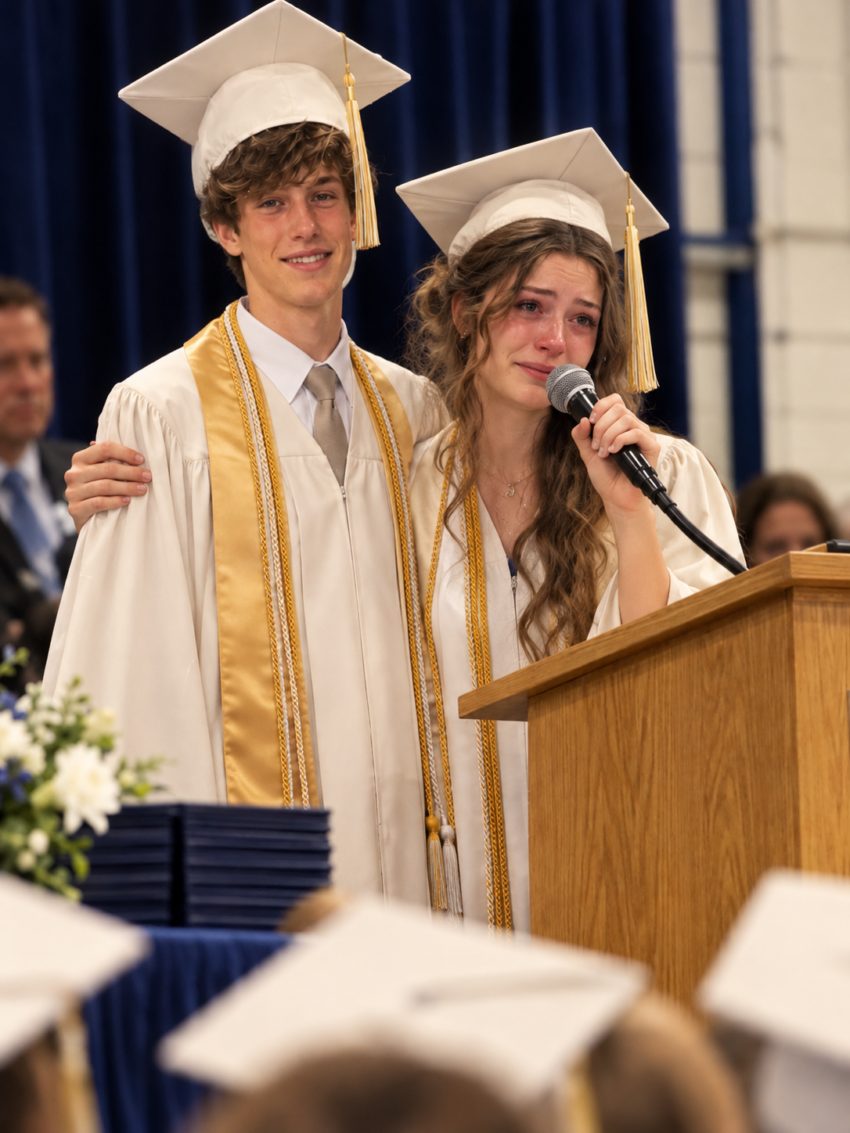
The gym fell silent. Emma faced the microphone.
“His name was Felix. And he wasn’t my boyfriend.” She paused. “He was my twin brother.”
A murmur rolled through the gym.
“He was supposed to graduate with us today. But he died two years ago.”
The girl who’d been recording lowered her phone.
My daughter rested a hand on the cardboard shoulder. “Some of you remember him. Some probably don’t. But he went here. He sat in these classrooms. He did the same homework we did.”
I stared at Felix’s smiling face. The photo had been taken shortly before his final hospitalization. His hair was thinner and his cheeks pale, but he was grinning because Emma had said something ridiculous.
Felix was born with a heart condition. For years we juggled medication, appointments, and hospital stays while trying to give both children an ordinary childhood. In sophomore year, his health worsened. He missed weeks, sometimes months, of school. Emma carried his completed work back to his teachers.
“I can’t let Emma beat me at everything,” he’d joke.
“Too late,” she’d say.
They’d competed since kindergarten: who ran faster, who finished books first, who earned better grades. Eventually, who would cross the graduation stage first. Felix claimed being born seven minutes earlier entitled him to go first. Emma said alphabetical order would settle it. Neither admitted they simply wanted to walk together.
After one hard appointment, Felix spread the graduation pages across his blanket. “Think they’ll let me walk with a chair if I’m too tired?”
“Obviously.”
“And if they don’t?”
“I’ll push you across myself.”
“Then make sure you don’t crash me into the principal.”
I’d laughed with them. I couldn’t have imagined how desperately I’d someday wish that conversation had come true.
Felix died six months later. He was 16.
For weeks, Emma barely spoke. I often found her on his bedroom floor, surrounded by belongings she couldn’t put away. What frightened me most was that she stopped talking about her future. Before, she’d dreamed of college, travel, becoming a teacher. Afterward, whenever I mentioned graduation, she changed the subject.
Then, in January, she came home with a folder.
“Mom, do you think the school would mention Felix at graduation?”
She’d emailed Principal William to ask for a brief acknowledgment of students who died before graduating. He replied that the ceremony was reserved for students receiving diplomas. She asked to put Felix’s photo in the entrance display. Declined. She asked to carry his photo while accepting her diploma. William said the ceremony must stay consistent for everyone.
“Did you explain why it matters?” I asked.
“Three times, Mom.”
I offered to arrange a meeting. She refused. “I can talk to him myself.”
At the time, I thought she was just stubborn. But at the microphone, she explained what I’d never fully understood.
“I didn’t want a special graduation for Felix. I know he can’t receive a diploma.” Her voice trembled. “I just wanted someone to remember he was supposed to be here.”
William stood beside her, still holding the letter. Emma reached for it, and he hesitated, then returned it. She unfolded it.
“This was written to Felix when he was hospitalized sophomore year. He kept it.”
She began to read.
“Dear Felix, your teachers have told me how hard you’re working despite everything you’re facing. Your determination makes you a valued member of our school community. Whatever the future holds, I hope you remember that you will always have a place among your classmates.”
She looked up. “It was signed by Principal William.”
Nobody laughed. William stared at the floor.
I remembered that letter. Felix had been delighted. “See, Mom? The principal knows I’m still part of the class.” He’d tucked it into his school folder beside the assignments he meant to finish. After he died, I’d packed that folder away. I hadn’t known Emma had found it.
“Mr. William,” she said, “you told my brother he would always have a place here.”
He raised his eyes. “I remember writing it.”
“Then why was it so hard to let me remember him today? I asked for his name to be mentioned. I asked about a photograph. I even asked to carry a picture. Every time, I was told no.”
William pressed a hand to his forehead. “Emma, I was trying to keep the ceremony fair.”
“Fair to who?”
The question hung in the air.
“I’m not asking you to pretend Felix graduated,” she said. “I’m asking you to remember he was here.”
Several parents wiped their eyes. But Emma wasn’t done.
“My brother hated when people felt sorry for him. He got so annoyed when people talked to me instead of him, like being sick meant he couldn’t answer questions. He wanted people to remember he was funny. That he loved school. That he was terrible at basketball but kept playing anyway.”
A few students smiled.
“Before he died, he asked me not to turn his picture into something sad for people to stare at.”
I remembered that night. Felix, exhausted in bed, Emma helping him with an assignment. He’d suddenly asked what she’d do if he didn’t make it to graduation. She told him to stop talking like that. He insisted. “Just don’t turn me into some sad picture everybody stares at. Make sure they remember I was actually part of the class.”
Emma had promised. I hadn’t understood how heavily it weighed on her.
“I know this looks ridiculous,” she said, glancing at the cutout. “Honestly, Felix would’ve made fun of it himself.”
Gentle laughter passed through the room.
“But when the school wouldn’t let me include even a small picture, I didn’t know what else to do.” She straightened the gown. “So I made him big enough that nobody could overlook him.”
I covered my mouth.
“Mom, I’m sorry I didn’t tell you about the letter.” She turned back to William. “I wasn’t planning a speech. I hoped you’d let me carry him across the stage.”
“Then why bring the letter?”
“Because I wanted to be ready if you stopped me again. And because I needed to know whether your promise still meant anything.”
For a long moment, nobody moved. Then William stepped to the microphone.
“Emma, I owe you an apology.”
His voice carried through the gym.
“I remember Felix. I remember his teachers speaking highly of him. And I remember writing that letter. When you contacted me, I treated your requests like scheduling problems. I didn’t consider what I’d promised your brother. I was wrong to dismiss you, and especially wrong to embarrass you today.” He breathed deeply. “I’m sorry.”
Emma looked down at Felix’s photograph.
William stepped aside. “If you’d still like to walk with your brother, you may.”
For a moment, she couldn’t move. Then she nodded. “Thank you.”
She adjusted Felix’s cap and lifted the cutout. As she approached the stage, a boy in the second row stood. Then another student. Then another. Soon, much of the graduating class was on its feet. The applause wasn’t coordinated. Some clapped right away, others rose slowly.
But nobody laughed.
William handed Emma her diploma. “Congratulations, Emma.”
She accepted it with one hand, steadying Felix with the other.
I raised my phone, and through tears took the photograph I’d imagined taking years earlier. My daughter onstage in her blue cap and gown. Beside her, her twin brother, smiling.
It wasn’t the picture we’d planned. But it was theirs.
After the ceremony, classmates came to talk with Emma. Several apologized for laughing. One girl admitted she’d thought the cutout was a joke because she hadn’t been at school when Felix was alive. Emma accepted every apology quietly.
When they’d gone, William approached us. “Melinda, I’m deeply sorry about today.”
“I nearly broke my promise to Emma when you threatened to stop her graduation.”
He nodded. “Felix loved this school,” I said. “Even when he couldn’t attend, he asked about his teachers every day.”
“I should have remembered that.”
He wanted to discuss a permanent remembrance display with school staff. Emma studied him. “Please don’t do it just because everyone heard what happened today.”
“I won’t. I’d like you and your mother to help decide what’s appropriate.”
“Felix would have liked that.” Then she added, “I wish you’d listened before today.”
William didn’t argue. “So do I.”
That evening, Emma received messages from classmates sharing memories of Felix: his ridiculous cartoons in worksheet margins, the times he helped with math. She showed me every one. For the first time in two years, talking about him made her smile more than cry.
Later, I found her on her bedroom floor beside the cutout. She’d taken off Felix’s cap and set it next to her own, her diploma across her knees.
“Are you okay?”
She nodded, then shook her head. “I thought walking across that stage without Felix would mean leaving him behind. But when I got my diploma, I was happy.” She looked ashamed. “Then I felt guilty.”
I held her hand. “Remember what Felix told you, the last time you talked about graduation?”
She stared at me. I remembered his words. “Promise me something, Em. If I don’t get to do all the things we planned, don’t spend your life feeling bad because you still can.”
Emma closed her eyes. “He made me promise. I’ve been trying so hard to remember him that I forgot that part.”
“You can miss him and still have a wonderful life.”
“I wish he’d been there for real.”
“Me too, sweetheart.”
We sat quietly. Then she studied her diploma. “Do you think Felix would’ve been proud of me?”
I looked at my son’s smiling face. “He would’ve bragged about you to everyone.”
She laughed. “He would’ve said he could’ve gotten better grades.”
“Absolutely.”
She leaned against my shoulder, and soon she was talking about college again: classes she wanted to take, places she hoped to visit.
For two years, I’d feared that moving forward meant losing what remained of Felix. But watching Emma imagine her future with her brother’s photograph beside her, I finally understood.
Felix never needed his sister to stop living for him. He wanted her to keep going.
And she’d found a way to take him with her without leaving herself behind.