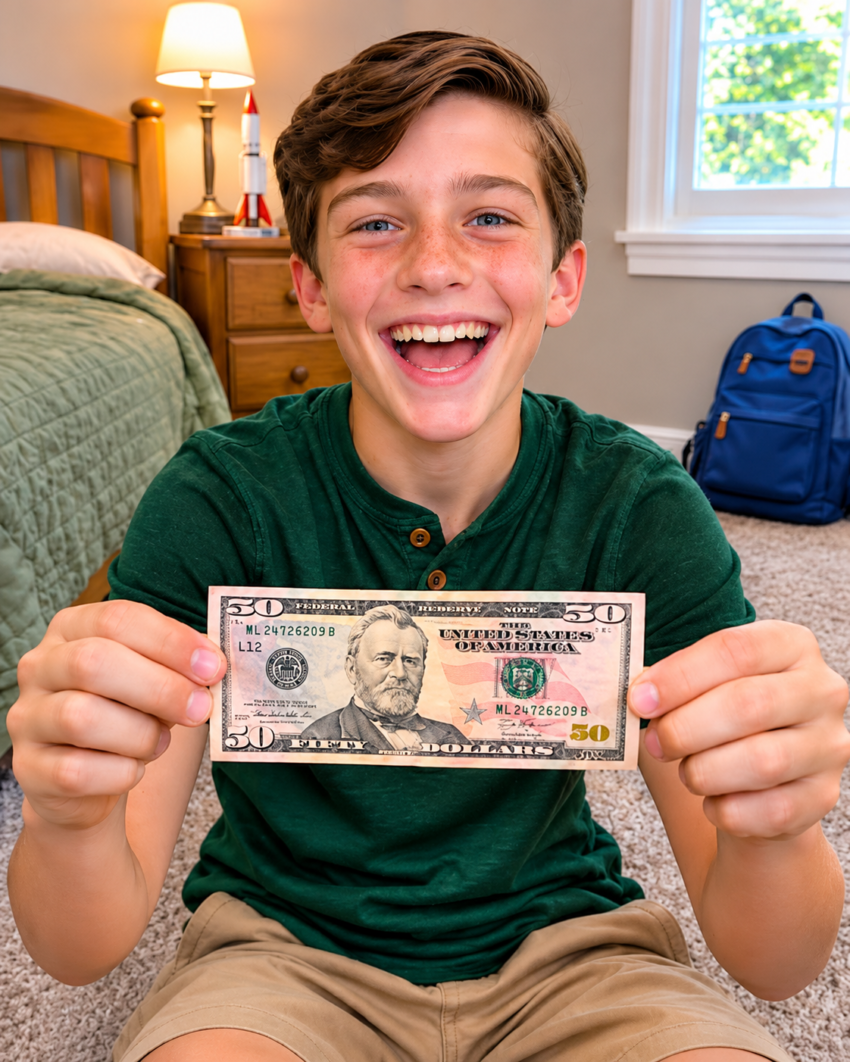
When I gave my eleven-year-old son, Noah, fifty dollars for his school fair, I imagined he would spend it on pizza, carnival games, and one of those enormous cookies children seem to consider priceless.
I never imagined that the money would become something much more meaningful.
At 2:18 on Friday afternoon, my phone rang at work. It was Noah’s teacher, Grace Collins. Her first words were reassuring.
“Ms. Hayes, Noah is safe, and he isn’t in trouble.”
I immediately felt a little better.
Then she paused.
“Something happened at the fair. Something good. If you can come before it ends, I think you should see it for yourself.”
Her voice began to break, and suddenly I had more questions than answers.
I had no idea that my son had used every dollar I gave him to create an experience that would stay with several children long after the school fair was over.
The Fifty-Dollar Surprise
Noah and I had always been a small family of two. His father wasn’t part of our everyday lives, but we had built our own routines and found happiness in the ordinary moments.
Dinner together, conversations about school, library books, and occasional arguments about bedtime made up much of our world.
For two weeks, Noah had been talking about the school’s spring fair. He had already planned what he wanted to buy.
“Pizza, ring toss, basketball, and giant cookies,” he announced one evening.
He was also considering a giant pencil, although neither of us could explain why an ordinary pencil wasn’t good enough.
The night before the fair, I found him sitting on his bedroom floor with twelve dollars arranged neatly in front of him. He was calculating how much he could spend while protecting the money he had been saving for a model rocket.
I had received a little extra money from overtime that week. Our bills were covered, and I could afford to give him a treat.
I took a fifty-dollar bill from my wallet.
“Here. This is for the fair. Buy whatever makes you happy.”
He stared at the money.
“All fifty dollars?”
“All fifty. Keep your savings for the rocket.”
He carefully accepted the bill and smiled.
“What if I buy something stupid?”
“Then you’ll learn a fifty-dollar lesson.”
He laughed, hugged me, and asked me to take a photograph of him holding his new spending money.
The next morning, he checked his backpack repeatedly to make sure the bill was still there. I reminded him not to spend everything on cookies, and he ran into school laughing.
Seven hours later, his teacher was calling me.
A Table Beneath the Basketball Hoop
When I arrived at Maple Creek Elementary, Mrs. Collins was waiting outside the gym.
She looked as though she had been crying, but she smiled when she saw me.
Before opening the doors, I asked the question that had been bothering me since the phone call.
“What exactly did my son buy?”
She smiled again.
“Come and see.”
Inside the gym, children were moving between folding tables, carrying toys and snacks. Near the far basketball hoop, I noticed a small table surrounded by students.
Behind it stood Noah.
He was wearing a paper crown.
In front of him were stuffed animals, toy cars, small dinosaurs, and other inexpensive prizes. A handwritten sign in green marker read:
FREE PRIZES — ONE EACH WHILE THEY LAST
Underneath, someone had added another message:
JOKE, FUNNY FACE, SILLY QUESTION — OR JUST SAY HELLO.
I stood still, trying to understand what I was seeing.
A little girl named Lucy was standing at the front of the line. She had a folded piece of paper in her hands and seemed nervous about speaking.
Noah leaned toward her.
“You don’t have to,” he told her quietly. “We can do it together.”
Lucy shook her head.
“I want to try.”
She took a breath and told him a joke.
“Why did the cookie go to the doctor?”
“Why?” Noah asked.
“Because it felt crummy.”
Noah slapped his hand against the table.
“A medical emergency!”
The children around them laughed. Lucy smiled, her shoulders finally relaxing.
Noah picked up a stuffed rabbit and handed it to her.
“Excellent work. One rabbit.”
Lucy looked surprised.
“I can really take it?”
“That’s the whole prize system.”
She hugged the rabbit and then, unexpectedly, hugged Noah.
He froze for a moment, clearly unsure what to do with the affection. Then he managed a very serious response.
“Okay. Thank you. Very professional.”
I had to press my lips together to keep from laughing.
But I was also beginning to understand why his teacher had called me.
Where the Fifty Dollars Went
After the children finished their turns, I sat with Noah on the gym bleachers.
He handed me a small receipt folded into a square.
I opened it and checked the numbers.
Six stuffed animals at four dollars each: $24.
Eight medium toys at two dollars each: $16.
Ten small prizes at one dollar each: $10.
Total: $50.
I looked at him.
“You spent all fifty dollars on these prizes?”
He nodded.
“Twenty-four prizes?”
“Yes.”
“And you didn’t buy yourself anything?”
He shook his head.
I asked him to explain.
He told me that when the fair began, he had planned to buy pizza, a giant cookie, and perhaps the oversized pencil he had been talking about.
Then he noticed Lucy standing near the prize stall.
She had spent her three dollars playing games but hadn’t won enough tickets to get the stuffed rabbit she wanted. She had picked it up, admired its unusually long ears, and eventually put it back.
Noah noticed.
He asked whether she liked the rabbit.
She said she did.
He considered buying it for her, but then he noticed other children watching the toys too.
Ben was interested in the toy cars. Owen wanted a dinosaur. A few other children were simply standing nearby, looking at the prizes they couldn’t afford.
Noah told me he didn’t want to choose just one child and make everyone else feel left out.
“I thought there should be a way for everybody to get something without paying,” he explained.
So he approached the parent volunteer and asked whether he could buy the remaining prizes and give them away.
The volunteer helped him understand the prices and count what his fifty dollars could purchase. Mrs. Collins checked that he had permission to spend the money, and the fair coordinator approved the idea.
A parent volunteer named Mrs. Alvarez helped arrange a second table.
They put the toys on display and created a simple activity. Children could tell a joke, make a funny face, answer a silly question, or simply say hello.
Nobody had to be funny.
Nobody had to perform.
Everyone was welcome.
The Moment That Made His Teacher Cry
As Noah explained what happened, Mrs. Collins joined our conversation.
She told me that the most important moment wasn’t when he bought the toys or arranged the table.
It was what happened when Lucy became nervous.
At first, Lucy had tried to tell her joke. Two children laughed before she could finish, and someone impatiently told her to hurry up.
She became uncomfortable and wanted to leave.
Noah immediately stopped the activity.
He told the children that nobody was going to receive a prize if people were going to make the experience unpleasant for someone else.
He didn’t shout or try to handle everything himself. He asked Mrs. Collins for help, and she stepped in to remind everyone about taking turns and treating one another respectfully.
Lucy was offered the chance to leave.
Instead, she decided she wanted to try again, but only when she felt ready.
Noah waited.
He didn’t pressure her or demand that she finish her joke. He simply gave her time.
Eventually, Lucy told the joke again. This time, Noah deliberately gave the wrong answer, allowing her to correct him.
They both laughed.
That was when she received her stuffed rabbit.
Mrs. Collins looked at me and said something I will never forget.
“He wasn’t trying to decide what Lucy needed. He kept listening and asking. I wanted you to see that.”
I reached for Noah’s hand.
He looked embarrassed.
“Mom, please don’t start.”
But I couldn’t help feeling proud.
My son hadn’t simply given away toys. He had noticed someone struggling, considered how she might feel, and found a way to include her without making her feel different.
A Lesson From the Principal
A little later, Principal Reed joined us.
He congratulated Noah but also wanted to make one important point.
He told my son that what he had done was generous, but it wasn’t his responsibility to make sure every child could participate in school activities.
That responsibility belonged to the adults.
Noah listened carefully.
Then he asked a question.
“So next time, could there already be a table like this?”
The principal smiled.
“Possibly. If we plan it properly.”
I appreciated that answer. He didn’t make unrealistic promises or expect one child to solve a problem that the school itself needed to address.
The remaining three prizes were placed in Mrs. Collins’s classroom activity box.
The fair ended, and Noah helped the volunteers clean up.
On the drive home, he became unusually quiet.
Finally, he asked:
“Are you really not mad that I didn’t buy myself anything?”
I looked at him through the rearview mirror.
“Noah, you used the money I gave you to do something that made you happy. You were allowed to buy pizza and cookies, and you were also allowed to buy toys for other people.”
He looked down at his hands.
I continued.
“But I want you to understand something. You don’t have to give everything away to make me proud.”
He smiled.
“Good. Because I still want the rocket.”
I laughed.
“That’s what I thought.”
Then I asked the most important question.
“Did you eat anything?”
He told me he had eaten his sandwich, shared a slice of pizza with a friend, and received a giant cookie from Lucy’s mother.
Apparently, the cookie had been enormous.
A Small Idea Becomes a School Tradition
The story didn’t end when we left the school gym.
A few days later, Mrs. Collins sent me a photograph from the fair. Noah was standing behind the table in his crooked paper crown, while Lucy held the stuffed rabbit beside him.
Her message was simple:
“Thank you for raising a child who notices—and who asks how he can help.”
I printed the photograph and put it on our refrigerator.
Noah pretended to be embarrassed when he saw it, but I noticed he kept looking at it whenever he opened the refrigerator.
A few weeks later, the school invited parents and teachers to discuss the following year’s fair.
Noah joined the beginning of one planning meeting as a student adviser.
During the discussion, an adult suggested that children could earn a free prize by telling a joke. Noah listened before quietly raising an objection.
“If we do this again, we can’t make getting a prize depend on being brave.”
He explained that some children enjoyed telling jokes, while others preferred to watch or choose something quietly.
“If somebody just wants to watch, they shouldn’t have to earn being there.”
The adults listened.
His suggestion helped shape a more inclusive plan.
The school eventually developed a free activity and prize table called the Second Chance Table. Every child could participate without needing spending money or performing in front of others.
Children could tell jokes, draw something, read a riddle, or simply choose a prize.
Adult volunteers managed the activity, and the school arranged enough inexpensive bookmarks and activity cards to ensure that every student had an option.
The idea had grown beyond Noah’s original fifty-dollar purchase.
It had become a practical way for the school to make sure more children felt welcome.
The Cookie He Bought With His Own Money
By the following spring, Noah and Lucy were still friends.
They worked together on some school projects and disagreed about others. Lucy preferred drawing planets, while Noah sometimes believed his ideas were better.
They were ordinary children building an ordinary friendship.
The paper crown from that first fair still sat on the top shelf of Noah’s bookcase. One point had collapsed, but he refused to let me repair it.
“Historical accuracy,” he explained.
On the next school fair day, I couldn’t leave work early enough to see the beginning. This time, there was no emotional phone call.
Mrs. Collins sent a photograph showing Noah and Lucy behind the table, with an adult volunteer helping them.
The table was organized, the sign was straight, and children were choosing prizes without anyone having to explain why they deserved to participate.
I arrived for the final twenty minutes.
I watched Lucy offer a younger boy a joke card. He declined and chose a bookmark instead.
“Good choice,” she told him.
There was no pressure, no applause, and no expectation that he had to overcome anything.
He was simply allowed to participate in his own way.
Later that evening, Noah walked into the kitchen carrying a paper bag from the fair’s bake sale.
He placed an enormous cookie between us.
“For you,” he said.
“Did you buy it with your own money?”
“Yes.”
“All of it?”
He laughed.
“Three dollars, Mom.”
Then he broke the cookie in half, studied the two pieces, and handed me the larger one.
“What is the occasion?” I asked.
He shrugged.
“You’re my favorite mom.”
I smiled.
“I’m your only mom.”
“Still counts.”
We sat together, eating the cookie and leaving crumbs across the kitchen table.
I kept thinking about the fifty dollars I had given him.
I had imagined it would buy him a few hours of entertainment. Instead, it gave him an opportunity to discover something about himself—and helped the adults around him recognize something their school could do better.
That afternoon, I learned that kindness isn’t always about giving someone what they cannot afford.
Sometimes, it’s about noticing when someone feels left out, giving them room to participate, and making sure they never have to prove they deserve a place.
And sometimes, the most meaningful thing a child can do is simply wait until another child is ready.
Editorial note: The supplied source explicitly identifies this story as fiction inspired by real-life themes. The names, characters, places, and events are fictionalized and should not be presented as a verified news report.