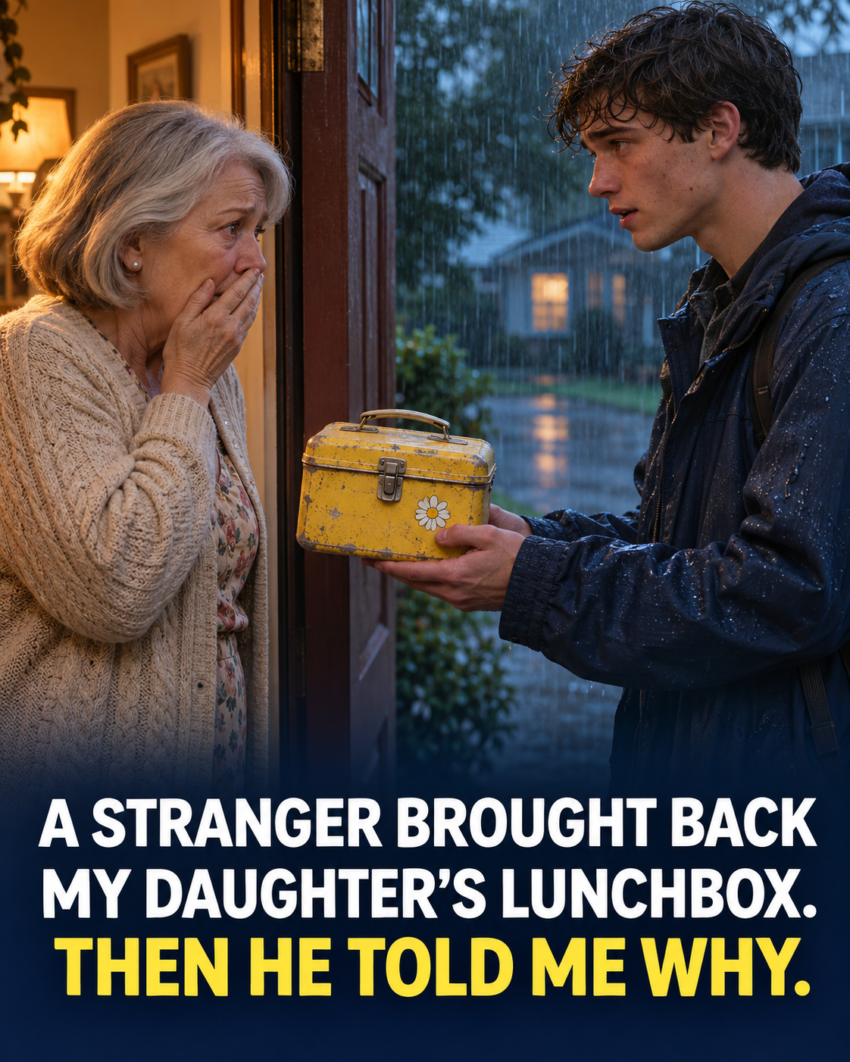
The young man on my porch had rain dripping off his sleeves and my daughter’s yellow lunchbox in his hands. I knew it by the daisy sticker she’d put on crooked in second grade. What I didn’t know was how a stranger had gotten hold of it, or why the first thing he said was, “Do you still cut the apples thin?”
My daughter, Ellen, would have turned 46 that Thursday. I’d bought two red apples because they were her favorite, then left them in the grocery bag all afternoon. It had been a year since she died. At 68, I could make it through a whole trip to the supermarket without crying. Putting the groceries away was sometimes another matter.
The boy on my porch looked about nineteen. When I asked where he’d found the lunchbox, he tightened his grip on the handle.
“Your daughter lent it to me,” he said. “I meant to bring it back sooner.”
I used to pack an extra lunch
When Ellen was eight, she started asking for two sandwiches. I thought she was going through a growth spurt until she asked me to leave the mustard off one of them.
“You love mustard,” I said.
“Diane doesn’t.”
That was how I found out a girl in her class spent most lunchtimes pretending she’d already eaten. When Ellen offered her half a sandwich, Diane took it only after Ellen said I had a habit of packing too much.
After that, I packed two lunches every school day. I cut the apples thin because Ellen had a loose front tooth and because two children could get more slices out of one apple if I took my time.
By spring, Diane was bringing her own lunch. I packed two sandwiches for another week anyway. Ellen ate both of them on the bus home and asked me, very politely, if we could go back to one.
I hadn’t thought about that extra week in years.
The note under the lid
The young man’s name was Noah. He sat at my kitchen table with a dish towel around his shoulders while I put the kettle on.
He’d worked the Saturday shift with Ellen at the town library. One day he’d skipped lunch so he could put enough gas in his car to get home. My daughter came back from her break with a sandwich, an apple, and her old yellow lunchbox. She said the box was a loan and the sandwich was ham, if that was all right.
“She made it sound like I was doing her a favor,” he said.
That sounded like Ellen. She knew what it cost some people to say yes to help.
Noah opened the clasp. A square of wax paper sat in the bottom, folded around a note. I recognized my daughter’s handwriting before I could read the words.
My mom used to pack two. She always cut the apples thin. If you’re reading this, I finally remembered to put a napkin in.
I laughed at that. Ellen had been terrible about napkins. I used to find evidence of strawberry season on the cuffs of her school sweaters.
Noah waited for me to finish reading. Then he asked, “How come you stopped?”
I told him Diane had started bringing her own lunches. He shook his head and took another slip of paper out of his coat pocket.
It was a packing list in my handwriting. Two sandwiches. One apple. Two napkins. Ellen had stuck it on her fridge the winter she broke her wrist and I dropped off lunches before her shift. I must have made her an extra sandwich out of habit. I’d started leaving a bag on her porch every Saturday, long after she could make her own lunch again.
One morning she’d called and said, “Mom, you can stop worrying about me.” By the time she finished that sentence, I’d already decided she wanted me to stop coming.
“She told me about those Saturdays,” Noah said. “She thought she’d hurt your feelings.”
I kept smoothing the creases in the list. “She could have called me.”
He looked down into his mug. “She said you could’ve called her, too.”
I wanted to argue with that. I folded the list along the old creases instead.
On the next Saturday, I made two
Noah told me he wanted to put a lunch in the library staff fridge each Saturday, with a note that said anyone working the shift could take it. He’d asked his supervisor. All he needed was somebody to show him how to slice an apple that thin.
I took the two apples out of the grocery bag. We ate one standing at the counter while I showed him how I cut around the core. He tried it with the second one. His first slice was so thick it stood up on its own.
“Still tastes the same,” he said, and ate it.
That Saturday, he knocked just before ten. I packed one lunch in a brown bag for the staff fridge and put the second in the yellow lunchbox. When he tried to hand the box back to me, I told him he could bring it by next week.
I let him get as far as the front steps before I called him back. Then I tucked a napkin under the clasp where he’d be sure to see it.