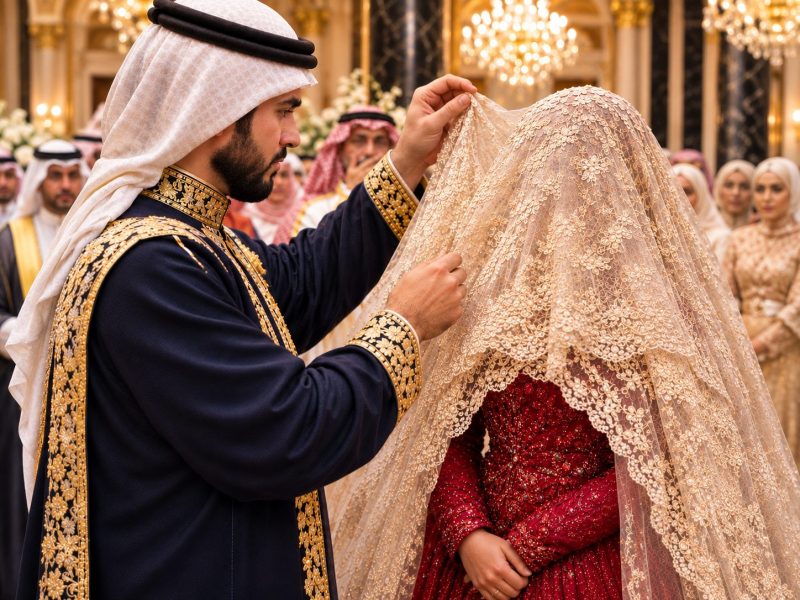
The moment Prince Nadir Al-Hassan lifted his bride-to-be’s veil, the atmosphere inside Al-Nour Palace changed dramatically. Two long scars crossed the young woman’s left cheek, but it wasn’t their appearance that shocked him most. It was the reaction of three powerful dignitaries standing behind him.
One of them whispered in disbelief, while another appeared unable to breathe. An elderly man finally murmured words that sent a chill through the entire gathering.
“This girl should be dead!”
What had happened to the young woman years ago? And why were powerful men suddenly terrified of the truth?
The Two Scars Beneath the Veil
Beneath the magnificent crystal chandeliers of Al-Nour Palace, Prince Nadir Al-Hassan stood before his bride-to-be, Amira.
At 34, Nadir was accustomed to formal ceremonies, political gatherings, and the expectations that came with his royal position. But that evening was different. He had waited months for the moment he could finally see the face of the woman he intended to marry.
Amira, 27, stood before him in a beautiful burgundy gown embroidered with golden threads. Her matching hijab framed her head, while a delicate lace veil concealed her face.
Her hands were clasped tightly together.
“Are you afraid?” Nadir whispered.
She shook her head gently.
“Just promise me you won’t look away.”
The prince frowned in confusion.
“Why would I?”
Amira remained silent.
With a gentle movement, Nadir lifted the veil. He first noticed her dark eyes, then her delicate features and trembling lips. But as the veil fell away, two long reddish scars became visible across her left cheek.
They were nearly parallel, slightly slanted, and unmistakable.
Nadir froze.
Yet the scars themselves weren’t what truly disturbed him.
Behind him, three dignitaries had reacted as though they had witnessed something impossible.
“By Allah…” one whispered.
Farid Al-Mansour, a 62-year-old dignitary dressed in an elegant cream-colored robe, covered his mouth with his hand.
Qassem, standing beside him, looked as though he had lost the ability to speak.
Rachid instinctively stepped backward.
“Did you see those marks?” Qassem whispered.
Farid shook his head slowly.
“That’s impossible…”
Nadir turned toward his bride.
“Why did no one tell me about these scars?”
A tear rolled down Amira’s cheek.
“Because no one wanted you to know where they came from.”
The prince felt his heart begin to race.
“Tell me. Who did this to you?”
Amira looked past his shoulder and fixed her eyes on Farid.
“Ask him.”
The room fell silent.
Farid immediately stepped backward.
“I don’t know this woman!”
Amira moved closer.
“Really? Then why did you tell my father that I hadn’t survived the fire?”
The words sent a wave of shock through the gathering.
Nadir looked between them, struggling to understand.
“What fire are you talking about?”
“The fire that destroyed the west wing of the palace seventeen years ago.”
The prince’s face turned pale.
That night, his younger sister Lina, who had been only eight years old, had mysteriously disappeared. Despite weeks of searching, no one had ever found her body.
“How do you know about that night?” he asked.
Amira took a deep breath.
“Because I was with Lina when the flames began to spread.”
Farid suddenly erupted.
“She’s lying! This woman is an impostor!”
Amira pointed toward the scars on her cheek.
“Then explain these marks. Explain why the three men who stood in front of the locked door have just recognized me.”
Nadir turned toward the dignitaries.
Qassem lowered his eyes. Rachid began to tremble. Farid tried to move toward the exit.
“No one leaves this room!” the prince ordered.
Then he turned back to Amira.
“My sister… what happened to her?”
Amira looked directly at him.
“Lina didn’t die in that fire.”
The Door That No One Was Supposed to Open
Seventeen years earlier, Amira had been just ten years old.
Her mother, Samira, worked as an embroiderer inside the palace. Through her mother’s work, Amira had become friends with Princess Lina. The two girls quickly grew close, spending countless hours together.
They even developed a special ritual. Whenever Lina wanted to visit her friend, she would knock three times on the door.
On the evening of the fire, the girls were playing near the old archives when they overheard Farid speaking with two other men.
“The records must disappear before tomorrow,” he said.
The conversation frightened them, although they didn’t fully understand what the men were discussing.
Minutes later, smoke began spreading through the corridor.
The girls rushed toward the exit, but the door was locked.
Amira began pounding against it.
“Open the door! Princess Lina is with me!”
Their cries echoed through the corridor, but Farid heard them and walked away without helping.
Desperate to escape, Amira noticed a small service window nearby. She grabbed a metal object and smashed the glass.
As she attempted to climb through, two burning-hot metal bars fell against her cheek, leaving the terrible scars that would remain for the rest of her life.
Despite her injuries, she managed to get Lina out.
Samira eventually found both girls in an outside passageway. Lina was unconscious, while Amira was badly injured.
Farid ordered them to be taken to a distant clinic.
But during the journey, Samira overheard him speaking on the telephone.
“We absolutely cannot allow that little girl to tell anyone what she heard.”
Samira immediately understood that the girls were in danger.
She fled with them and sought refuge at her sister’s home.
Lina survived the fire, but the trauma left her with significant memory loss. Samira tried repeatedly to contact the royal family, but Farid controlled communications and had men watching their home.
The family was forced to move repeatedly, changing identities and living in fear.
Years passed.
After Samira’s death, Amira discovered a hidden box containing photographs, letters that had never been delivered, and Lina’s silver bracelet.
The bracelet became the most important clue in the mystery.
The Bride Who Had Been Searching for the Truth
Lina had grown up under another name: Leïla Ben Salem.
She had no clear memory of her childhood in the palace or of the brother she had lost. Her memories of the fire were fragmented, and the people around her had never revealed the truth.
Meanwhile, Amira had spent years protecting the secret.
Six months before the wedding ceremony, she joined a humanitarian program funded by Prince Nadir’s foundation. Their paths crossed, and they gradually fell in love.
But Amira remained uncertain about the prince’s connection to the old tragedy.
She feared that the royal family might have been involved in the events that destroyed her childhood.
Rather than reveal everything immediately, she decided to observe the men who had been connected to the fire.
That was why she had invited Farid, Qassem, and Rachid to the ceremony.
She wanted to see their reactions when the truth could no longer be hidden.
Suddenly, Rachid broke down in tears.
“She’s telling the truth,” he confessed. “We locked that door on Farid’s orders. When we heard the girls screaming, he stopped us from helping them.”
Nadir stared at him in disbelief.
“You kept silent for seventeen years?”
Farid tried to defend himself, but the prince cut him off.
“You protected your lies, not my sister!”
Three Knocks That Changed Everything
The ceremony was immediately interrupted.
Nadir ordered that the three men be handed over to investigators and that the old palace archives be secured. The accusations were serious, and the truth would have to be established through a formal investigation.
Two days later, Nadir stood outside a room with trembling hands.
Amira had told him that Leïla was waiting inside.
The young woman stood near the window, wearing the silver bracelet decorated with a small moon and three stars.
Nadir recognized it immediately.
It was the bracelet he had given Lina for her eighth birthday.
“Are you Nadir?” she asked quietly.
“Yes.”
He wanted to embrace her immediately, but he stopped himself. Seventeen years of separation couldn’t be erased in a single moment, and he didn’t want to overwhelm her.
“I don’t expect you to remember everything,” he said softly. “And I don’t want to ask you to recover seventeen years of memories in just a few minutes.”
Leïla looked down at her bracelet.
“I don’t know why, but I’ve always been afraid of losing it.”
Nadir stepped back toward the door.
Then he gently knocked three times.
Knock.
Knock.
Knock.
Leïla suddenly froze.
A memory flashed through her mind: two little girls hiding behind a curtain, laughing quietly, followed by a familiar voice.
“Wait for me… I’ll be back…”
Nadir’s eyes filled with tears.
“Yes, Lina. Those are exactly the words you said to me.”
The young woman rushed into his arms.
For several long minutes, brother and sister held each other tightly, crying as the years of separation, uncertainty, and loss finally gave way to an emotional reunion.
The Truth Finally Came to Light
The investigation gradually confirmed the accusations.
Documents recovered from the old archives revealed financial embezzlement that had been concealed through the fire. Farid was convicted, while Qassem and Rachid were also held accountable for their involvement.
The truth that had been buried for seventeen years was finally exposed.
Lina, however, made her own decision about the future.
She chose to continue using the name Leïla in her everyday life. Nadir respected her choice, understanding that recovering her identity didn’t mean she had to abandon the life she had built.
Three months later, a small wedding ceremony was held in the palace gardens.
Amira wore a magnificent burgundy gown. Her scars remained visible, but for the first time, she no longer felt the need to conceal them.
Nadir gently took her hand.
“Do you know what I see when I look at you?” he asked.
“A ten-year-old girl who could have escaped alone, but who risked her life to save my sister.”
Leïla joined them, carrying a small jewelry box.
Inside was a silver bracelet with an inscription:
“To the one who opened the door for me.”
Amira burst into tears.
“Without you, I wouldn’t be here today,” Leïla whispered before embracing her.
Nadir gently caressed Amira’s hand.
“Your scars are not imperfections. They tell the story of a child’s courage, a little girl who refused to abandon someone she loved.”
For the first time, Amira understood that she no longer needed to hide her face.
Her scars would remain, but they no longer represented only pain. They had become a symbol of courage, sacrifice, and extraordinary love.
Sometimes, the marks that others see as imperfections carry the most beautiful stories of bravery.
And perhaps the greatest lesson of all is that we should never judge someone by the scars they carry. We may never know the courage, sacrifice, or love that lies behind them.