When my mother died, the world seemed to lose every color it had ever held.
I was sixteen, still trying to understand how to live without the person who had made everything feel safe, when my father remarried Sharon. She was a woman who smiled with her mouth but never with her eyes. She moved into our house with her two little girls and an air of order that left no room for grief.
At first, I tried to be accommodating. I told myself that if I was patient, things would eventually get better. Perhaps we would become a family in the way people described in movies and books.
But Sharon had other ideas.
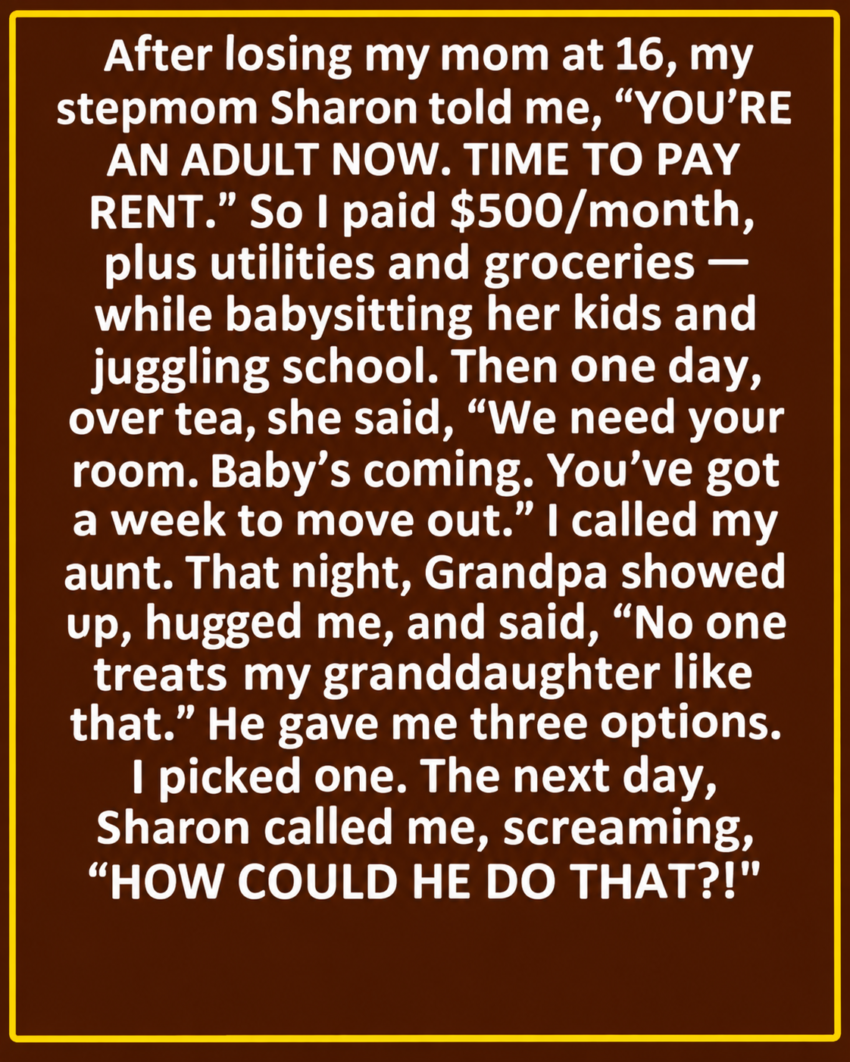
“You’re almost an adult now,” she told me one afternoon. “Time to start paying your way.”
I nodded, swallowing my shock.
So I found a job after school. Every month, I handed her five hundred dollars. I bought groceries whenever the refrigerator grew empty, and I babysat her daughters whenever she wanted to go out with friends.
I kept telling myself it was fine.
I convinced myself that hard work would make me stronger, that being responsible would earn me respect, and that eventually, I would find a place in the household that felt like home.
I didn’t realize how much I was giving up just to be accepted.
Then one afternoon, Sharon placed her teacup on the table and looked at me as though she were delivering an ordinary household announcement.
“We need your room. The baby is coming. You have a week.”
I stared at her.
My fingers felt cold around the chipped mug I had washed and used for years.
“Okay,” I said quietly.
That was all I could manage.
That evening, I folded my clothes into an old suitcase. I placed my mother’s photograph carefully on top, making sure it wouldn’t get damaged.
I didn’t cry.
Instead, I called my aunt and asked whether I could stay with her for a few days while I figured out what to do next.
But before I could pack the last box, someone knocked on the door.
It was Grandpa.
He stood there wearing his old wool coat, his expression filled with a quiet fury I had rarely seen.
He didn’t ask permission to come inside.
He simply wrapped his arms around me.
“No one treats my granddaughter like that.”
For the first time in months, I felt someone was standing beside me rather than expecting something from me.
That night, Grandpa offered me three choices.
I could move in with him. I could stay with my aunt. Or I could use the college fund my mother had left me to begin a new life somewhere else.
He didn’t pressure me. He didn’t tell me what I should do.
He simply made sure I knew I had options.
I chose to live with Grandpa.
The following morning, Sharon called. Her voice was sharp, and she accused me of being ungrateful.
I listened without arguing.
For years, I had spent so much of myself trying to earn the love of someone who never seemed willing to give it. That morning, something finally changed.
I stopped believing that her approval was something I needed to survive.
When I hung up, Grandpa poured me a cup of coffee.
“Kindness is a gift, sweetheart,” he said gently, “but sometimes, you need to give it to yourself first.”
I never forgot those words.
They became the compass I would carry through the rest of my life.
Building a Life Beyond Rejection
The years that followed weren’t easy, but they were mine.
I finished college, working part-time and studying late into the night. There were days when I felt exhausted, days when I wondered whether I was doing enough, and days when the absence of my mother still hurt in ways I couldn’t explain.
But Grandpa was always there.
He came to every graduation ceremony, every milestone, every important moment. Whenever I looked into the crowd, I knew I would find him. His applause was always the loudest.
He never made me feel like I was a burden.
He never reminded me how much he had done for me.
He simply showed up.
And that, I eventually learned, was what love looked like.
Years later, when I bought a small house down the street from his, I planted two rosebushes in the front yard.
One was for me.
The other was for my mother.
I wanted something living to remind me of the woman I had lost and the life I had slowly rebuilt.
On summer evenings, Grandpa would sit outside and watch the roses bloom. He would smile whenever a new petal opened beneath the sunlight.
Sometimes, we talked about the past. Sometimes, we talked about nothing important at all.
But I no longer felt the need to prove that I deserved a place in someone’s life.
I had finally learned that family isn’t always defined by blood, marriage, or the people who share your roof.
Family is the person who shows up when you’re hurting.
Family is the person who gives you a choice when others leave you with none.
Family is the person who reminds you that you matter, even when the world makes you feel otherwise.
Sharon’s rejection had once broken something inside me. I had believed that being pushed out of my own home meant I wasn’t worthy of love.
But in time, I understood something I hadn’t been able to see at sixteen.
Her rejection didn’t define my future.
It led me toward a life where love wasn’t conditional, where kindness didn’t come with a price, and where I no longer had to beg to belong.
In truth, it led me home.
To the kind of love that doesn’t ask for rent, only respect.