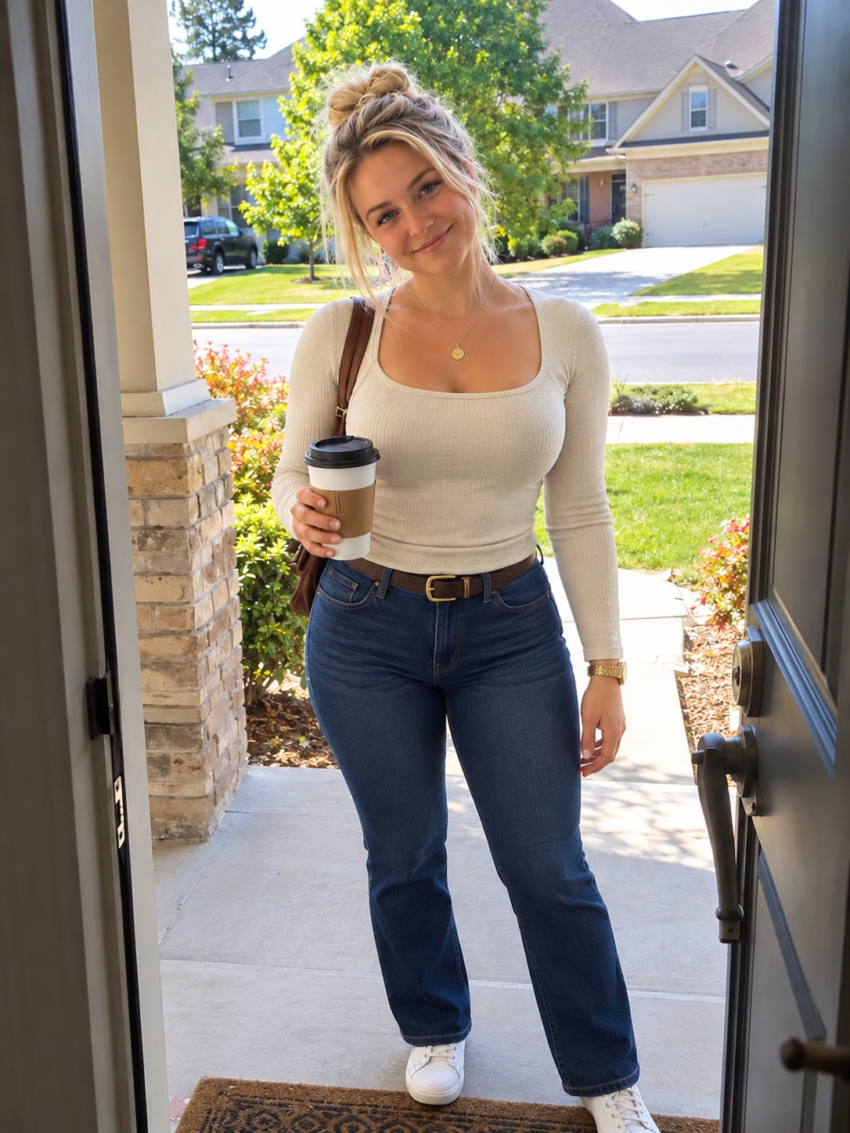
When I first noticed our new neighbor bringing my husband coffee every morning, I thought she was simply being friendly. Then, one Tuesday morning, she handed him a handwritten note. The moment Tony read it, the smile disappeared from his face. His expression changed so dramatically that I knew whatever was written on that piece of paper had nothing to do with coffee.
I was fifty-one years old, and I had never walked across the street to confront a stranger before that morning. Yet there I was, standing on Dakota’s front steps in my slippers and bathrobe, holding a crumpled note in my fist, with my heart racing.
To understand why I was there, you need to know how the coffee started—and what Tony and I had endured during the twenty-five years of our marriage.
Dakota moved into the little gray house across the street at the end of August.
The house had belonged to Mr. Petrakis for nearly forty years. When his children moved him into assisted living in the spring, they put the property up for sale. Our neighborhood was small, with eleven houses arranged in a horseshoe-shaped street. Maple Court was the kind of place where people knew one another’s routines, and where the things nobody knew were often invented by someone who had too much time on their hands.
Tony and I watched the moving truck arrive from our front porch, sipping iced tea.
The movers carried a couch, a drafting table, several boxes and a bed into the house. Then a young woman stepped out of a small blue Honda with Arizona plates. She looked to be in her late twenties, with dark hair pulled beneath a knitted beanie. She was thin, and she wore the hat despite the summer heat.
She stood on the sidewalk, studying her new house. Then she turned and looked directly at us.
More specifically, she looked at Tony.
She held his gaze for several seconds before turning and walking inside.
“Friendly,” Tony remarked.
“Maybe she’s just tired from moving,” I replied.
Two days later, she knocked on our door with a plate of homemade chocolate chip cookies.
“Hi,” she said with a smile. “I’m Dakota. I just moved in across the street, and I wanted to introduce myself.”
Up close, she looked even younger. Her dark eyes were large, and her skin was pale. She was wearing another knitted hat, this one gray.
“I’m Jennifer Moretti,” I said, welcoming her inside.
Tony was in the kitchen repairing our garbage disposal, a task he seemed to revisit every couple of months. He came out wiping his hands on a dish towel.
“This is my husband, Tony,” I introduced him.
Dakota looked at him in a way I couldn’t quite explain. It wasn’t the look of someone attracted to a man. It was something else, something more personal. Almost as though she were trying to memorize his face.
Tony was fifty-four, but he still had his hair, strong arms from decades of electrical work, and an easy smile. Women occasionally noticed him. I knew that.
But Dakota’s expression was different.
“Hi,” she said, her voice sounding slightly unusual.
“Welcome to the neighborhood,” Tony replied, shaking her hand. “Where did you move from?”
“Phoenix.”
“That’s quite a distance. What brought you to Ohio?”
“Work. I’m a graphic designer. I can work from anywhere. I just needed a change.”
Tony joked that she’d chosen a good street, although she should be careful around Marlene at number seven, who could probably learn a person’s blood type before the end of the week.
Dakota laughed.
It was a pleasant laugh, but it sounded a little rusty, as though she hadn’t used it very often.
She stayed for about twenty minutes, asking questions about our neighborhood, our jobs and how long we’d lived there. Tony had been an electrician for thirty years and ran his own company, Moretti Electric, with six employees. I worked as an office manager at a pediatric dental practice.
Then she asked whether we had children.
“No,” I answered.
Her expression changed slightly. She lowered her eyes and apologized for asking.
“It’s alright,” I told her. It was a question I’d learned to answer casually over the years.
After she left, I put the cookies on a plate. They were genuinely good.
“Nice girl,” Tony said, reaching for his third cookie.
“She seems sad,” I remarked.
“Everybody’s sad when they move. It’s the boxes. Boxes make everybody sad.”
At first, Dakota really did seem like an ordinary, friendly neighbor.
She waved when she collected her mail. She stopped to chat when she saw us outside. She asked me where the best grocery store was and whether the farmers market was worth visiting.
She even brought zucchini bread to Marlene at number seven, which was probably the smartest thing she could have done. Marlene promptly declared Dakota a sweetheart, although she also wondered aloud why the young woman was so thin and why she always wore a hat.
Then Dakota began paying more attention to Tony.
It started with little things.
When Tony was mowing the lawn, Dakota would come outside to water her flowers. When he washed his truck, she’d walk over and ask something about her circuit breaker. If we were sitting on the porch in the evening, she would slowly carry her recycling bin to the curb and wave.
I noticed.
But Tony was the kind of man people naturally approached when they needed help with something electrical. I didn’t think much of it.
Then came the coffee.
Tony had left for work at the same time every morning for thirty years. At 6:50, he would kiss me in the kitchen, grab his thermos and head out to his truck. I usually watched him through the kitchen window while finishing my own coffee.
It was one of those small routines that quietly became part of a marriage.
One Monday morning in late September, something changed.
Tony stepped outside at 6:50. At almost exactly the same moment, Dakota’s red front door opened. She walked down her steps and crossed the street carrying two paper cups from the Daily Grind on Main Street.
I was standing at the kitchen window, my mug halfway to my mouth.
“Morning!” she called. “I accidentally bought an extra. Do you want it? Otherwise, it’ll go to waste.”
Tony looked surprised, but he smiled and accepted it.
“Well, thank you. That’s very nice.”
“Have a good day!”
She returned to her house.
The following morning, she did it again.
Same time. Same two cups. Same explanation.
This time, Tony laughed.
“Twice in a row? You need to talk to those people about their ordering system.”
“I’m terrible at mornings,” she replied.
By Wednesday, I was no longer finishing my coffee while watching Tony leave. I was simply standing at the window, observing.
By Friday, Dakota knew exactly how he liked his coffee.
“Two sugars, no cream, right?” I heard her ask through the screen door.
Tony stopped beside his truck.
“How did you know that?”
“Just a lucky guess.”
That evening, I brought it up over dinner.
“I think our new neighbor has a crush on you.”
Tony shook his head, continuing to eat his spaghetti.
“I think she’s lonely. She’s new here. She doesn’t know anyone. Maybe she’s just trying to make friends.”
“By bringing my husband coffee every morning?”
He laughed.
“Apparently, I’m very approachable before eight in the morning.”
“Apparently.”
Then he reached across the table and covered my hand with his.
“Jen, she’s younger than some of my apprentices. She’s practically a kid. I’m a fifty-four-year-old man with a bad knee who falls asleep during Jeopardy.”
“You do fall asleep during Jeopardy.”
“Every single night,” he admitted. “She’s lonely. That’s all.”
We turned it into a running joke.
Whenever Dakota appeared with another coffee, I’d tease Tony about his morning delivery. I’d ask whether he was going to leave her a tip or whether the Daily Grind had made him employee of the month.
When he came home, I’d ask how his coffee date had gone.
“She’s already discussing our future,” he’d joke. “I think she wants a June wedding.”
We had been married for twenty-five years. We laughed about nearly everything because, for much of our early marriage, the alternative had been crying. And we’d already done plenty of that.
I wasn’t worried about Tony. He never encouraged Dakota beyond being polite and friendly. He genuinely seemed to believe she was lonely, and I mostly believed it too.
But Marlene at number seven had a different opinion.
She caught me at the mailbox on the second Thursday.
“Jennifer,” she said, lowering her voice, “I don’t like to say anything.”
Marlene loved saying things. It was practically her favorite pastime after bingo.
“But that girl,” she continued, nodding toward the gray house. “Every morning with the coffee. I see it from my kitchen. The whole street sees it. People are talking.”
“People can talk,” I replied.
“I’m just saying, honey. Young woman living alone, wearing hats in the heat, bringing a married man coffee every morning. My cousin’s husband in Toledo started with coffee. Next thing you know, he was living in a condo in Sandusky with a dental hygienist.”
“Tony isn’t moving to Sandusky, Marlene.”
“I’m just saying.”
I walked back home with the mail, but her words stayed with me.
That night, lying beside my snoring husband, I felt a small, uncomfortable thought creeping into my mind.
Not suspicion exactly.
Just the feeling that something wasn’t quite right.
Two sugars. No cream.
How had Dakota known?
A week later, I was collecting my mail when Dakota was doing the same. She smiled and waved, and before I could think too carefully, I crossed the street.
“Dakota, can I say something?”
She stopped smiling and held her mail against her chest.
“Of course.”
“The coffee,” I said. “It’s very sweet of you, but you really don’t have to keep bringing it. Tony has a thermos. And people on the street are beginning to talk. I just don’t want anyone getting the wrong idea. You know how neighborhoods can be.”
I tried to soften the words with a smile.
Something changed in her face. It was quick, but I noticed it. It wasn’t embarrassment or anger.
It looked almost like grief.
“I’m just trying to be nice,” she said quietly.
“I know.”
“I’m sorry. I didn’t mean to cause any trouble. I’ll stop.”
She went inside.
And she did stop.
For nearly a week, we didn’t see her in the mornings. Tony walked to his truck at 6:50 with his thermos, and the red door across the street remained closed.
I thought I’d feel relieved.
Instead, I felt strangely guilty.
“Do you think I hurt her feelings?” I asked Tony.
“Maybe a little,” he said. “But you were right to say something. It was getting a bit strange.”
“She looked so sad.”
“She always looks sad, Jen. I don’t know what she’s carrying. But it’s not our business.”
That week, I noticed her lights were on late every night. Sometimes at two or three in the morning.
One night, I got up for a glass of water and saw her standing at her front window in the dark, looking toward our house.
She was just standing there.
I stepped away from the window before she could see me.
I didn’t tell Tony.
Then came Tuesday.
It was the second week of October. The morning was cold and bright, and the maple tree in our front yard had turned completely red overnight.
I was standing at the kitchen window with my coffee, watching Tony walk toward his truck.
The red door across the street opened.
Dakota came down her steps and walked toward him.
This time, she wasn’t carrying coffee.
She was holding a folded piece of paper with both hands, as though it were something fragile.
When she reached Tony, she handed it to him.
He looked surprised. Then he glanced toward our house, as if checking whether I was watching.
I was.
He unfolded the paper and began reading.
I had watched Tony’s face for twenty-seven years, including the two years we dated and the twenty-five years we were married. I knew his tired expression, his guilty expression, his expression when he forgot to pay the gas bill. I knew the face he made when the Browns lost, and I knew the face he wore when his father died.
I had never seen this expression before.
His smile disappeared completely.
He read the note again, slowly. His lips moved slightly. Then he looked up at Dakota, and his face turned pale.
He looked stunned. Almost frightened.
Dakota said something quietly, but I couldn’t hear it through the window.
Tony didn’t answer.
She turned and walked back across the street, entering her house and closing the red door behind her.
The moment her door shut, I was outside.
I didn’t even put on shoes.
I crossed our cold lawn in my slippers.
“What did she write?”
Tony folded the note. Then he folded it again, making it smaller.
“It’s nothing.”
“Tony, I just watched your face change. Give it to me.”
He hesitated. His eyes were wet.
“Seriously, Jen. Let it go. Please. Just let me handle this.”
That made me even more determined.
Tony Moretti had never asked me to let something go in twenty-five years of marriage. He wasn’t the kind of man who kept secrets. He told me when he dented the truck. He told me when he lost a contract. Once, at two in the morning, he told me about a girl he’d liked in high school who had died in a car accident and how he still thought about her sometimes.
He didn’t keep secrets.
Yet here he was, standing in our driveway, holding a piece of paper and asking me to let it go.
“Give me the note.”
“Jen…”
“Give me the note, Tony.”
After a few seconds, he opened his hand.
His hand was shaking.
I unfolded the paper.
It was a page torn from a spiral notebook, its edges ragged on one side. The handwriting was small and neat, written in purple ink.
I began reading.
Mr. Moretti,
I’m sorry about the coffee. I know it was strange. I didn’t know how else to get close enough to see what kind of man you are before I asked you for anything. I know that’s not fair. I’m sorry.
My name is Dakota Reyes. My mother’s name was Lisa Reyes. You knew her in San Diego, in the summer of 1996, when you were in the Navy. She worked at the Coffee Cove on Shelter Island. She told me you drank coffee with two sugars and no cream, and that you once said coffee without sugar was a punishment for people who’d done something wrong.
She died two years ago. Before she died, she gave me a box of letters. One of them was addressed to you. It came back unopened in 1997. Return to sender. She never tried again.
I was born in March of 1997. You are my father.
I didn’t come here to ruin your life. I know you have a wife. I know you don’t have other children. I won’t bother you if you don’t want me to.
But I have acute myeloid leukemia. This is my second time. My doctors say I need a stem cell transplant, and I don’t have any brothers or sisters, and they haven’t found a match on the registry. They told me a parent can sometimes be a half match. They told me to find you.
I start my next round of chemo in two weeks. If you’re not willing, I’ll understand. I really will.
But I didn’t want to die without meeting you at least once.
Dakota.
By the time I reached the final line, my stomach had dropped.
I didn’t ask Tony another question.
I turned and walked straight across the street.
“Jennifer, wait!”
But I was already climbing Dakota’s front steps.
I knocked.
For a long time, nothing happened. I almost knocked again.
Then the door opened.
Dakota stood in front of me without her beanie. Her head was almost bare, covered only by soft, dark fuzz. Her scalp was pale, and the veins beneath her skin were visible.
Without the hat, she looked so much younger.
She looked at the note in my hand, then at my face.
She didn’t speak. She simply waited.
I had come across the street with a speech prepared. I was going to ask how she could do this, how she could walk into our lives and reveal something so enormous, how she could make my husband and me confront a secret we had never known existed.
But none of those words came out.
I was looking at her eyes. Large, dark brown, with a tiny fleck of gold in the left one.
And suddenly, I saw what I’d been overlooking for weeks.
Her chin.
Her eyebrows.
The small crease beside her mouth when she worried.
Tony’s chin. Tony’s eyebrows. Tony’s crease.
I’d been seeing her every day across the street, but I hadn’t wanted to recognize the resemblance.
“Is it true?” I whispered.
“Yes.”
“How do you know? How can you be sure?”
She reached into her sweater pocket and pulled out a folded photograph.
It was old and faded, with rounded corners. A young sailor in dress whites stood with his arm around a laughing woman with long dark hair. They were on a pier, with boats in the background.
The sailor was grinning. His hair was black, and he had a chipped front tooth.
It was Tony.
He had been twenty-four years old. I had never seen a photograph of him that young because his mother had lost the old albums in a basement flood.
“My mom kept it on her nightstand,” Dakota said. “I asked her who he was once. She said he was the best summer of her life. She said he didn’t know about me. And that it wasn’t his fault.”
Behind me, I heard Tony’s footsteps.
He stopped at the bottom of the steps.
I turned around.
He was looking at Dakota’s bare head. His face had gone gray.
“Lisa,” he said, his voice breaking. “Lisa Reyes. I didn’t know. I swear to God, Jen. I didn’t know.”
I looked from him to her.
Then I did something I still struggle to explain.
I handed Dakota back her photograph. I put the note into Tony’s hand. And I walked down the steps, past my husband, across the street and into our house.
I closed the door.
Then I locked it.
I sat on the kitchen floor with my back against the cabinets and cried like I hadn’t cried in seventeen years.
Tony and I had met in 1999 at a friend’s barbecue in Akron. He was twenty-seven, out of the Navy and two years into his electrician’s apprenticeship. I was twenty-four and working at the front desk of a dental office.
He spilled beer on my shoe and spent the next three hours apologizing.
By the end of the night, I’d decided I was going to marry him.
We married in June 2001. The following year, we began trying to have a baby.
For two years, nothing happened.
Then came the tests, the specialists, the injections, the hormones, the procedures. The waiting rooms with fish tanks and photographs of smiling babies on the walls. The phone calls that seemed to arrive on Thursdays, always with news we weren’t hoping for.
In 2004, after our second round of IVF, I became pregnant.
We were having a girl.
We named her Grace.
Tony painted the spare bedroom yellow. He built a crib out of oak in our garage, staying up until midnight sanding the wood. I bought a little white dress decorated with ducks.
At twenty-two weeks, Grace died.
I won’t describe that day. I can’t.
I’ll only tell you that I held her in a hospital room for two hours. She was perfect. She was the size of Tony’s hand, and she had his chin.
We tried three more times afterward. Three more rounds of IVF. Nothing.
In 2009, my doctor sat me down and gently told me it was time to stop.
We considered adoption, but the waiting lists were long, and the agencies wanted things we didn’t have. We were exhausted. We were grieving Grace and all the babies we never got to hold.
Eventually, we stopped trying.
Tony dismantled the crib and put it in the attic. I painted the yellow bedroom blue and turned it into a sewing room, even though I never sewed. The sewing machine sat there untouched for fifteen years.
We built a good life.
We celebrated our twentieth anniversary in Italy. We shared a cabin on Lake Erie every August. We had friends, nieces and nephews, Sunday crosswords and a dog named Bruno, whom we lost in 2022.
We laughed. We loved. We were happy.
But there was always a hole in our lives.
A hole shaped like a little girl with Tony’s chin.
And now, across the street, there was a twenty-nine-year-old woman with that same chin. She had been born in March 1997, four years before our wedding and eight years before Grace.
Tony had a daughter all along.
And I hadn’t been able to give him one.
That was why I was crying on the kitchen floor.
Not because Tony had cheated. He hadn’t. He hadn’t even met me yet.
Not because of the coffee.
I was crying because the one thing I’d wanted most in my life had walked across the street carrying two cups of coffee, and it wasn’t mine.
After about twenty minutes, Tony knocked softly on the kitchen door.
He had a key, but he didn’t use it.
“Jen,” he said. “Please let me in.”
I got up and unlocked the door.
He entered, looked at my face, then wrapped his arms around me. He held me in the middle of the kitchen, and I could feel him shaking.
“I didn’t know,” he whispered into my hair. “I swear. I swear to God, Jen. I didn’t know.”
“I know you didn’t.”
“Lisa. We were together for three months that summer. Then my ship was transferred to Norfolk with two weeks’ notice. I wrote to her three times. She never wrote back. I thought she’d moved on.”
He pulled back and looked at me.
“When I came through San Diego in ’98, I went to the Coffee Cove. They said she’d quit. Nobody knew where she’d gone. I looked, Jen. I did look.”
“I believe you.”
“I didn’t tell you about her because there was nothing to tell. It was one summer, a long time before you.” His eyes filled with tears. “If I’d known there was a baby…”
“What would you have done?”
He was silent for a moment.
“I don’t know,” he admitted. “I was twenty-four. I don’t know. But I would have done something. I would never have let her grow up believing I didn’t care.”
I looked at him, this good, kind and stubborn man I’d been married to for twenty-five years.
“She looks like you,” I said.
His face crumpled.
“I know. I saw it on the steps. She has my mother’s eyes.”
“She has Grace’s chin.”
Neither of us spoke for a long time.
We called in sick to work that day. It was the first time we’d both done that since 2004.
We sat at the kitchen table, the note spread between us. Tony read it again and again. Every time he reached the last line, he stopped.
“Leukemia,” he kept saying. “She’s twenty-nine. This is her second time.”
“She’s been sick this whole time,” I said. “The hats. She’d been wearing them since August.”
“And I thought she was lonely.”
He put his head in his hands.
“I kept saying she was lonely.”
“She was,” I said. “She is.”
Around noon, Tony looked up.
“I have to get tested, Jen. For the transplant. I have to.”
“I know.”
“I’m going to call her doctor today. I’ll do whatever they need.”
“I know, Tony.”
He looked at me carefully.
“But I need to know you’re okay with this. If you’re not, I need to know that too. I’m not going to do this behind your back. And I’m not going to ask you to be okay with something you’re not okay with.”
I looked at him across the table.
The part of me that had been crying on the kitchen floor wanted to say no. I wanted to tell him she wasn’t ours, that she belonged to Lisa, that she was somebody else’s sad story. I wanted to close the door, pull the blinds and return to the life we’d had the previous Sunday.
But I thought about Grace.
I thought about holding her in that hospital room. I thought about how I would have walked through fire for another hour with her. Another minute.
Somewhere out there, Lisa Reyes had walked through fire for twenty-seven years to raise her daughter alone. Now Lisa was gone, and her daughter was across the street, waiting to find out whether her father could help save her life.
“Call her doctor,” I said.
Tony went to the Cleveland Clinic the following Monday. They took a swab from the inside of his cheek and six tubes of blood. The doctors said the results could take a week or two.
I didn’t go with him.
I told him I had work, but that wasn’t the truth. I simply couldn’t bring myself to do it yet.
Dakota went with him. She drove herself to the Clinic and met him in the waiting room.
Tony told me they sat in plastic chairs for an hour, barely speaking. She had brought two coffees from the Daily Grind.
Two sugars. No cream.
“She said she didn’t know what else to bring,” Tony told me afterward. “I told her coffee was perfect.”
“What did you talk about?”
“Her mom, mostly. Lisa.”
He looked down at his hands.
“She was a nurse’s aide. Worked nights at a nursing home in Phoenix for twenty years. Raised Dakota alone. Never married. Dakota said she dated a little but never brought anyone home.”
He swallowed.
“Lisa used to tell her stories about me. About that summer. How I tried to teach her to fish off the pier and ended up catching her sunhat instead. How I sang Springsteen badly in the car.”
He shook his head.
“I don’t remember half of it. Lisa remembered everything.”
“She loved you,” I said.
“I don’t know about that.”
“She kept your picture on her nightstand for twenty-nine years, Tony.”
He didn’t answer.
For the next week, I stayed away from Dakota’s house. I went to work and came home. I didn’t look out the kitchen window in the mornings.
Tony visited her a few times. He would return home quiet and thoughtful, telling me small things about her.
Dakota liked old movies. She had a cat named Pancake who was staying with a friend in Phoenix because she was too sick to care for him. She had found Tony by searching Navy records and an old high school yearbook online. She had driven past our house three times before renting the gray house across the street.
“Why across the street?” I asked. “Why didn’t she just knock?”
“She was afraid,” Tony said. “She thought I’d slam the door in her face. She wanted to see what kind of man I was before she told me everything.”
“She said the coffee was the only way she could talk to you without having to explain it all.”
“And the two sugars were a test.”
“I think so,” Tony said. “I think she wanted to see if I’d notice.”
“You didn’t.”
“No,” he admitted. “I didn’t.”
The test results arrived on a Thursday.
Tony was a half match, a haploidentical donor. It wasn’t a perfect match, but it was enough for Dakota’s transplant team.
They wanted to move forward as soon as possible.
Dakota needed one more round of chemotherapy to get her into remission before the transplant. Tony would receive injections for five days to encourage his stem cells to enter his bloodstream. Then the doctors would collect them using a machine, and the cells would be infused into Dakota.
“It’s not like donating a kidney,” Tony explained that evening. “They don’t cut me open. It’s more like giving blood for a really long time. Six hours, maybe. Then I go home.”
“And what about her?”
He was quiet.
“Her part is harder. Much harder. They have to destroy her immune system with high-dose chemo first. Then they give her my cells. We wait and hope they take. We hope her body doesn’t reject them.”
He looked at me.
“The doctor said things can go wrong. Infections. Graft-versus-host disease. She’ll be in the hospital for a month, maybe longer. And afterward, she can’t be alone for a hundred days. Somebody has to be with her constantly.”
“Who is going to do that?”
He didn’t answer.
“Tony. Who?”
“I don’t know. I’ll take time off. I’ll figure it out.”
“You run a company with six guys who can’t find their own toolboxes. You can’t take three months off.”
“Then I’ll figure something else out.”
I lay awake that night, listening to Tony’s breathing. I knew he wasn’t sleeping either.
Around three in the morning, I got up to drink some water.
Dakota’s light was on across the street.
I stood at the window and watched her through the front window of her house. She was sitting on the couch, wrapped in a blanket, her knees pulled toward her chest.
She wasn’t watching television. She wasn’t reading.
She was simply sitting there, alone.
I thought about Grace.
I thought about the yellow room I’d painted blue.
I went back to bed, but I couldn’t sleep.
The following Saturday, I was raking leaves in the front yard. Tony was at a job site, responding to an emergency call.
Dakota came outside to collect her mail.
She was halfway down her driveway when she stopped. She put a hand against her mailbox, swayed and suddenly collapsed onto the concrete.
I dropped the rake and ran across the street.
She was conscious, but barely. Her face was ashen, and she was breathing rapidly. There was blood on her lip where she’d bitten it.
“I’m okay,” she whispered. “I’m okay. I just got dizzy.”
“You’re not okay. You’re burning up. Where are your keys?”
“In the house. Mrs. Moretti, I’m fine. I just need to lie down.”
“Jennifer,” I said. “My name is Jennifer. And you’re going to the hospital.”
I helped her into my car. She weighed almost nothing.
I drove to the Clinic emergency room, forty minutes away, with my hazards on. I ran two yellow lights and one that was definitely red.
Dakota lay in the passenger seat with her eyes closed, shivering beneath the blanket I kept in my trunk.
An hour later, the ER doctor explained what was happening.
“Neutropenic fever,” he said. “Her white blood cell count is almost zero from the chemotherapy. She has virtually no immune system right now. A fever like this can become septic very quickly.”
He looked at me.
“You did the right thing bringing her here. Another few hours, and this could have been much worse. Are you family?”
I opened my mouth, uncertain what to say.
“Yes,” I finally answered.
He nodded and walked away.
Dakota was placed in an isolation room. I sat beside her bed wearing a mask, gown and gloves. She was asleep, with an IV in her arm and an oxygen tube in her nose.
Her bare head looked incredibly small against the white pillow.
I called Tony. He said he’d be there in an hour.
Then I sat and watched her breathe.
Eventually, she woke up and turned toward me.
“You’re still here,” she whispered.
“I’m still here.”
“Why?”
I didn’t have an answer.
So I told her the truth.
“I don’t know.”
She looked at me for a long time.
“I’m sorry,” she said. “I’m sorry about all of it. The coffee. The note. Moving across the street. I know I’ve made your life a mess.”
She swallowed.
“I know about Grace.”
I went very still.
“How?”
“Tony told me last week. He wanted me to understand why he looked so scared when he read my note. He said it wasn’t because of me. It was because of you. Because he was afraid of hurting you.”
Her eyes filled with tears.
“He told me you’d lost a daughter. And that you’d never had another one. And that I would remind you of her every day.”
I couldn’t say anything.
“I’m so sorry,” Dakota whispered. “If I’d known, I would never have moved across the street. I would have found another way. I swear I never wanted to hurt you.”
I looked down at my gloved hands.
“Her name was Grace,” I said. “She was born in 2004. She was twenty-two weeks. She lived for about four minutes.”
Dakota didn’t speak.
She reached across the sheet with the hand that didn’t have an IV.
I looked at her hand for a long time.
Then I took it.
“She had his chin,” I whispered.
Dakota began crying.
I sat there in my paper gown, holding her hand while she cried. And somewhere in that moment, I started crying too, behind my mask.
Tony arrived an hour later.
He found us holding hands, both of us crying, neither of us speaking.
He stood in the doorway for a moment. Then he came inside, pulled up another chair and took Dakota’s other hand.
None of us said anything.
We didn’t need to.
Dakota remained in the hospital for nine days with the fever. After she was discharged, she began her final round of chemotherapy before the transplant.
And during those nine days, something changed between us without either of us making a conscious decision.
I began visiting her house.
At first, I brought things she needed. Soup. Ginger ale. Saltine crackers. A heating pad.
Then I started sitting with her when she couldn’t get off the couch. I drove her to the Clinic for infusions when Tony was working. I made sure she ate something. I cleaned her bathroom when she couldn’t manage it herself.
Sometimes, I sat on the edge of her bed in the middle of the night while she struggled with nausea.
She never asked me to do any of it.
I simply couldn’t stop.
We talked constantly. In waiting rooms, in the car and on her couch at two in the morning while watching old black-and-white movies she loved, including Bringing Up Baby and The Philadelphia Story.
She told me about Lisa.
Her mother had worked nights for twenty years so she could be home when Dakota finished school. They didn’t have much money, but Lisa always made sure there was a birthday cake.
She sang Springsteen in the kitchen while cooking, badly, just as Tony had once sung in a car.
When Dakota was twenty-five, Lisa developed breast cancer. Dakota quit her job to care for her. Lisa died fourteen months later in a hospice bed, holding Dakota’s hand.
“She asked me to find him,” Dakota told me one evening. “In hospice, during her last week. She said, ‘Your father was a good man, mija. Find him. Don’t be alone.'”
Dakota looked down at the blanket.
“Then I got sick six months later. The first time. And I thought, well, I guess I’m going to be alone after all.”
“Why didn’t you look for Tony then?”
“I was scared. And I was so sick I could barely get out of bed. Then I got better, and I went into remission. I thought I’d find him when I was stronger. When I could meet him as a healthy person instead of someone asking for something.”
She gave a bitter little laugh.
“Then it came back in June. And I didn’t have time to become stronger anymore.”
“So you came to Ohio.”
“So I came to Ohio.”
She looked at me.
“I’m sorry it took me so long to tell him. I kept losing my nerve. Every morning I’d stand at the window with the note in my pocket. He’d come outside, and I’d chicken out and bring him coffee instead.”
“And then I told you to stop.”
“And then you told me to stop,” she said, smiling slightly. “I realized I couldn’t keep pretending forever. That was the push I needed.”
She paused.
“So, in a strange way, thank you.”
I laughed.
“I thought you had a crush on him.”
Dakota looked horrified.
“Oh my God. Did you really?”
“For about a week. Marlene at number seven was convinced this was going to end with a condo in Sandusky.”
Dakota laughed so hard she had to grab the bucket beside the couch. Then she laughed even more.
It was the first time I’d heard her really laugh.
Not that little rusty laugh from her first day.
A big, genuine laugh. A Tony laugh.
“Please tell me Marlene doesn’t know,” she gasped.
“Marlene knows everything. Yesterday, she asked if you were my niece.”
“What did you say?”
I thought about it.
“I told her you were family.”
Dakota stopped laughing.
She looked at me for a long time.
“Am I?”
I didn’t answer immediately. On the television, Katharine Hepburn was saying something sharp to Cary Grant.
“Ask me again after the transplant,” I said.
The transplant was scheduled for December 15.
Tony began his injections five days beforehand. They were administered into his stomach and made his bones ache so badly that he couldn’t sleep.
I gave him the injections every morning at our kitchen table.
He winced, made faces and complained. I told him he was a big baby. He told me I had terrible bedside manners.
We laughed, the way we always did.
On the fifth day, the Clinic connected him to a machine through both arms. His blood was drawn from one arm, the stem cells were separated, and the remaining blood was returned through the other arm.
The process took six and a half hours.
Tony watched three Westerns on his phone, ate two turkey sandwiches and fell asleep twice.
When the procedure was finished, the nurse held up a small bag filled with red-orange fluid.
It looked like tomato soup.
“That’s it?” Tony asked.
“That’s it,” the nurse replied.
Tony stared at the bag.
“That’s what’s going to save her?”
The next morning, the cells were infused into Dakota.
She was in a special transplant unit on the eighth floor, with air filters, double doors and a long list of restrictions.
Four days of high-dose chemotherapy had already destroyed her bone marrow. She was exhausted, gray and swollen. Mouth sores made eating nearly impossible.
But when Tony entered the room wearing his paper gown and mask, Dakota smiled.
“Hi, Dad.”
It was the first time she’d ever called him that.
Tony stopped in the middle of the room. He couldn’t move.
I watched his shoulders shake.
“Hi, kiddo,” he finally said.
The nurse hung the bag on the IV pole.
Tony’s cells.
They dripped slowly through the tube into the port in Dakota’s chest. The infusion took about an hour.
It was the most ordinary and extraordinary hour of my life.
Tony held one of her hands.
I held the other.
When the bag was empty, the nurse smiled.
“Happy birthday.”
“It’s not my birthday,” Dakota said.
“In the transplant world, it is,” the nurse explained. “Day zero. Your new birthday. From now on, you’ve got two.”
The next three weeks were the hardest of my life.
For a while, we genuinely didn’t know whether Dakota would survive.
The chemotherapy had destroyed everything in her body that could fight infection, and Tony’s cells hadn’t begun taking over yet.
On day nine, she developed a fever of 104.
On day eleven, her blood pressure crashed, and she was transferred to the ICU.
A doctor with a kind face took Tony and me into a small room with a box of tissues on the table.
“The next forty-eight hours are critical,” he said. “Her body is extremely weak. I want you to be prepared.”
Tony put his head in his hands.
I sat there thinking about the hospital room in 2004, about a little girl the size of Tony’s hand.
No.
Not again.
Not this time.
I didn’t go home that night or the next.
Tony had to return to work. He was handling a major job at a hospital wing, and he couldn’t abandon it. He came every evening at five and stayed until midnight.
But during the day, it was me.
I sat beside Dakota’s bed in the ICU, wearing my gown, gloves and mask. I held her hand and watched the numbers on the monitors.
She was unconscious or heavily medicated much of the time. Sometimes she woke up confused.
On the second night, she opened her eyes and looked at me.
“Mama?”
I didn’t know what to say.
So I squeezed her hand.
“Mama, I’m scared.”
“I know, baby,” I whispered. “I know. I’m right here.”
She closed her eyes and fell asleep again, still holding my hand.
I cried behind my mask.
At three in the morning on the third night, a nurse came in to check her numbers.
Her name was Bev. She was about sixty years old, with a Southern accent and bright pink sneakers.
She looked at the monitor, then looked again.
Finally, she smiled at me.
“Honey, her white count’s up.”
I stared at her.
“What?”
“Her white cells. They were point four this morning, and now they’re point nine.”
She tapped the screen.
“Those are her daddy’s cells, sugar. They’re taking. Engraftment’s starting.”
I couldn’t speak.
“She’s going to turn the corner,” Bev said. “I’ve been doing this for twenty-two years. I can feel it. She’s going to turn the corner.”
And she did.
On day twenty-one, Dakota’s counts had risen substantially.
On day twenty-four, she moved out of the ICU.
On day twenty-eight, she managed to eat half a grilled cheese sandwich and keep it down. The nursing staff cheered.
On day thirty-four, she was discharged.
She went home to the gray house across the street.
For the next hundred days, she wasn’t allowed to be alone. The risk of infection and complications was too high.
Somebody had to be with her around the clock.
So I took a leave of absence from work.
My boss, Dr. Patel, didn’t even let me finish explaining.
“Go,” he said. “Take whatever you need. Your job will be here.”
Then he asked quietly, “Is she your daughter, Jennifer?”
I thought about it.
“She’s my husband’s daughter,” I answered. “And she’s going to be okay.”
In January, I moved into Dakota’s spare room.
Tony stayed at our house across the street, keeping the dust, dog hair and other potential germs away from her. But he visited every morning and every evening.
He repaired everything in her house that needed attention. The garbage disposal. The circuit breaker. A leaking bathroom faucet.
He said he was making the house safe.
I think he simply needed something to do with his hands.
Those hundred days changed everything.
I made breakfast every morning, usually oatmeal because that was all she could tolerate at first. I drove her to the Clinic twice a week for blood work and checkups. I organized her medications in a weekly pillbox. I disinfected every surface with bleach.
I learned how to flush the port in her chest.
I learned how to recognize a bad night from a dangerous one.
And we talked.
I learned that she hated mushrooms. That she’d broken her arm falling off a horse at summer camp when she was eleven. That her first kiss had been with a boy named Javier behind the gym in seventh grade, and that he’d tasted like Doritos.
She’d wanted to become an architect but couldn’t afford the school.
She drew every night before bed in a sketchbook she kept on her nightstand. She rarely showed anyone her drawings.
She learned about me too.
About my mother, who had been tough and funny and died of a stroke in 2015. About my sister in Indiana and her five children. About Bruno, our dog. About our wedding, when the rain was so heavy the tent collapsed and we ended up getting married in a parking garage.
She learned about Italy.
And she learned about Grace.
One night in February, she asked to see a photograph.
I had one. It was in my wallet, behind my driver’s license.
A hospital photograph of Grace, taken when she didn’t survive. She wore a little white knit cap and was wrapped in a white blanket. Her eyes were closed.
You could see her chin.
Dakota held the photograph in both hands for a long time.
“She’s beautiful,” she said.
“She was.”
“She looks like Dad.”
“She does.”
Dakota was quiet.
Then she spoke carefully, as though she were stepping onto thin ice.
“Jennifer, I know I’m not her. I’ll never be her. I don’t want to be. But I don’t want you to look at me and only see what you lost.”
She looked up.
“I want you to look at me and see me.”
I took the photograph back and looked at it. Then I looked at her.
“I do see you,” I said. “That’s what scares me.”
“Why?”
“Because I’d forgotten how much I could love somebody. After Grace, I closed everything up. I locked the door and threw away the key.”
I paused.
“And then you came across the street with two cups of coffee, and you kicked it right open.”
Dakota laughed and cried at the same time.
“I’m sorry.”
“Don’t be,” I said. “I’m not.”
On day one hundred, the doctors at the Clinic said she could be alone again.
Her blood counts were normal, and her body had accepted Tony’s cells completely.
Her blood type had even changed from hers to his.
The doctor joked that Dakota was now technically a little bit Tony.
Tony thought it was the funniest thing he’d ever heard.
He told the guys at work. He told the cashier at the hardware store.
“She’s got my blood,” he’d say. “Literally. My blood.”
Dakota was in remission.
The doctors were careful not to call her cured. They would monitor her closely for five years. But she was in remission, and she had a real chance.
I moved back across the street on day one hundred and one.
It felt strange returning to my own house. It was quiet.
Tony was at work. The sewing room was still blue, and the sewing machine sat beneath its dust cover.
I stood in the doorway for a long time.
Then I went into the kitchen, made a pot of coffee and thought about the mornings that had changed our lives.
At 6:50 the next morning, I did something I never thought I’d do.
I poured two cups.
One was black, for me.
The other had two sugars and no cream.
I crossed the street and knocked on the red door.
Dakota opened it in her pajamas. Her hair was beginning to grow back, soft, dark and curly.
It had never been curly before.
Tony’s hair was curly.
She looked at the coffee in my hand.
Then she looked at me.
“I bought an extra by mistake,” I said. “Do you want it? Otherwise, it’ll just go to waste.”
She stared at me.
Then she laughed.
Then she cried.
Then she did both at once, standing in her doorway in her pajamas at six-fifty in the morning.
Across the street, Tony came out of our house carrying his thermos. He stopped in the driveway and watched us.
His face wore an expression I’d never seen before.
“Two sugars,” Dakota said, accepting the cup. “No cream.”
“Coffee without sugar is a punishment,” I replied. “For people who’ve done something wrong.”
She hugged me right there on her front step.
And Marlene at number seven, watching from her kitchen window, nearly dropped her cereal bowl.
A year has passed since then.
Dakota still lives in the gray house across the street. She bought it from the Petrakis children in the spring and painted the shutters green. She planted tomatoes in the side yard, most of which were eaten by rabbits, so Tony built her a fence.
Her cat, Pancake, finally arrived from Phoenix in May. He’s an enormous orange cat who sits in the front window judging everyone on the street.
Marlene is terrified of him.
Dakota is working again. She does freelance design from home, and in August, she began taking architecture classes online at Kent State.
She’s good. Really good.
Her professor told her she has an eye for design.
On Sunday afternoons, she brings her drawings to our house and spreads them across the dining room table. Tony pretends to understand the architectural details, and I make lasagna.
She calls him Dad.
It took him about six months to stop getting choked up every time.
She calls me Jennifer.
Mostly.
Last month, she had her one-year checkup at the Clinic.
Her doctor came into the room with Dakota’s chart and a big smile.
“Clean,” she said. “Every single test. No sign of disease. Happy first birthday, Dakota.”
Dakota grabbed Tony’s hand and mine and held them so tightly that my fingers went numb.
That evening, we had a small celebration.
Dakota insisted on two cakes because, as she explained, she now had two birthdays and had earned both of them.
One in March, when Lisa gave birth to her.
The other in December, when Tony’s cells entered her body.
Marlene came to the party with zucchini bread.
“I always knew you were a sweetheart,” she told Dakota. “I said so from day one.”
Which was technically true, if you ignored the condo in Sandusky.
Bev, the nurse with the pink sneakers, drove all the way from Cleveland. She brought balloons.
After everyone left, Dakota stayed to help me with the dishes.
Tony fell asleep on the couch during Jeopardy, as usual. We could hear him snoring from the kitchen.
Dakota was drying a plate when she set it down and reached into her back pocket.
She pulled out a folded piece of paper.
A page torn from a spiral notebook, with ragged edges on one side.
She handed it to me.
My heart gave a little jump.
“Oh no,” I said. “Not another note.”
She laughed.
“Just read it.”
I unfolded it.
Purple ink. Neat, small handwriting.
Jennifer,
When I moved across the street, I was looking for my father. I thought that was the only family I had left to find.
I didn’t know I’d find a mother too.
I know you’re not mine. I know I’m not yours. My mother was Lisa, and your daughter was Grace. Nobody can ever replace either of them. I don’t want to.
But you walked across the street when you didn’t have to. You sat with me in the hospital when you didn’t have to. You held my hand when I was so scared I couldn’t breathe. You brought me coffee.
I don’t know what to call that. But I know what my mom would call it.
She’d call it family.
Thank you for walking across the street.
Love,
Dakota
I read it twice.
Then a third time.
I couldn’t see anything anymore.
I looked up at her. She stood in my kitchen with a dish towel over her shoulder and her short, curly hair sticking up at the back. She had Tony’s chin, Tony’s eyebrows and his mother’s eyes.
She looked nervous, as though she were standing in front of a firing squad again.
“You asked me once,” I said, my voice rough. “In your living room, while we were watching The Philadelphia Story. You asked whether you were family. And I told you to ask me again after the transplant.”
She nodded slowly.
“You never asked again,” I continued.
“I was scared to,” she whispered.
I folded the note carefully and put it in my wallet, behind my driver’s license.
Right next to Grace’s photograph.
Then I wrapped my arms around her.
“Yes,” I said into her curly hair. “Yes, you’re family. You were always family. I just had to walk across the street to find out.”
She held on to me for a long time.
The dishwater went cold in the sink. Pancake meowed at the back door. Tony snored on the couch through Final Jeopardy.
And for the first time in many years, my heart felt whole in a way I hadn’t thought possible.
The next morning, at 6:50, my kitchen door opened.
Dakota came in carrying two paper cups from the Daily Grind.
“I bought an extra by mistake,” she said, setting one down in front of me. “Black. No sugar. Right?”
I looked at her.
“How did you know that?”
She smiled. Tony’s smile. The little crease beside her mouth.
“Lucky guess.”
Then she sat across from me at the kitchen table, the same table where I’d once sat crying over her note.
We drank our coffee together as the sun rose over Maple Court.
Outside the window, the maple tree in our front yard had turned red again overnight.
The way it does every year.
Like somebody flipped a switch.